Tenant Fit Outs · South Florida
Tenant Fit Out Contractor for South Florida Commercial Spaces
Tenant fit out contractor serving Broward & Palm Beach. Demo to final CO — retail, office, and restaurant buildouts with in-house MEP. Free estimates.
Reviewed by Aldo Dellamano, Licensed Florida General Contractor·Last updated: April 2026
Recent Work
Project Gallery
Introduction
tenant fit-out is the transformation of a raw or previously occupied commercial shell into a fully code-compliant, operational business space — and in South Florida, that process runs through one of the most layered permitting environments in the country. Retail stores, medical offices, and restaurants all face different MEP (mechanical, electrical, and plumbing) demands, ADA egress requirements, and lease-defined scopes that determine who pays for what. Dellamano Construction is a licensed Florida general contractor holding in-house mechanical and plumbing licenses under one roof, which means we self-perform the MEP rough-in that most GCs hand off to separate subcontractors.
Whether your space is in a Boca Raton retail plaza, a Fort Lauderdale office tower, or a West Palm Beach mixed-use development, we carry the project from demo day through final Certificate of Occupancy — on one permit, one timeline, and one point of accountability. This guide covers everything a South Florida business owner or tenant needs to know before signing a lease or a construction contract.
Questions about your remodel or addition?
Get a free, no-pressure estimate from our licensed South Florida team.
Florida Building Code Section 481 defines two distinct starting conditions for commercial tenant fit-outs, and which one you inherit shapes every line item in your budget. An existing-shell space has a completed exterior envelope — roof, exterior walls, windows — plus utilities stubbed to the meter but no interior finishes, no interior partitions, and no HVAC distribution.
A core-and-shell space goes one step further: it includes shared-area MEP infrastructure (main electrical panels, fire-suppression risers, domestic water mains) but still leaves all tenant-side distribution to the fit-out permit. aspx).
“Florida Building Code Section 481 defines two distinct starting conditions for commercial tenant fit-outs, and which one you inherit shapes every line item in your budget.”
Knowing your shell condition before lease execution — not after — determines whether your tenant improvement allowance will cover MEP from the main to the space or only from the branch panels inward. We read shell conditions on-site before budget day so nothing surprises you at permit intake.
One License Holder. Three Active DBPR Licenses.
Founder Aldo Dellamano holds FL DBPR licenses as a Certified General Contractor (CGC1525289), Certified Mechanical Contractor (CMC1251666), and Certified Plumbing Contractor (CFC1434398) — verifiable at Florida DBPR contractor lookup. Self-performing MEP rough-in removes the coordination failures that plague multi-sub tenant fit-out projects.
The lease work letter is the legal document that splits construction responsibility between landlord and tenant — and misreading it costs money. Most South Florida commercial leases use one of three structures: a turnkey build (landlord delivers a finished space to tenant spec), a tenant improvement (TI) allowance (landlord credits a fixed dollar amount per square foot toward tenant-directed construction), or an as-is delivery (tenant takes the space in current condition and performs all work). TI allowances in Broward and Palm Beach retail corridors typically run $40–$80 per square foot for vanilla office finishes and $80–$150 per square foot for restaurant or medical use, but those figures vary by market and landlord.
“Our team reviews the work letter before contract execution so the scope of our fit-out agreement aligns exactly with what the landlord is obligated to deliver.”
Our team reviews the work letter before contract execution so the scope of our fit-out agreement aligns exactly with what the landlord is obligated to deliver. We flag gaps — like when a landlord promises 'HVAC rough-in' but the work letter defines that as only the rooftop unit, not the ductwork or air handler — before those gaps become change orders on your budget.
In the Field
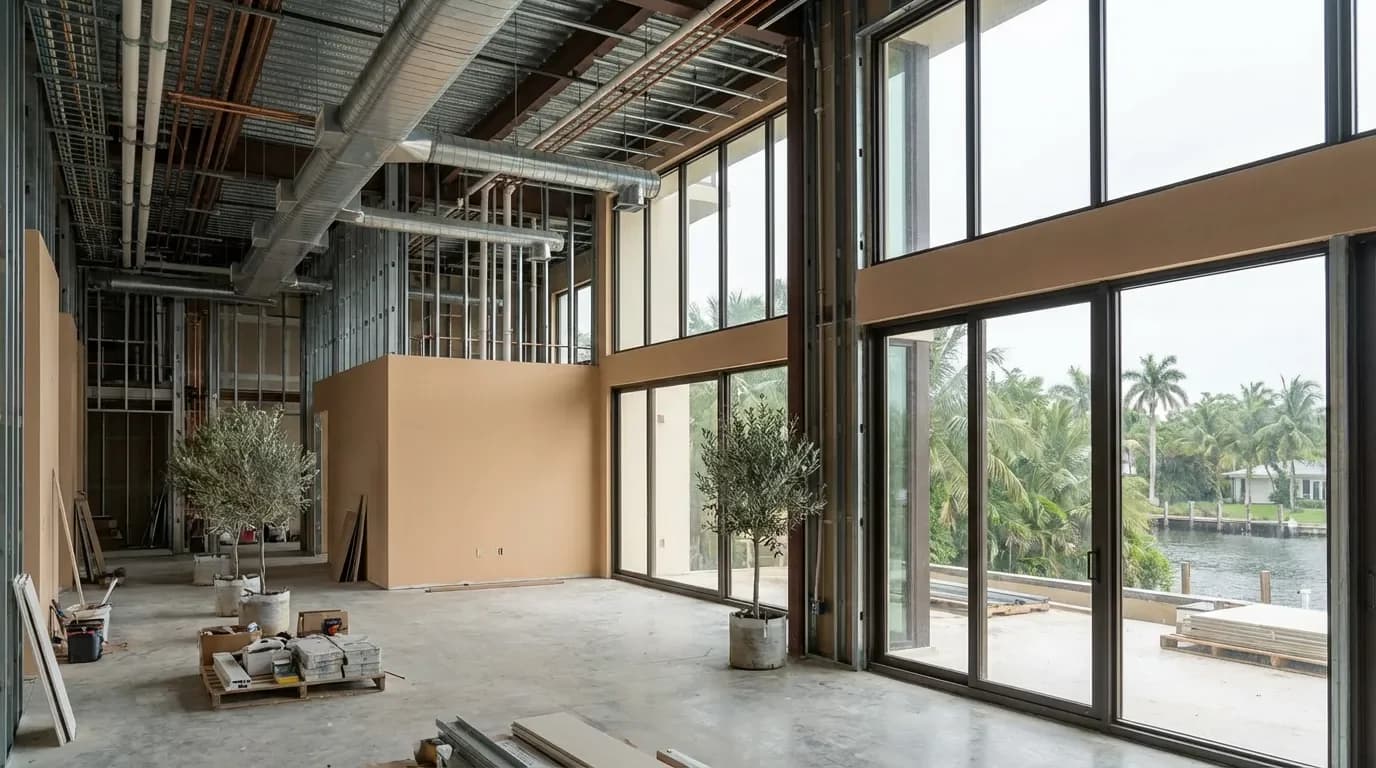
MEP Rough-In Stage: Framing, Duct, and Pipe in Place
MEP Rough-In Stage: Framing, Duct, and Pipe in Place — Dellamano Construction, Fort Lauderdale, FL
What You Get
MEP Rough-In by Use Type: What Each Space Actually Needs
Restaurant Fit-Outs
Commercial kitchens require Type I hood exhaust (for grease-laden vapor) with dedicated make-up air, grease interceptors on floor drains sized per the Florida Building Code plumbing appendix, and a 3-compartment sink with separate hand-wash station. Gas lines, if applicable, must meet NFPA 54 and receive a pressure test before drywall close-in.
Medical Office Fit-Outs
Medical spaces need dedicated circuits for imaging equipment, isolation-panel wiring for procedure rooms, medical-grade plumbing for handwashing stations in every exam room, and HVAC zoning that keeps waiting areas under positive pressure relative to treatment areas to control pathogen spread.
Retail Fit-Outs
Retail buildouts focus on lighting layout (lumen targets per merchandise type), 20-amp circuits for POS systems and security equipment, and clean slab-to-slab partition framing that keeps egress corridors compliant with a minimum 44-inch clear width under FBC Chapter 10.
Office Fit-Outs
Open-plan offices need balanced HVAC distribution across demountable partitions, structured cabling raceways, and dedicated server-room cooling with independent thermostat control. Conference rooms typically require AV-grade conduit runs sized for future cable upgrades without tearing open walls.
Salon and Spa Fit-Outs
High-plumbing-density spaces like salons need backflow preventers on every shampoo bowl, GFCI (ground-fault circuit interrupter) protection within 6 feet of water sources, and exhaust ventilation meeting ASHRAE 62.1 minimums for chemical fume dilution.
gov/law-and-regs/design-standards/) and the Florida Accessibility Code (which adopts and in some cases exceeds federal minimums). For a tenant fit-out, that means accessible routes from the public entrance to every customer-facing function — service counters at 34–36 inches max height, restrooms with 60-inch turning radius clearances, and van-accessible parking if the tenant controls the lot. Egress requirements under FBC Chapter 10 are just as firm: every occupiable space must have at least 2 remote exits above a certain occupant load, exit signs must be illuminated at all times, and corridor widths cannot be reduced below 44 inches by casework or display fixtures.
“Reduced review cycles are one of the fastest ways to compress a tenant fit-out timeline.”
We design partition layouts in AutoCAD before permit submittal so the building department reviewer sees a compliant floor plan on the first review — not a corrected resubmittal three weeks later. Reduced review cycles are one of the fastest ways to compress a tenant fit-out timeline.
Process
Tenant Fit-Out Project Timeline: Demo to CO
- 1
Pre-Construction: Lease & Shell Review
We walk the space with the work letter in hand, confirm utility stub locations, and photograph existing conditions. This 1–2 week phase produces the scope agreement, budget, and permit drawings — before any demolition begins.
- 2
Permit Submittal and Plan Review
We submit architectural, mechanical, electrical, and plumbing drawings as a single coordinated package. Broward County and Palm Beach County both accept digital submittals. Plan review typically runs 3–6 weeks for commercial tenant fit-outs; expedited review is available in both counties for an added fee.
- 3
Demolition and Rough-In
With permit in hand, demo crews remove existing partitions, ceilings, and finishes per the approved demo plan. MEP rough-in — framing, duct, pipe, and conduit — runs concurrently where code allows, compressing the schedule. In-house mechanical and plumbing licenses mean our crews start the same day rather than waiting for subcontractor mobilization.
- 4
Rough Inspections and Insulation
All rough MEP work must pass county inspection before walls close. We schedule mechanical, plumbing, and electrical rough inspections in coordinated sequence to avoid re-inspection gaps. Once rough inspections are signed off, insulation and drywall follow within days.
- 5
Finishes, Final Inspections, and CO
Flooring, ceilings, paint, millwork, and fixture installation run in parallel to final MEP connections. Final inspections — fire, building, MEP, and ADA accessibility — are scheduled in a single close-out week where possible. The Certificate of Occupancy is the legal document that authorizes your business to open.
South Florida Permitting Reality Check
Plan review in Broward and Palm Beach Counties averages 3–6 weeks for commercial tenant fit-outs. Submitting a complete, coordinated MEP package on the first attempt — not a partial set — is the single fastest way to shorten that window.
Ready to talk to a real local GC?
Tell us about your project — we respond within 24 hours.
By the Numbers
South Florida Tenant Fit-Out by the Numbers
3
Active DBPR Licenses
GC, mechanical, and plumbing held by one license holder
$40–$150/sf
Typical TI Allowance Range
Varies by use type and market corridor
3–6 weeks
Plan Review Timeline
Broward and Palm Beach Counties, commercial fit-outs
44 in.
Minimum Egress Width
Side-by-Side
Single-Trade GC vs. Dellamano Multi-License GC
| Feature | Typical GC (Subs Out MEP) | Dellamano Construction (In-House MEP) |
|---|---|---|
| Mechanical Contractor | Separate sub — separate mobilization schedule | In-house license (CMC1251666) — starts same day as GC crew |
| Plumbing Contractor | Separate sub — separate permit if required | In-house license (CFC1434398) — coordinated under one permit set |
| Rough Inspection Coordination | 3 subs must align schedules for inspector visit | One crew, one call, inspections scheduled as a package |
| Change Order Risk | Each sub prices scope changes independently | Single contract covers MEP changes without sub markup layers |
| Accountability | GC, mechanical sub, and plumbing sub each responsible for own scope | One license holder accountable for the entire fit-out |
In the Field
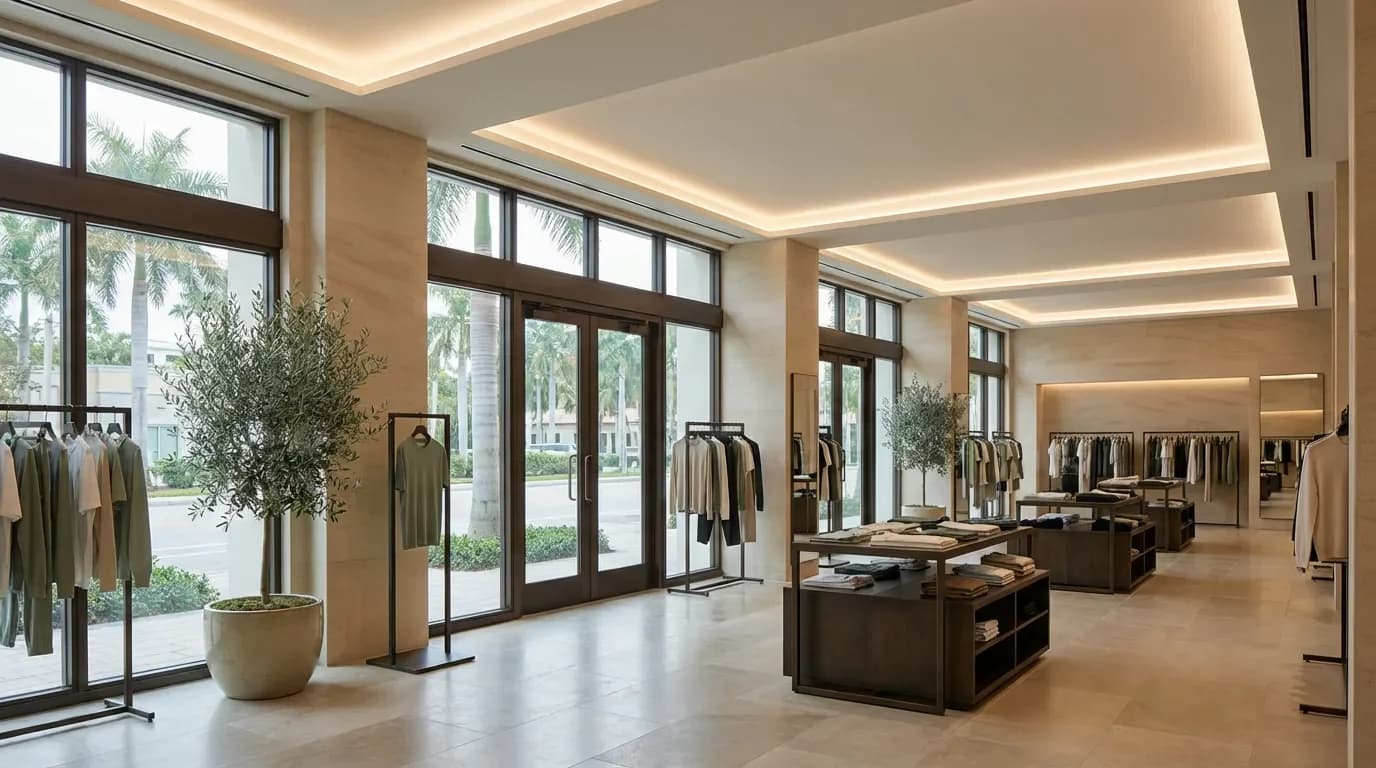
Completed Retail Fit-Out: Ceilings, Lighting, and Final Finishes
Completed Retail Fit-Out: Ceilings, Lighting, and Final Finishes — Dellamano Construction, Fort Lauderdale, FL
Value engineering (VE) in a tenant fit-out means finding cost savings that do not reduce code compliance, occupancy safety, or the scope required to obtain a Certificate of Occupancy. On the mechanical side, VE opportunities include right-sizing HVAC equipment to Manual J load calculations instead of oversizing — a common mistake that drives up equipment cost and utility bills.
On the plumbing side, grouping wet areas (restrooms, janitor closets, break rooms) along a shared wet wall reduces linear feet of waste and vent pipe, which cuts both material and labor. gov) cost more upfront but eliminate the wattage overages that force a panel upgrade.
“On the electrical side, LED fixtures spec'd to the ENERGY STAR energy efficiency standards cost more upfront but eliminate the wattage overages that force a panel upgrade.”
What we never cut: fire-alarm rough-in, exit illumination, accessible route clearances, or the inspection-required blocking for restroom grab bars. Those line items are not optional — a missing grab-bar block means a failed final inspection and a delayed CO, which costs far more than the lumber would have.
Not sure what your project should cost?
Free, itemized estimates — no obligation, no sales pressure.
South Florida's building environment adds layers that most national fit-out guides ignore. Coastal properties in Fort Lauderdale, Pompano Beach, Hollywood, and Dania Beach sit in High-Velocity Hurricane Zone (HVHZ) territory, which means exterior windows, storefront glazing, and roof-penetrating exhaust fans must meet Miami-Dade Notice of Acceptance (NOA) product approval standards — not just standard FBC.
gov/portal/home) is the authoritative source for determining your space's flood zone before you design your electrical room. Inland suburban markets like Parkland, Weston, Coral Springs, and Plantation carry their own municipal overlay requirements on top of county code.
“Inland suburban markets like Parkland, Weston, Coral Springs, and Plantation carry their own municipal overlay requirements on top of county code.”
org) base requirements plus county and municipal amendments — because a permit pulled to the wrong code edition can fail final inspection even if the work itself is sound. Our work is part of the broader Construction & Renovation services we offer across Broward and Palm Beach Counties, alongside Interior Renovation and Exterior Living & Outdoor Construction.
Coastal South Florida HVHZ Alert
Storefronts and exterior glazing in Fort Lauderdale, Hollywood, and Pompano Beach must carry Miami-Dade NOA product approval — a requirement that catches many out-of-state tenant fit-out contractors off guard and triggers failed inspections.
Get a Tenant Fit-Out Estimate
Dellamano Construction delivers retail, office, restaurant, and medical tenant fit-outs across Broward and Palm Beach Counties — from demo through final CO, with in-house MEP on every project. Request a free estimate and let's walk your space together.
Frequently Asked
Common Questions
How long does a tenant fit-out take in Broward County?
+
A typical tenant fit-out in Broward County runs 10–18 weeks from permit submittal to Certificate of Occupancy, depending on use type and space complexity. Plan review alone averages 3–6 weeks for commercial projects at Broward County Building Code Services. Restaurant and medical fit-outs typically run longer than retail or office because of the additional MEP inspections required — grease interceptor sizing, hood exhaust testing, and medical gas rough-in each add inspection milestones. Submitting a complete, coordinated architectural and MEP permit set on the first attempt is the single most effective way to compress the Broward County timeline.
Who pulls the permits for a tenant fit-out — the landlord or the tenant?
+
In most South Florida commercial leases, the tenant (or the tenant's contractor) pulls the fit-out permit. The landlord typically holds the base building permit for the shell. The lease work letter will specify who is responsible for permit fees, and whether the landlord must provide a Letter of Authorization allowing the tenant's contractor to pull permits on property the landlord owns. In Palm Beach County, the permit applicant must hold a valid Florida contractor license — which is why verifying your GC's license at the Florida DBPR lookup site before signing a construction contract matters.
What is the difference between a vanilla and warm vanilla shell?
+
A vanilla shell — also called a cold dark shell — delivers the space with only exterior walls, a roof, and utilities to the meter. No interior partitions, no HVAC, no lighting, and no ceilings. A warm vanilla shell adds one layer: basic HVAC equipment is installed and electrical panels are energized, but no distribution (ductwork, branch wiring, or plumbing fixtures) is run inside the tenant space. South Florida landlords in suburban Broward markets like Plantation and Coral Springs often deliver warm vanilla shells, while ground-floor retail in dense urban corridors like Fort Lauderdale may deliver cold dark shells with a larger TI allowance to compensate.
Does a restaurant fit-out require a separate hood exhaust permit?
+
Yes. In Palm Beach County, a Type I commercial kitchen hood — the kind required for cooking equipment that produces grease-laden vapor — requires its own mechanical permit in addition to the general fit-out permit. The hood system must meet NFPA 96 (Standard for Ventilation Control and Fire Protection of Commercial Cooking Operations) and pass a separate fire inspection before the kitchen can operate. Palm Beach County Planning, Zoning & Building reviews these concurrently with the base fit-out permit when submitted as a package, which is one reason submitting a complete coordinated set on day one saves weeks compared to phased submissions.
What ADA requirements apply to a new tenant fit-out in South Florida?
+
Any commercial space open to the public in Florida must comply with both the federal ADA Standards for Accessible Design and the Florida Accessibility Code (FAC), which adopts and in some cases exceeds federal minimums. For a tenant fit-out, that means accessible routes from the parking area through the entrance to every customer-facing function, restrooms with 60-inch turning clearances and grab bars at the correct heights, service counters no higher than 34–36 inches at accessible sections, and ADA-compliant signage on restroom doors. Florida also requires that accessible elements be shown on the permit drawings and verified by the building department at final inspection — a failed ADA inspection delays your Certificate of Occupancy just like a failed MEP inspection.
Can MEP work be self-performed on a tenant fit-out project?
+
Yes. Founder Aldo Dellamano holds three active Florida DBPR licenses: Certified General Contractor (CGC1525289), Certified Mechanical Contractor (CMC1251666), and Certified Plumbing Contractor (CFC1434398). All three are verifiable at myfloridalicense.com. This means Dellamano Construction self-performs mechanical (HVAC ductwork, exhaust, make-up air) and plumbing (drain, waste, vent, domestic water) rough-in without subcontracting those scopes. Electrical work is coordinated under a licensed electrical subcontractor on the same permit. Self-performing MEP removes the scheduling gaps and coordination failures that slow down tenant fit-out projects when three separate subs must align their crews and inspection schedules.
Does my coastal South Florida retail space need impact-rated storefront glazing?
+
Yes — if your space is located in a High-Velocity Hurricane Zone (HVHZ), which includes most of coastal Broward County and parts of Palm Beach County near the coast. HVHZ designation requires that all exterior glazing, storefront systems, and roof-penetrating equipment carry a Miami-Dade Notice of Acceptance (NOA) product approval. This is not just a best practice — it is a permit-required specification, and a building inspector will check product approval documentation at final inspection. Substituting a non-NOA storefront system to save money on a fit-out in Fort Lauderdale or Hollywood will fail final inspection and require replacement, which costs far more than specifying the correct product from the start.