Pergolas · South Florida
South Florida Pergola Builder: Aluminum, Wood & Louvered Roofs
Aluminum, wood, and louvered-roof pergolas engineered for South Florida wind loads and permit code. Licensed pergola builder serving Broward & Palm Beach.
Reviewed by Aldo Dellamano, Licensed Florida General Contractor·Last updated: April 2026
Introduction
pergola is one of the highest-return outdoor investments a South Florida homeowner can make — but only when it's built to survive the region's unique punishment: 150+ mph design wind speeds in HVHZ (High-Velocity Hurricane Zone) jurisdictions, salt-air corrosion along the coast, year-round UV intensity, and HOA/ARB approval requirements in gated communities from Weston to Wellington. Dellamano Construction is a licensed Florida general contractor that designs, permits, and installs custom aluminum, wood, and louvered-roof pergolas across Broward and Palm Beach Counties.
org) wind-load requirements — and the paperwork is handled in-house, from NOA documentation to final inspection sign-off. Whether you want a freestanding cabana or an attached louvered roof over an existing lanai, this guide covers exactly what it takes to do the job right in South Florida.
Questions about your remodel or addition?
Get a free, no-pressure estimate from our licensed South Florida team.
South Florida pergola builder projects face 3 code layers that most contractors in other states never encounter. org) sets baseline structural requirements for all pergolas statewide. Second, HVHZ provisions — which apply to much of Broward County and coastal Palm Beach County — mandate that every component carry an NOA (Notice of Acceptance), a product approval issued by Miami-Dade County showing the component was tested to 170+ mph wind speeds.
Third, local jurisdictions add their own permit and setback rules on top of FBC. After Hurricane Andrew in 1992 and Hurricane Wilma in 2005, Florida tightened these codes dramatically. A pergola that would pass inspection in Georgia or the Carolinas will fail here.
“South Florida pergola builder projects face 3 code layers that most contractors in other states never encounter.”
That means your pergola builder must understand structural calculations, product approvals, and local amendment libraries — not just how to drive a lag bolt.
What You Get
Pergola Frame Materials: Aluminum, Wood & PVC Compared
Extruded Aluminum
The dominant choice for South Florida pergolas. Aluminum is corrosion-proof, carries Miami-Dade NOA approvals for HVHZ use, and accepts powder-coat finishes that won't peel in coastal salt air. Aluminum systems from manufacturers like StruXure and Azenco ship with engineered drawings pre-stamped for Florida wind loads, which can cut permit-review time significantly.
Pressure-Treated Wood
ACQ or CA (copper-based) pressure-treated lumber rated for ground contact is the traditional choice for wood pergolas. It costs less up front than aluminum but requires ongoing sealing, staining, or painting every 2-4 years in South Florida's humidity. Wood also requires site-specific engineering because there are fewer pre-engineered, NOA-approved systems on the market.
Western Red Cedar & Ipe
Naturally rot-resistant hardwoods are popular for their aesthetics and need less chemical treatment than pressure-treated pine. Ipe (Brazilian walnut) is exceptionally dense and nearly impervious to moisture, though its hardness makes on-site machining slower. Cedar is lighter but still needs a UV-protective finish coat annually in South Florida.
PVC / Cellular PVC Trim
PVC is frequently used for decorative rafter tails, fascia, and finish trim on hybrid structures — not structural framing. It won't rot, warp, or need painting, making it a solid choice for the decorative elements that wood would struggle with near the water.
Motorized Louvered Systems
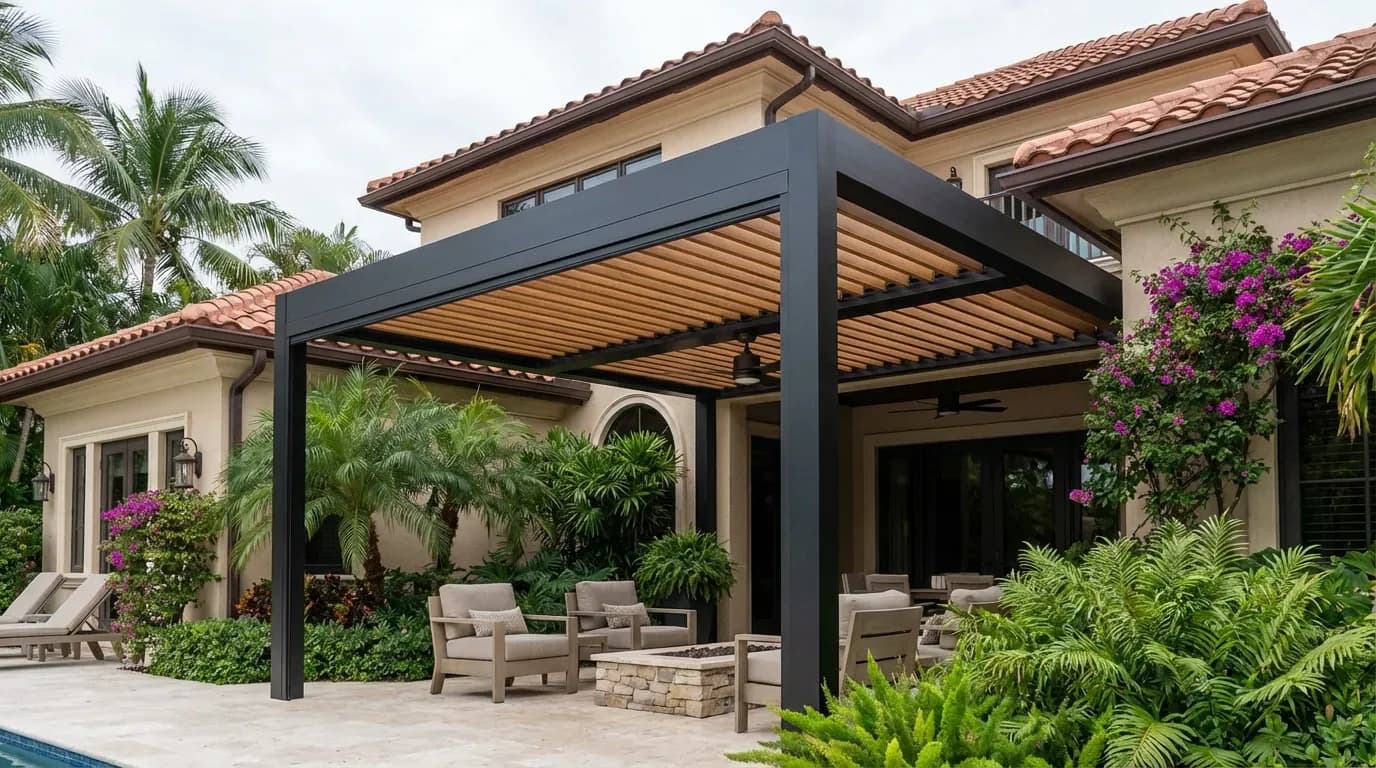
Louvered-roof pergolas use extruded aluminum louvers that rotate 0–135 degrees via a low-voltage motor, allowing full sun, partial shade, or complete rain coverage on demand. Most systems integrate with a wall switch or smartphone app. These are code-classified as patio covers or shade structures rather than roofed additions — a distinction that matters for permit routing and impact fees.
In the Field
Motorized Louvered Aluminum Pergola — Broward County
Motorized Louvered Aluminum Pergola — Broward County — Dellamano Construction, Fort Lauderdale, FL
Every permitted pergola in Florida must meet a design wind speed based on its location — typically 140 mph in inland Palm Beach County and up to 170 mph in HVHZ coastal Broward zones. The engineer of record (EOR) calculates the uplift, lateral, and shear loads on every connection: post base to footing, beam to post, and rafter to beam.
In HVHZ jurisdictions, each connection must use hardware with a valid NOA number from Miami-Dade County's product approval database. Simpson Strong-Tie and USP Structural Connectors are the two most common hardware lines that carry Miami-Dade approvals for this region.
“Jobsite-fabricated wood structures, by contrast, need a site-specific engineer's sealed drawing — adding 2-4 weeks and $800–$2,000 in engineering fees to the project budget.”
Pre-engineered aluminum pergola systems from certified manufacturers often ship with a Florida Product Approval (FPA) number, which functions like an NOA and streamlines the building department's plan review. Jobsite-fabricated wood structures, by contrast, need a site-specific engineer's sealed drawing — adding 2-4 weeks and $800–$2,000 in engineering fees to the project budget.
HVHZ Matters Even Inland
Many homeowners in western Broward communities like Parkland and Weston assume HVHZ only applies to beachfront properties. In reality, HVHZ covers all of Miami-Dade and Broward Counties — your pergola in a Weston gated community needs the same NOA-documented connections as one in Fort Lauderdale Beach.
Side-by-Side
Attached vs. Freestanding Pergola: Permit Differences
| Feature | Attached Pergola | Freestanding Pergola |
|---|---|---|
| Structural tie-in | Ledger bolted to house structure — requires engineer review of existing wall | Independent post footings — engineer calculates footing depth and diameter |
| Permit complexity | Higher — triggers review of the house attachment point and often a structural inspection | Moderate — standalone structure with its own footing plan |
| Load path | Lateral loads transfer to house framing — existing structure must be verified | All loads go into ground footings — no dependency on house structure |
| Setback rules | Often treated as an extension of the dwelling — may reduce allowable setback | Treated as an accessory structure — typically has its own setback schedule |
| HOA/ARB impact | Visible from street or neighbors — HOA approval almost always required | Same — freestanding does not exempt a structure from HOA review |
| Hurricane tie-in | Ledger-to-house connection is the critical uplift point — must use code-approved hardware | Post base anchors to concrete footing are the critical uplift points |
Process
How a Permitted Pergola Project Works
- 1
Site Evaluation & Design
We visit the site, measure the space, confirm setbacks against your property survey, and assess the existing structure if you want an attached pergola. We check your municipality's zoning map and pull any HOA CC&Rs (Covenants, Conditions & Restrictions) that apply. You choose your material system, louver option, and finish colors at this stage.
- 2
Engineering & NOA Package
For pre-engineered aluminum systems, we compile the Florida Product Approval (FPA) documents. For wood or hybrid builds, we engage a Florida-licensed structural engineer to produce signed-and-sealed drawings. Either way, the package includes a site plan, footing details, connection schedules with hardware NOA numbers, and a wind-load calculation summary.
- 3
Permit Submittal & HOA Filing
We submit to Broward County Building Code Services or Palm Beach County Planning, Zoning & Building, whichever applies. Simultaneously, we prepare your HOA/ARB application packet — site plan, renderings, material samples, and finish specs — so both approvals move in parallel rather than sequentially.
- 4
Foundation, Framing & Mechanical Rough-In
After permit issuance, we excavate and pour concrete footings sized per the engineer's drawings. Post bases are set in wet concrete with J-bolt anchor patterns that match the NOA-approved hardware. Framing follows the approved drawings, with every connection torqued and tagged for inspection. If you're adding integrated lighting, ceiling fans, or a motorized louver controller, electrical rough-in happens during the framing stage before any finishing work covers conduit runs.
- 5
Inspections & Final Walkthrough
Building department inspectors verify the footing, framing, and electrical rough-in at scheduled stages. We coordinate all inspection calls. After final inspection sign-off, we walk the completed structure with you, demonstrate any motorized louver controls or smart-home integrations, and hand you the permit card and NOA documentation for your records.
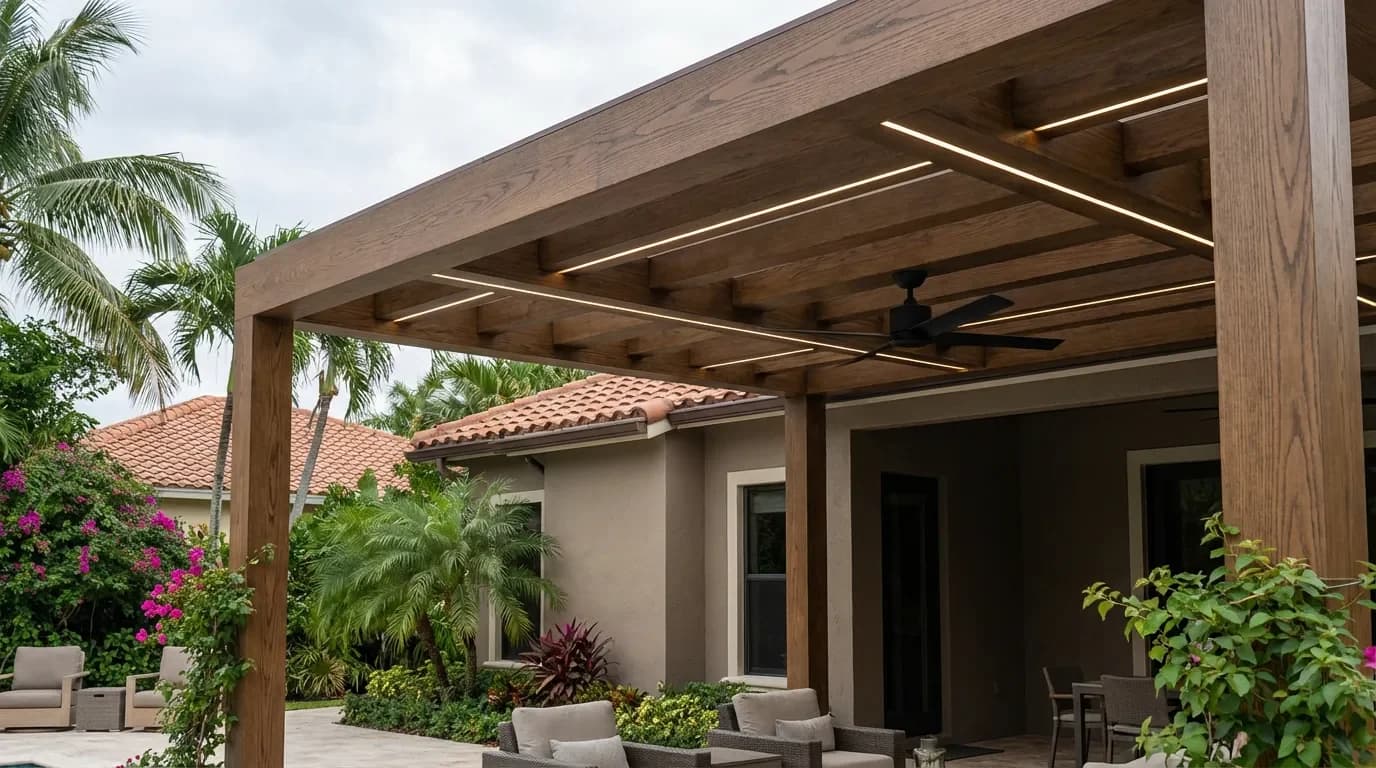
Modern pergola builds routinely include low-voltage LED lighting in the rafter channels, UL-listed outdoor ceiling fans on rated fan-mounting boxes, and low-voltage motorized louver actuators on louvered-roof systems. Because Aldo Dellamano, Dellamano Construction's licensed General Contractor, holds additional Florida DBPR licenses as a Certified Mechanical Contractor (CMC1251666) and Certified Plumbing Contractor (CFC1434398) — letting Dellamano self-perform the mechanical and plumbing trades most residential GCs subcontract — integrating a dedicated 20-amp circuit, ceiling fan branch circuit, and outdoor-rated GFCI (ground fault circuit interrupter) protection never requires a separate electrical sub who has to re-schedule around the framing crew. Motorized louver systems typically run on 24V DC actuators tied to a weather-sealed wall switch.
“Motorized louver systems typically run on 24V DC actuators tied to a weather-sealed wall switch.”
Most premium systems also support Wi-Fi or Z-Wave control modules that integrate with Amazon Alexa, Google Home, or dedicated apps. com/).
Ready to talk to a real local GC?
Tell us about your project — we respond within 24 hours.
One Contractor, All Trades
Because Dellamano holds GC, mechanical, and plumbing licenses in-house, the electrical and mechanical work for your pergola is self-performed — no waiting on a sub's schedule to run your fan circuits or motorized louver wiring.
In the Field
Integrated LED Lighting & Fan — Palm Beach County Pergola
Integrated LED Lighting & Fan — Palm Beach County Pergola — Dellamano Construction, Fort Lauderdale, FL
Gated communities across Broward and Palm Beach Counties — from Parkland's gated enclaves and Weston's master-planned villages to Wellington's equestrian estates and Boca Raton's country-club communities — require ARB (Architectural Review Board) approval before any exterior structure breaks ground. HOA review timelines range from 15 days to 60 days depending on how often the ARB meets and how complete your submittal package is.
Incomplete submittals — missing a color swatch, an insufficient rendering, or a vague material spec — are the number one reason approvals stall. Dellamano prepares a full ARB package: a dimensioned site plan at the correct scale, a photorealistic elevation rendering, a written material specification sheet, and manufacturer data sheets for every component including the louver system, post bases, and hardware finish.
“HOA review timelines range from 15 days to 60 days depending on how often the ARB meets and how complete your submittal package is.”
Submitting a complete packet in the first round dramatically increases the odds of single-meeting approval. We track the ARB calendar so your permit and HOA approvals land close together, avoiding a gap where your permit expires before HOA clears.
By the Numbers
South Florida Pergola Build: Key Numbers
170 mph
HVHZ Design Wind Speed
Required in all of Broward County per FBC HVHZ provisions
3 Licenses
In-House Trade Coverage
GC, mechanical, and plumbing — no sub coordination needed for MEP
15–60 Days
HOA/ARB Review Window
Varies by community; complete first-round submittals cut delays
2–4 Weeks
Permit Review Time
Pre-engineered FPA systems typically review faster than site-built wood
A South Florida pergola stands or falls at its connections — literally. Concrete footings are typically 18–24 inches in diameter and 24–36 inches deep, sized by the engineer based on the post-load matrix and local soil bearing capacity. In coastal areas near Fort Lauderdale or Pompano Beach, corrosion-resistant hardware is mandatory — stainless steel or hot-dip galvanized anchors, not zinc-plated zinc.
Post bases rated for the full uplift load connect the post to the footing with 4 to 6 anchor bolts set in concrete. For attached pergolas, the ledger connects to the house rim joist or concrete block wall using lag screws or wedge anchors specified in the engineer's connection schedule — never toe-nailed or surface-mounted with deck screws. gov/portal/home) is worth checking if your property is in or near a flood zone, because footings in AE or VE flood zones may require additional elevation or breakaway design considerations.
“Concrete footings are typically 18–24 inches in diameter and 24–36 inches deep, sized by the engineer based on the post-load matrix and local soil bearing capacity.”
These details are not optional — they are what separates a pergola that survives a Cat 3 pass from one that becomes airborne debris.
Not sure what your project should cost?
Free, itemized estimates — no obligation, no sales pressure.
Pergola Permits Are Not Optional
An unpermitted pergola can block your home sale, void your homeowner's insurance claim after a storm, and result in a stop-work order requiring costly demolition — permitting protects your investment.
Dellamano Construction serves homeowners throughout both counties as part of our broader Exterior Living & Outdoor Construction practice, which also includes outdoor kitchens, hardscape design, and pool enclosures. Along the coast in Broward, we work in Fort Lauderdale, Pompano Beach, Hollywood, and Dania Beach — communities where salt-air corrosion and HVHZ wind ratings are daily realities that shape every material choice.
In suburban Broward, we serve Parkland, Weston, Coral Springs, Plantation, and Davie, where gated-community HOA requirements add a planning layer most pergola builders are not prepared to navigate. Along the Palm Beach coast, our pergola builds include projects in Boca Raton, Delray Beach, Boynton Beach, and Palm Beach — waterfront properties where a louvered-roof pergola extends the usable outdoor season dramatically.
Inland Palm Beach clients in Wellington, Royal Palm Beach, Palm Beach Gardens, and West Palm Beach tap us for everything from wood-framed cabanas over pools to full aluminum louvered systems on extended lanais. Every project falls under our Construction & Renovation umbrella and is managed by the same licensed GC team that handles Interior Renovation projects — continuity of craftsmanship across every trade.
Get a Free Pergola Estimate
Ready to design a pergola built for South Florida's wind loads, your HOA's standards, and your family's outdoor living goals? Dellamano Construction handles engineering, permitting, HOA filing, and installation with a single licensed team — no subcontracted handoffs, no permit surprises. Contact us for a free on-site estimate and let's put your outdoor space to work.
Frequently Asked
Common Questions
Do I need a permit for a pergola in Broward County?
+
Yes — virtually every pergola in Broward County requires a building permit, regardless of whether it's attached to the house or freestanding. Broward County Building Code Services enforces Florida Building Code requirements including HVHZ (High-Velocity Hurricane Zone) wind-load provisions that apply county-wide. A permit application requires a site plan, engineering drawings with NOA-documented hardware connections, and in some cases a survey. Skipping the permit puts your homeowner's insurance, home sale, and physical safety at risk after a major storm like the ones South Florida has experienced with Hurricanes Wilma and Irma.
How long does a pergola permit take in Palm Beach County?
+
In Palm Beach County, permit review for a pergola typically runs 2–4 weeks for a pre-engineered aluminum system with a Florida Product Approval (FPA) number on file. Site-built wood pergolas requiring a site-specific engineer's sealed drawing can add 2–4 weeks to that timeline. Palm Beach County Planning, Zoning & Building accepts electronic permit submittals, which speeds up the intake process. If your property is in a gated community, HOA/ARB approval can run 15–60 days in parallel — Dellamano files both tracks simultaneously to avoid sequential delays.
What is the best pergola material for South Florida's climate?
+
Extruded aluminum is the top choice for most South Florida pergola builder projects. Aluminum does not rust, rot, or require periodic repainting, and leading systems carry Miami-Dade NOA (Notice of Acceptance) approvals for HVHZ wind speeds up to 170 mph. Near the coast in communities like Fort Lauderdale, Pompano Beach, and Boca Raton, salt-air exposure accelerates corrosion in ferrous metals and degrades untreated wood much faster than inland locations. If you prefer the look of wood, naturally dense species like Ipe (Brazilian walnut) perform well with proper sealing, but require more maintenance over time and site-specific engineering drawings for permitting.
Will my HOA in Parkland or Weston approve a pergola?
+
Most HOAs in Parkland, Weston, and other gated Broward County communities will approve a pergola that meets their ARB (Architectural Review Board) design standards — but the submittal package must be complete and accurate on the first submission. Typical HOA requirements include a to-scale site plan showing setbacks from property lines and the house, a color rendering or elevation drawing, a material specification sheet, and manufacturer product data for all visible components. Dellamano prepares full ARB packets designed for single-meeting approval, which avoids the 30–60 day delay caused by a resubmittal cycle.
Can I add lighting and ceiling fans to my pergola in South Florida?
+
Yes — and in South Florida, outdoor lighting and ceiling fans are practically essential given the long outdoor season. Integrated LED lighting and UL-listed outdoor ceiling fans are installed during the framing phase, with a dedicated branch circuit and GFCI (ground fault circuit interrupter) protection required by code for outdoor electrical applications. Because Dellamano holds both a General Contractor and Certified Mechanical Contractor license in-house, the electrical and mechanical rough-in for pergola amenities is self-performed — no waiting on a separate subcontractor's schedule. Motorized louvered-roof systems also use a low-voltage control circuit that can integrate with smart-home platforms like Amazon Alexa or Google Home.
What is a louvered-roof pergola and is it worth it in South Florida?
+
A louvered-roof pergola uses motorized extruded aluminum louvers that rotate from fully open (full sun) to fully closed (rain protection) at the touch of a button or app command. In South Florida's climate — where afternoon thunderstorms are common from May through October and the sun is intense year-round — a louvered roof extends the usable outdoor season dramatically by letting you enjoy the space during light rain and manage sun exposure without losing the open-air feel. These systems are classified as shade structures or patio covers rather than fully enclosed roofed additions, which typically means a simpler permit path and lower impact fees compared to a true room addition.
How are pergola footings designed for South Florida soil and flood zones?
+
In South Florida, pergola footings are typically 18–24 inches in diameter and 24–36 inches deep, with the exact sizing determined by a licensed structural engineer based on post-load calculations and local soil bearing capacity. Properties in or near FEMA-designated flood zones — which homeowners can verify at the FEMA Flood Map Service Center — may require additional footing elevation or breakaway design details to meet floodplain management regulations. Post base hardware must carry an NOA (Notice of Acceptance) approval for HVHZ wind speeds and be fabricated from corrosion-resistant materials such as stainless steel or hot-dip galvanized steel — standard zinc-plated hardware degrades rapidly in the coastal South Florida environment near communities like Dania Beach and Boynton Beach.