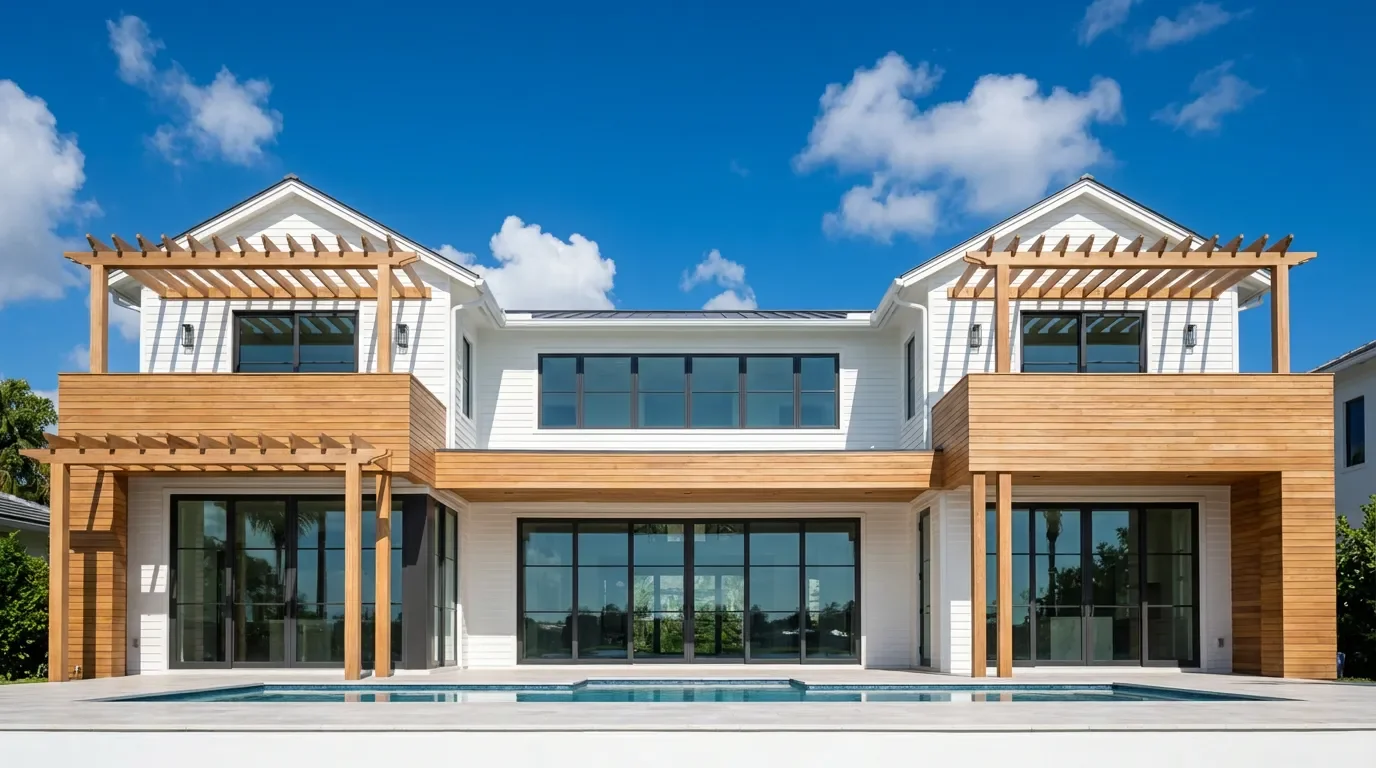
Outdoor Kitchens · South Florida
Outdoor Kitchen Construction in South Florida
Custom outdoor kitchen construction in Broward & Palm Beach Counties. Marine-grade materials, in-house MEP rough-in, HVHZ-compliant builds. Free estimates.
Reviewed by Aldo Dellamano, Licensed Florida General Contractor·Last updated: April 2026
Introduction
great outdoor kitchen does more than add a grill and a counter. It extends your living space, increases your home's resale value, and — when built correctly — survives decades of South Florida sun, salt, and summer storms.
That last part is where most outdoor kitchens fail. Generic big-box builds use materials spec'd for the Midwest: particle-board substrate, chrome fixtures, standard portland cement board.
In a coastal humid subtropical climate with Category 4 hurricane history and year-round UV intensity, those choices deteriorate fast. Dellamano Construction builds outdoor kitchens engineered specifically for Broward and Palm Beach Counties — custom structures that pass HVHZ (High-Velocity Hurricane Zone) wind-load inspections, tie into your home's gas, electrical, and plumbing systems under one licensed GC, and use counter and cladding materials proven to hold up against salt air and UV exposure for the long haul.
Questions about your remodel or addition?
Get a free, no-pressure estimate from our licensed South Florida team.
org), which includes HVHZ (High-Velocity Hurricane Zone) provisions across Broward County and parts of Palm Beach County — the same code regime tightened after Hurricane Andrew in 1992 and again after Hurricane Wilma in 2005. A fixed outdoor kitchen structure is not furniture; it is a built improvement that requires permits, engineering review, and wind-load calculations in HVHZ jurisdictions. That means anchor bolts, reinforced CMU (concrete masonry unit) block or steel-stud framing, and footings sized by a licensed contractor or engineer.
Beyond wind, coastal homeowners face salt-air corrosion that attacks bare metal within 12 to 18 months. Every fastener, frame member, and mechanical fitting on a coastal outdoor kitchen must be rated for marine-grade or equivalent corrosion resistance. Skipping this step is the most common and most expensive mistake South Florida homeowners make on outdoor builds.
“Beyond wind, coastal homeowners face salt-air corrosion that attacks bare metal within 12 to 18 months.”
Our Exterior Living & Outdoor Construction practice covers outdoor kitchens alongside pergolas, hardscape, and pool enclosures — all under the same code-aware approach.
What You Get
Core Materials for a Coastal-Ready Outdoor Kitchen
Marine-Grade 304 or 316 Stainless Steel
316-grade stainless (also called marine-grade) adds molybdenum to resist chloride pitting — the type of corrosion driven by ocean salt air. Use it for grill housings, access doors, and all exposed fasteners within 1 mile of the coast.
Powder-Coated Aluminum Framing
Aluminum does not rust, and a quality powder-coat finish resists UV fade for 10–15 years. It is lighter than steel, easier to anchor, and holds up in the humidity that causes painted steel to blister within a single rainy season.
Stone Veneer & Stucco Cladding
Natural stone veneer or high-density stucco over cement board gives the cabinet structure a finish that handles thermal expansion and salt air. Avoid standard drywall backer or foam substrates — both absorb moisture and fail within a few years outdoors.
Porcelain & Quartzite Countertops
Porcelain slab (20mm thick) and quartzite are the two top choices for South Florida outdoor countertops. Both are non-porous, UV-stable, and handle thermal shock from a hot grill surface. Concrete countertops are also an option but require a penetrating sealer refreshed annually in this climate.
Cement Board & Hardiebacker Substrate
All cabinet framing must be sheathed in fiber cement board — never OSB (oriented strand board) or plywood — before any cladding is applied. Fiber cement resists mold, moisture, and insects, all of which are active threats in South Florida's humid subtropical climate.
In the Field
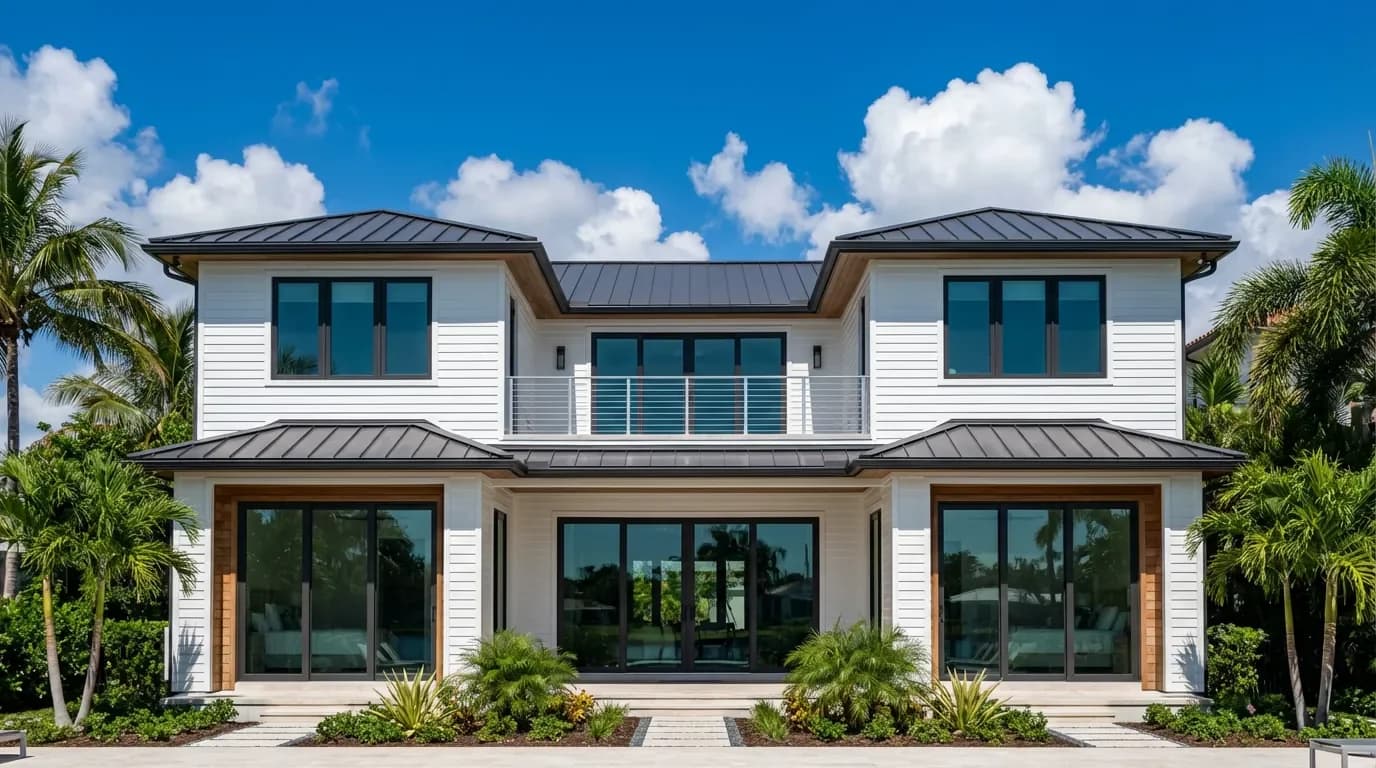
Marine-Grade Build, HVHZ-Compliant Structure
Marine-Grade Build, HVHZ-Compliant Structure — Dellamano Construction, Fort Lauderdale, FL
Rough-in coordination is where outdoor kitchen projects break down most often. A typical outdoor kitchen needs a natural gas or LP (liquid propane) stub-out to the grill and any side burners, a 240V circuit for an outdoor refrigerator or power burner, standard 120V GFCI (ground-fault circuit interrupter) outlets along the counter, and cold-water supply with a drain for a prep sink. When three separate subcontractors — a plumber, an electrician, and a gas-line mechanic — work under separate scopes, scheduling gaps and coordination failures add weeks to a project and create liability seams.
Dellamano Construction holds active Florida licenses as a Certified General Contractor (CGC1525289), Certified Mechanical Contractor (CMC1251666), and Certified Plumbing Contractor (CFC1434398). Because one license holder covers all three scopes, we self-perform MEP (mechanical, electrical, plumbing) rough-in in-house instead of coordinating three separate subcontractors — a rare combination in South Florida residential construction. Every rough-in is inspected under the same permit package, reducing re-inspection delays and keeping your project on a single timeline.
“Every rough-in is inspected under the same permit package, reducing re-inspection delays and keeping your project on a single timeline.”
com/).
One Permit Package, Three Trade Scopes
Dellamano Construction pulls gas, electrical, and plumbing rough-in under a single permit package — so your outdoor kitchen inspection closes in one visit, not three.
Every built-in gas grill must meet minimum clearance requirements defined by the appliance manufacturer and enforced under the Florida Building Code mechanical provisions. A typical built-in grill requires 3 inches of clearance on each non-combustible side and 24 inches of vertical clearance to any overhead structure, though HVAC-style overhead hoods above a built-in grill need their own engineering review for exhaust velocity and make-up air.
For covered outdoor kitchens under a pergola or lanai roof, combustible overhead materials must be protected or replaced with non-combustible alternatives — a detail that gets missed when the outdoor kitchen contractor and the pergola contractor are different companies. Gas line sizing is governed by the appliance BTU load; a 60,000 BTU grill plus a 30,000 BTU side burner plus a pizza oven draws enough gas to require at least a 3/4-inch supply line from the meter.
“Every built-in gas grill must meet minimum clearance requirements defined by the appliance manufacturer and enforced under the Florida Building Code mechanical provisions.”
We size every line to the full connected load — not just the grill — so you can add an appliance later without a costly reline. org/other/consumer-resources) resource library has additional homeowner guidance on outdoor appliance planning.
Process
How a Dellamano Outdoor Kitchen Project Works
- 1
Site Assessment & Design Consultation
We walk the site, identify the gas meter location, electrical panel proximity, and existing drainage patterns. We note wind exposure, overhead structures, and any HVHZ zoning that affects framing requirements. You share your appliance wish list and budget range. This is where the design begins — not with a catalog, but with your actual yard.
- 2
Permit & Engineering Package
We prepare permit drawings showing framing, footing depth, anchor details, MEP rough-in locations, and appliance clearances. HVHZ projects in Broward County go through Broward County Building Code Services for wind-load review. Palm Beach County projects route through Palm Beach County Planning, Zoning & Building. We handle submission and follow-up — you just sign the owner authorization form.
- 3
Foundation & Framing
Depending on the structure size and soil conditions, we pour a concrete pad or stem-wall footing, then frame the cabinet structure in CMU block, aluminum stud, or a combination. All framing is anchored per the approved wind-load calculations. No wood structural members are used in the outdoor kitchen frame — wood invites rot and termites in South Florida's humidity.
- 4
MEP Rough-In & Inspections
Our in-house crews run the gas line, set the GFCI electrical circuits, and rough in the sink supply and drain — all under the same permit. The building inspector signs off on rough-in before any countertop or appliance goes in. This sequence protects you and ensures no finish work gets torn out for a re-inspection.
- 5
Countertop, Cladding & Appliance Install
Porcelain or quartzite slabs are templated after framing and set once rough-in passes. Stone veneer or stucco cladding is applied next, followed by appliance drop-in and final connections. Final inspection closes the permit. You receive a copy of the closed permit card — important documentation for homeowner's insurance and future resale.
Ready to talk to a real local GC?
Tell us about your project — we respond within 24 hours.
In the Field
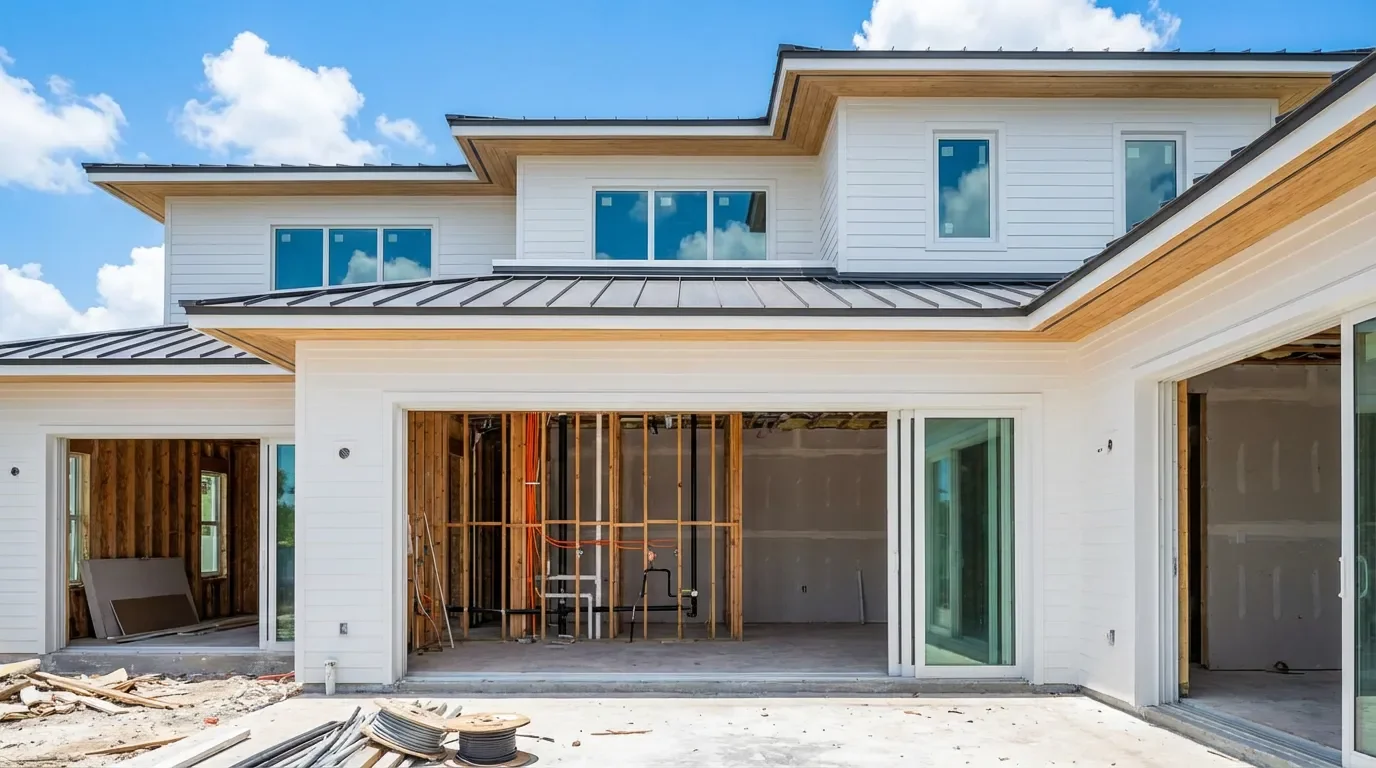
In-House MEP Rough-In — Gas, Electric & Plumbing
In-House MEP Rough-In — Gas, Electric & Plumbing — Dellamano Construction, Fort Lauderdale, FL
HVHZ Is Not Optional
In Broward County's High-Velocity Hurricane Zone, a built-in outdoor kitchen is a permitted structure — skipping the permit exposes you to fines, insurance claim denial, and forced demolition at resale.
Side-by-Side
Outdoor Kitchen Countertop Materials Compared
| Feature | Porcelain Slab (20mm) | Concrete (Sealed) |
|---|---|---|
| UV Resistance | Excellent — color-stable for 15+ years | Good — fades without annual resealing |
| Salt-Air Corrosion | Non-porous; salt cannot penetrate | Porous; sealer must be refreshed yearly |
| Heat Tolerance | Handles grill-side radiant heat well | Can crack with direct high heat over time |
| Maintenance | Soap and water only | Annual penetrating sealer required |
| Cost Range (installed) | $85–$130 per sq ft | $65–$110 per sq ft |
| Best For | Coastal properties, low-maintenance preference | Custom aesthetic, inland locations |
By the Numbers
By the Numbers: South Florida Outdoor Kitchen Builds
3
Active FL Licenses Held
GC, Mechanical (CMC1251666), and Plumbing (CFC1434398) — one holder covers all three scopes
175+ mph
HVHZ Design Wind Speed
Broward County HVHZ structures must be engineered for this wind load per the Florida Building Code
20mm
Porcelain Slab Minimum
Thinner porcelain cracks under the thermal and load stress of an outdoor kitchen countertop
316
Stainless Grade for Coast
316 stainless (marine-grade) resists chloride pitting; 304 grade is adequate 1+ miles from the shore
Not sure what your project should cost?
Free, itemized estimates — no obligation, no sales pressure.
Dellamano Construction builds outdoor kitchens throughout Broward and Palm Beach Counties, and the geography shapes every material and code decision we make. Coastal communities carry the highest corrosion and wind exposure. In Fort Lauderdale, Pompano Beach, Hollywood, and Dania Beach, we default to 316 marine-grade stainless and fiber-reinforced framing — and every project goes through Broward County Building Code Services for HVHZ wind-load review.
Inland Broward communities like Parkland, Weston, Coral Springs, and Plantation still fall under Florida Building Code requirements, though wind-load parameters ease slightly as you move away from the coast. In Palm Beach County, oceanfront builds in Boca Raton, Delray Beach, Boynton Beach, and Palm Beach face similar salt-air demands as coastal Broward, while inland communities like Wellington, Royal Palm Beach, and Palm Beach Gardens offer more flexibility on material grade — though UV protection standards stay the same across the region. Wherever your property sits, every outdoor kitchen project we build starts with the same question: what does this specific site require?
“Dellamano Construction builds outdoor kitchens throughout Broward and Palm Beach Counties, and the geography shapes every material and code decision we make.”
Our full scope of Construction & Renovation services gives us the context to answer that question across every trade involved in an outdoor build. For homeowners also planning interior updates alongside an outdoor kitchen, our Interior Renovation team can coordinate both scopes under one permit package and one project schedule.
Energy-Smart Outdoor Appliance Selection
Choosing ENERGY STAR-rated outdoor refrigerators and EPA WaterSense-labeled prep-sink faucets keeps utility costs low without sacrificing outdoor kitchen performance.
Get a Free Outdoor Kitchen Estimate
Ready to build an outdoor kitchen that actually holds up in South Florida? Dellamano Construction offers free on-site estimates across Broward and Palm Beach Counties. We walk the site, assess your MEP access points, and give you a clear scope — materials, permits, and timeline included — before you commit to anything. Call or submit the form to schedule your consultation.
Frequently Asked
Common Questions
Do outdoor kitchens in Broward County require a building permit?
+
Yes. In Broward County, a built-in outdoor kitchen is classified as a permanent structure under the Florida Building Code and requires a building permit. HVHZ (High-Velocity Hurricane Zone) provisions apply across most of Broward County, which means the structure must meet wind-load calculations engineered for design speeds of 175 mph or higher. Skipping the permit in Broward County can result in code enforcement fines, forced demolition, and denial of homeowner's insurance claims after storm damage. Dellamano Construction prepares and submits the full permit package — including structural drawings and MEP rough-in plans — through Broward County Building Code Services.
What countertop materials work best for coastal outdoor kitchens?
+
Porcelain slab (20mm thickness) and quartzite are the two best countertop materials for coastal South Florida outdoor kitchens. Both are non-porous, which means salt air and humidity cannot penetrate the surface. Porcelain is UV-stable and color-consistent for 15 or more years with only soap-and-water maintenance. Quartzite is a natural stone that handles UV well but requires sealing every 1 to 2 years outdoors. Concrete countertops are a custom aesthetic option but need an annual penetrating sealer application in South Florida's humid subtropical climate. Granite and marble are not recommended for coastal outdoor kitchens — both are porous and degrade faster in sustained salt-air exposure.
Can you handle gas, electrical, and plumbing for an outdoor kitchen?
+
Yes. Dellamano Construction holds active Florida licenses as a Certified General Contractor (CGC1525289), Certified Mechanical Contractor (CMC1251666), and Certified Plumbing Contractor (CFC1434398). This means we self-perform gas rough-in, GFCI electrical circuits, and sink plumbing in-house under a single permit package — instead of coordinating three separate subcontractors. That combination is rare in South Florida residential construction and directly reduces scheduling gaps, coordination failures, and re-inspection delays. Every license is verifiable at the Florida DBPR contractor lookup at myfloridalicense.com.
What is HVHZ and how does it affect my outdoor kitchen in Palm Beach County?
+
HVHZ stands for High-Velocity Hurricane Zone — a designation under the Florida Building Code that applies to Miami-Dade and Broward Counties in full, and to parts of Palm Beach County depending on proximity to the coast. In HVHZ jurisdictions, all permitted structures, including outdoor kitchens, must be engineered to resist design wind speeds of 175 mph or higher. This affects footing depth, framing anchors, and material choices. Palm Beach County homeowners should confirm their property's HVHZ status through Palm Beach County Planning, Zoning & Building before starting an outdoor kitchen project. Dellamano Construction handles wind-load compliance as part of every permit package we prepare in the region.
How long does it take to build a custom outdoor kitchen in South Florida?
+
A typical custom outdoor kitchen in South Florida takes 6 to 12 weeks from signed contract to final inspection, depending on project complexity, permit review timelines, and countertop fabrication lead times. The permit phase alone can take 2 to 4 weeks in Broward and Palm Beach Counties. Porcelain or quartzite slab templating and fabrication adds another 2 to 3 weeks after the framing rough-in passes inspection. Projects that add a pergola structure, outdoor refrigerator circuits, or a gas pizza oven take longer due to additional inspection stages. Dellamano Construction's in-house MEP capability helps compress the rough-in phase by eliminating subcontractor scheduling coordination.
What grade of stainless steel should an outdoor kitchen use near the coast?
+
For outdoor kitchens within about 1 mile of the South Florida coast — including Fort Lauderdale and Boca Raton waterfront and near-coastal properties — 316 stainless steel (also called marine-grade) is the correct spec. The difference between 304 and 316 stainless is the addition of molybdenum in 316, which resists chloride pitting caused by ocean salt air. Standard 304 stainless will pit and corrode within 12 to 24 months in high-salt-air exposure. For grill housings, access doors, cabinet hardware, and all exposed fasteners, specify 316 grade. Inland communities in Broward and Palm Beach Counties — such as Weston, Parkland, Wellington, and Palm Beach Gardens — can generally use 304-grade stainless without accelerated corrosion risk.
Do you build outdoor kitchens in Palm Beach Gardens and Wellington?
+
Yes. Dellamano Construction serves homeowners across Palm Beach County, including Palm Beach Gardens, Wellington, Royal Palm Beach, West Palm Beach, Boca Raton, Delray Beach, and Boynton Beach. Palm Beach Gardens and Wellington are inland communities that fall under standard Florida Building Code requirements — HVHZ provisions may or may not apply depending on the exact parcel, which we confirm during the site assessment. Both communities have active permit offices through Palm Beach County Planning, Zoning & Building, and we handle submission and tracking for every project we build there. Contact us for a free on-site estimate at your Palm Beach County property.