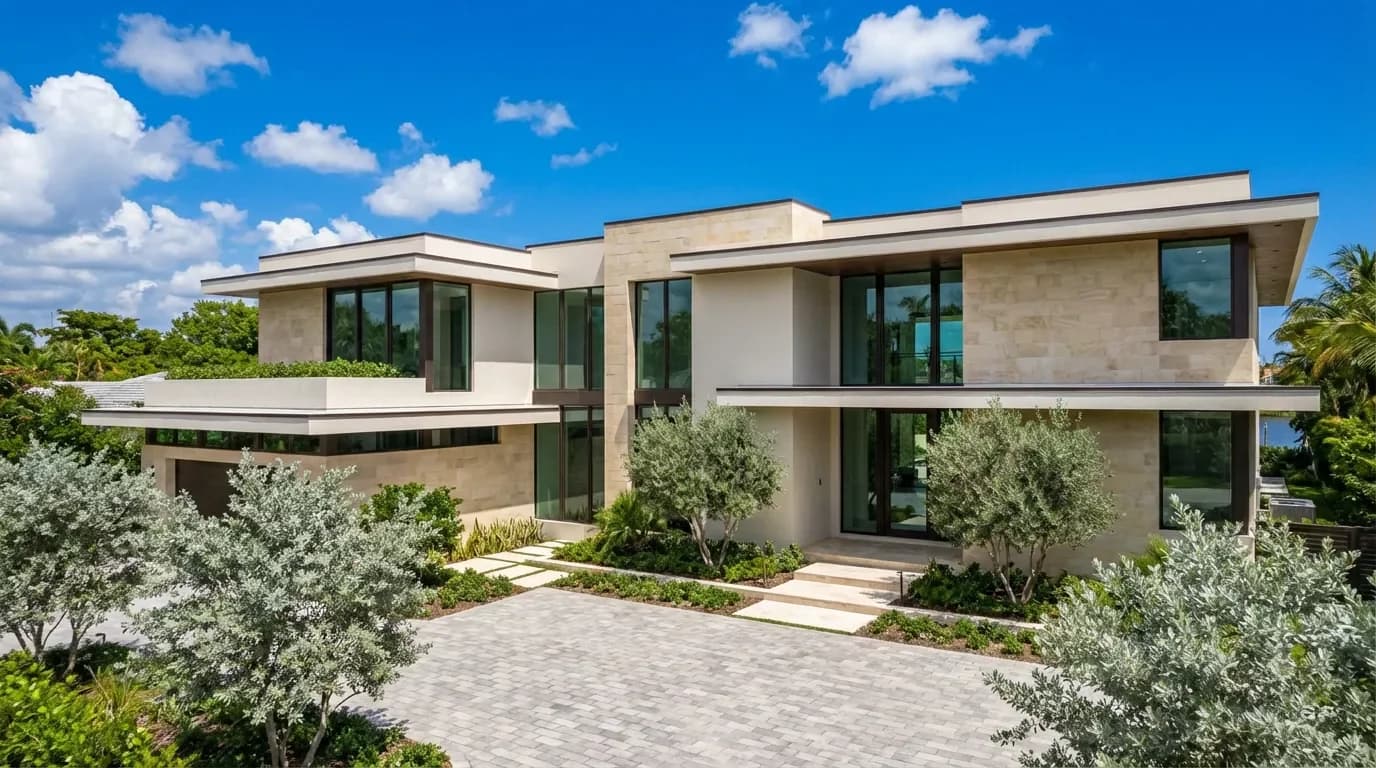
Home Remodeling · South Florida
Home Remodeling in South Florida
Home remodeling in Broward & Palm Beach Counties — one licensed GC managing structural, MEP, and finishes from demo through final inspection. Free estimates.
Reviewed by Aldo Dellamano, Licensed Florida General Contractor·Last updated: April 2026
Recent Work
Project Gallery
Introduction
hole-home renovations are the most complex projects a South Florida homeowner can take on. You're not just picking tile and paint — you're coordinating permits, structural surveys, mechanical upgrades, finish selections, and HOA reviews across a construction timeline that can span 4 to 14 months.
Most projects stall because the general contractor hands off plumbing to one sub and HVAC to another, and nobody owns the schedule when trades conflict. Dellamano Construction is built differently: one licensed GC managing every trade under three active Florida DBPR licenses held by founder Aldo Dellamano.
That structure means faster rough-in, fewer RFIs (requests for information between trades), and a single point of accountability from demolition through the final walkthrough. This guide covers everything South Florida homeowners need to know before starting a home remodeling project — scope planning, structural realities, MEP upgrades, phasing decisions, and budget contingencies unique to this region.
Questions about your remodel or addition?
Get a free, no-pressure estimate from our licensed South Florida team.
org), including High-Velocity Hurricane Zone (HVHZ) wind-load requirements that apply to large portions of Broward County and coastal Palm Beach communities. Those provisions set stricter fastening schedules, impact-rated product requirements, and mandatory wind mitigation inspections that don't exist in most of the country.
“Those provisions set stricter fastening schedules, impact-rated product requirements, and mandatory wind mitigation inspections that don't exist in most of the country.”
Beyond code, the regional housing stock creates its own challenges: a large share of homes built between 1960 and 1990 carry 60-amp or 100-amp electrical panels too small for modern loads, galvanized or cast-iron supply and drain piping that corrodes faster in the humid subtropical climate, and original flex-duct HVAC systems that have degraded well past their 15-year service life. Any serious home remodeling plan must account for these latent conditions before the first tile goes down — or you'll find them mid-project and blow your contingency budget on emergency trades work instead of finishes.
What You Get
What a Whole-Home Remodel Typically Covers
Structural Survey & Scope Planning
Before demo, a licensed GC walks the framing, slab, and load-bearing walls to identify hidden rot, termite damage, or out-of-plumb conditions that affect your design intent and permit set.
Electrical Panel Upgrades
Older South Florida homes often need a 200-amp or 400-amp service upgrade to support modern kitchens, EV chargers, whole-house generators, and HVAC systems — all permitted under the Florida Building Code.
Repiping (Supply & Drain Lines)
Galvanized supply lines and cast-iron drain stacks in pre-1990 homes are a leading cause of mid-project cost overruns. Repipe to CPVC or PEX supply and PVC DWV (drain-waste-vent) before closing walls.
Duct Replacement & Air Sealing
Original fiberglass flex duct loses 20–30% of conditioned air to leakage in South Florida attics that regularly hit 140°F. Replacing with insulated duct board and air-sealing the envelope cuts energy bills and improves comfort.
Finish Selection & Code Coordination
Kitchens, baths, flooring, windows, and exterior elements all require product approvals that meet FBC impact and energy requirements — plus HOA or historical-review board sign-off in many Broward and Palm Beach communities.
Final Inspections & Certificate of Occupancy
Every permitted trade requires a rough-in inspection before walls close and a final inspection before sign-off. A GC who self-performs MEP can schedule these inspections in sequence without waiting on multiple subs.
In the Field
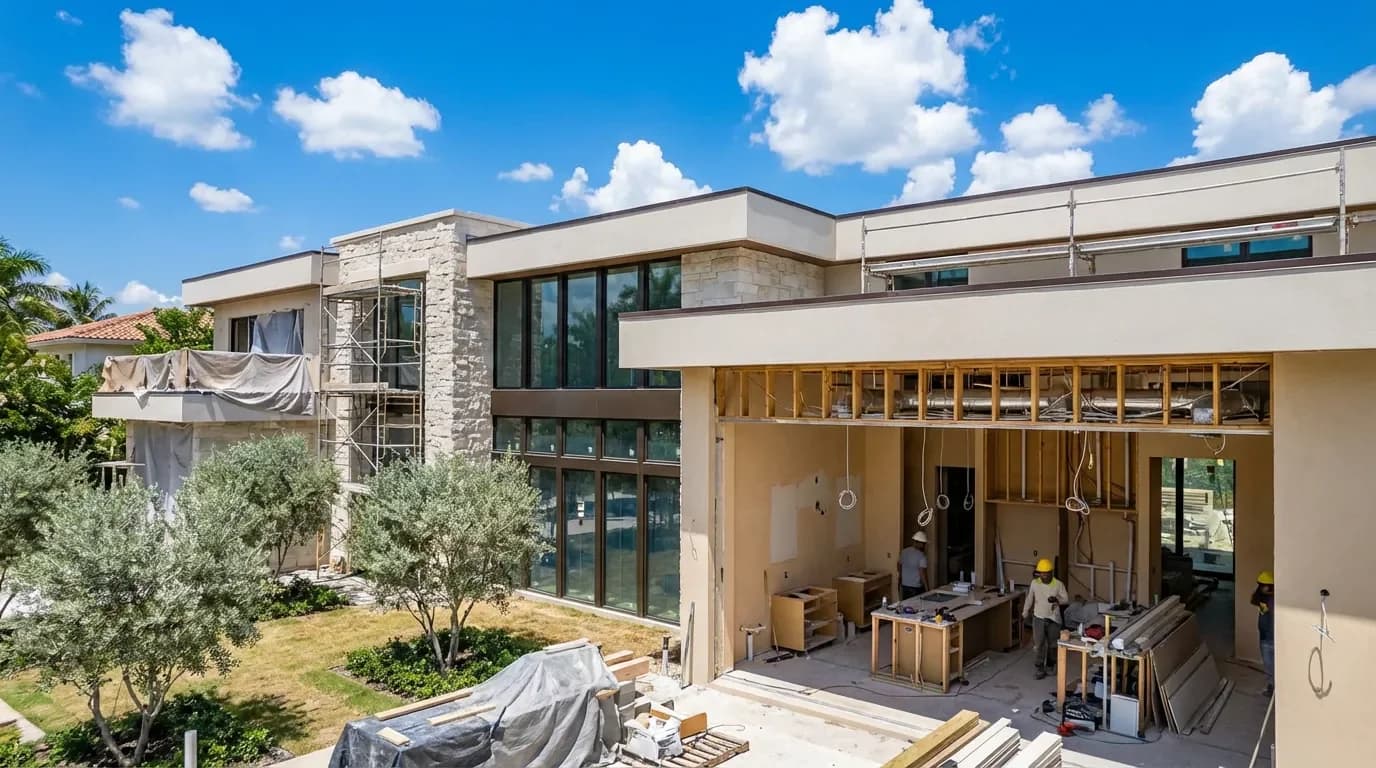
Open-Concept Kitchen Renovation with MEP Rough-In
Open-Concept Kitchen Renovation with MEP Rough-In — Dellamano Construction, Fort Lauderdale, FL
Phasing a home remodeling project around an occupied household is possible, but it costs more and takes longer — typically 25 to 40% more calendar time than a vacated-home approach. The tradeoff is real: moving out for 4 to 8 months requires temporary housing costs that can run $3,000 to $7,000 per month in Broward and Palm Beach markets, which sometimes exceeds the phasing premium.
The practical rule: if your project touches the main electrical panel, replaces supply plumbing, or guts more than one bathroom simultaneously, moving out is almost always the faster and cleaner path. Live-in phasing works best when the remodel is sequenced room by room and the kitchen remains usable throughout.
“Ad-hoc phasing is how projects stall and homeowners get stuck in construction limbo for months longer than promised.”
Either way, your GC should build a written phasing plan into the contract — specifying which areas are live construction zones, dust-barrier (temporary poly sheeting) locations, and which days inspectors will require site access. Ad-hoc phasing is how projects stall and homeowners get stuck in construction limbo for months longer than promised.
One GC, Three Active Licenses
Dellamano Construction founder Aldo Dellamano holds active FL DBPR licenses as a Certified General Contractor (CGC1525289), Certified Mechanical Contractor (CMC1251666), and Certified Plumbing Contractor (CFC1434398) — verifiable at myfloridalicense.com. Self-performing MEP removes the scheduling gaps that break most whole-home renovation timelines.
Process
How a Home Remodeling Project Runs
- 1
Discovery & Structural Survey
We walk the entire home before pricing: framing, slab condition, panel capacity, plumbing age, duct layout, and any HOA or historical-review requirements. This prevents scope gaps from surfacing after demo.
- 2
Design, Permits & HOA Approval
We coordinate architectural or design drawings, submit to the county building department — Broward County Building Code Services or Palm Beach County PZB depending on your location — and handle HOA or historical-board submissions concurrently to avoid sequential delays.
- 3
Demolition & MEP Rough-In
Demo is sequenced to protect structural elements and existing systems still in use. MEP (mechanical, electrical, plumbing) rough-in follows immediately — run by in-house crews under Aldo's licenses, not handed off to multiple subcontractors chasing their own schedules.
- 4
Rough-In Inspections & Framing
County inspectors sign off on each trade's rough-in before walls close. Passing on the first inspection is standard when one license holder coordinates the work — no miscommunication between a GC and an independent MEP sub.
- 5
Finishes, Punch List & Final Walkthrough
Tile, cabinetry, fixtures, flooring, and exterior elements are installed to the approved finish schedule. A formal punch list is generated at substantial completion, and the final walkthrough with the homeowner happens before any final payment is released.
The 3 costliest surprises in South Florida home remodeling are all hidden inside walls and ceilings: undersized electrical service, corroded plumbing, and failed ductwork. A 1970s or 1980s home in Coral Springs, Plantation, or Weston often has a 100-amp main panel shared across the entire house — inadequate for a modern kitchen with dual ovens, an induction cooktop, and a whole-house standby generator. Upgrading to a 200-amp or 400-amp service with a new load center typically runs $4,000 to $9,000 and must be coordinated with FPL (Florida Power & Light) for the utility reconnect.
Repiping a 2,000-square-foot home from galvanized to PEX averages $8,000 to $15,000 depending on slab penetrations. Duct replacement for a 3-ton system adds another $4,000 to $7,000. None of these appear on a surface-level renovation estimate — they appear when a wall opens.
“The 3 costliest surprises in South Florida home remodeling are all hidden inside walls and ceilings: undersized electrical service, corroded plumbing, and failed ductwork.”
org/other/consumer-resources).
By the Numbers
South Florida Home Remodeling: Key Numbers
3
Active DBPR Licenses
GC, mechanical, and plumbing held by one license holder — Aldo Dellamano
15%+
Recommended Contingency
For pre-1995 South Florida homes where hidden MEP deficiencies are common
140°F
Attic Temps in Summer
South Florida attics routinely reach this temperature, degrading original flex-duct systems
4–14 mo
Typical Whole-Home Timeline
Scope, permit complexity, and phasing decisions drive the range
Ready to talk to a real local GC?
Tell us about your project — we respond within 24 hours.
Hundreds of communities across Broward and Palm Beach Counties operate under active homeowner association (HOA) covenants that govern exterior materials, window finishes, roof colors, driveway surfaces, and even the timing of construction deliveries. In gated communities like Parkland, Weston, and Palm Beach Gardens, HOA architectural review committees meet monthly — and a missed submission can add 6 to 8 weeks to your project start date. Coastal historic districts in Fort Lauderdale, Delray Beach, and Palm Beach add a second layer: the local historic preservation board reviews any change to the exterior envelope, including window replacements and door styles.
Both processes run parallel to the county building permit — they are separate approvals with separate submission packages. An experienced home remodeling contractor submits to the HOA and the building department simultaneously, not sequentially. Dellamano Construction handles both submissions as part of the pre-construction phase so permit issuance and HOA approval land within the same window.
“Dellamano Construction handles both submissions as part of the pre-construction phase so permit issuance and HOA approval land within the same window.”
Our broader Construction & Renovation scope also includes work in Interior Renovation and Exterior Living & Outdoor Construction for homeowners who want to extend their project beyond the home's interior.
In the Field
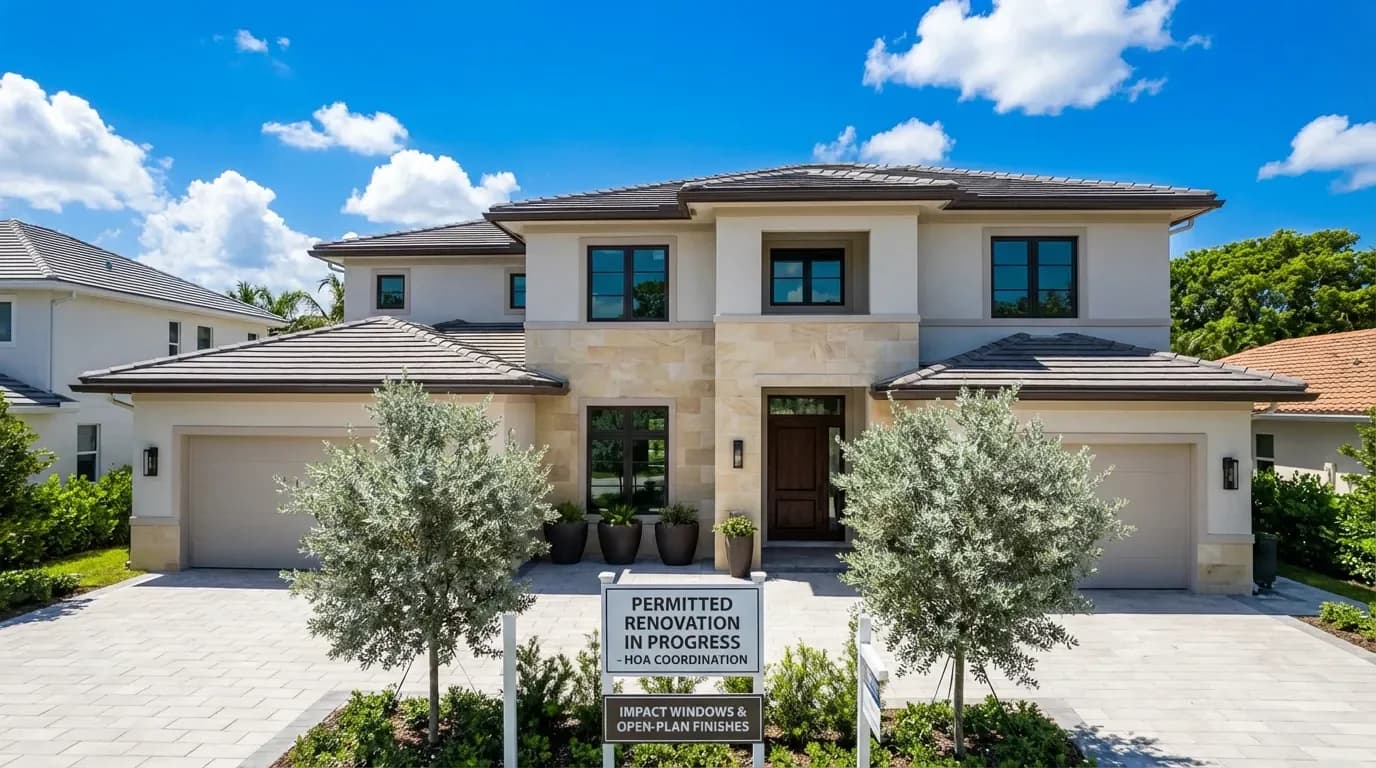
Impact Windows & Open-Plan Finishes — Broward County
Impact Windows & Open-Plan Finishes — Broward County — Dellamano Construction, Fort Lauderdale, FL
HVHZ Compliance Is Non-Negotiable
Large portions of Broward County and coastal Palm Beach fall within the High-Velocity Hurricane Zone — a designation that requires impact-rated windows, doors, and roofing products tested to the Miami-Dade Notice of Acceptance (NOA) standard. Check your property's flood zone status at the FEMA Flood Map Service Center before finalizing your scope.
Side-by-Side
Single-Trade GC vs. Multi-License Self-Perform Model
| Feature | Traditional Multi-Sub GC | Dellamano Self-Perform Model |
|---|---|---|
| MEP Coordination | 3+ separate subs, each with their own schedule | One license holder runs GC, mechanical, and plumbing |
| Inspection Readiness | GC waits on sub availability before calling inspectors | In-house crews ready for inspection on the GC's timeline |
| Change Order Disputes | Each sub issues separate change orders; costs multiply | Single contract covers all in-house scopes |
| Schedule Risk | Any sub delay ripples across all other trades | Internal scheduling eliminates sub-availability gaps |
| License Verification | Homeowner must verify each sub's license independently | All scopes verifiable under Aldo Dellamano's DBPR licenses |
Not sure what your project should cost?
Free, itemized estimates — no obligation, no sales pressure.
Home remodeling budgets in South Florida require more contingency than national averages suggest — not because contractors here are less reliable, but because the regional housing stock is older, the climate is harsher, and code requirements are stricter. Homes built before the post-Hurricane Andrew (1992) code reforms frequently lack hurricane straps (metal connectors anchoring roof trusses to wall plates), proper shear walls, and modern egress window sizing. Opening a wall to relocate a bathroom often reveals all three.
Budget frameworks that work: allocate your hard construction budget first, add 15% contingency for pre-1990 homes and 10% for homes built between 1990 and 2005, and keep a separate soft-cost line for HOA fees, permit fees, and design revisions. Permit fees in Broward and Palm Beach Counties typically run 1 to 2% of the permitted construction value. Design revisions between permit submission and approval add time, not just cost — every revision resets the plan reviewer's queue.
“Permit fees in Broward and Palm Beach Counties typically run 1 to 2% of the permitted construction value.”
Getting your drawings right before submission is the single highest-leverage action you can take to protect your timeline and your budget.
Energy Efficiency Pays Back in South Florida
Replacing original windows with ENERGY STAR-rated impact glass and upgrading to a high-SEER (Seasonal Energy Efficiency Ratio) HVAC system during a home remodeling project can cut annual cooling costs by 20–35% in South Florida's year-round cooling climate — savings that compound over the home's remaining service life.
Ready to Plan Your Home Remodeling Project?
Dellamano Construction offers free on-site estimates across Broward and Palm Beach Counties. Whether you're planning a full whole-home renovation or targeting specific systems — electrical, plumbing, HVAC, or structural — our in-house multi-trade team can scope, permit, and build it under one contract. Contact us to schedule your walkthrough.
Frequently Asked
Common Questions
How long does a whole-home remodel take in South Florida?
+
Most whole-home remodeling projects in Broward and Palm Beach Counties take between 4 and 14 months from signed contract to final walkthrough. The range is wide because permit issuance timelines, HOA review periods, structural conditions, and scope complexity vary significantly. A straightforward cosmetic renovation on a post-2000 home with no MEP surprises can close in 4 to 6 months. A full gut renovation on a pre-1985 home with panel upgrades, repiping, and duct replacement typically runs 9 to 14 months. The biggest controllable factor is how quickly the permit set and HOA submission are prepared and submitted — delays at that stage cascade through the entire project schedule.
Do I need to move out during a home remodeling project in South Florida?
+
Not always, but it depends on scope. If your home remodeling project in South Florida touches the main electrical panel, replaces supply plumbing under the slab, or guts more than one bathroom at a time, moving out is usually the faster and safer path. Staying in the home adds 25 to 40% more calendar time because crews must sequence around occupied spaces, dust barriers require daily management, and certain trades (especially electrical disconnects and panel swaps) require the home to be de-energized. Temporary housing in Broward and Palm Beach markets typically runs $3,000 to $7,000 per month — a real cost that should be weighed against the phasing premium. Your contractor should present both scenarios in writing before you decide.
What permits are required for home remodeling in Broward County?
+
Home remodeling in Broward County requires permits for any structural, electrical, plumbing, or mechanical work — and for many cosmetic changes like window replacements, which must meet HVHZ (High-Velocity Hurricane Zone) impact requirements. Permit applications are submitted to Broward County Building Code Services, and each trade — general, electrical, mechanical, and plumbing — requires a separate permit pulled under the appropriate license. Contractors who self-perform MEP, like Dellamano Construction, can pull all permits under one firm, which streamlines the process. Every permit requires at least one rough-in inspection before walls close and a final inspection at project completion. Unpermitted work discovered during a future sale or insurance claim can result in costly remediation orders.
How much should I budget for home remodeling contingency in South Florida?
+
For home remodeling projects on South Florida homes built before 1990, plan a 15% contingency on top of your hard construction budget. For homes built between 1990 and 2005, 10% is a reasonable baseline. The reason is regional: older South Florida homes commonly hide undersized electrical panels, galvanized or cast-iron plumbing, degraded flex ductwork, and structural deficiencies that only surface after demolition. These aren't contractor errors — they're latent conditions that visual pre-inspections can't fully reveal. Permit fees in Broward and Palm Beach Counties typically add 1 to 2% of the permitted construction value. Keeping contingency and soft costs as separate budget line items prevents homeowners from raiding contingency for finish upgrades, which leaves nothing to absorb structural surprises.
Does Dellamano Construction handle HOA approval for home remodeling projects?
+
Yes. Dellamano Construction manages HOA architectural review submissions as part of the pre-construction phase for home remodeling projects across Broward and Palm Beach Counties. In communities like Parkland, Weston, and Palm Beach Gardens, HOA review committees meet on monthly cycles — a missed submission can delay your project start by 6 to 8 weeks. In coastal historic districts like Fort Lauderdale, Delray Beach, and Palm Beach, historic preservation board approval is a separate requirement for any exterior envelope changes. Dellamano submits to the county building department and the relevant HOA or review board simultaneously rather than sequentially, so both approvals are targeted to land in the same window and your construction start isn't delayed by avoidable administrative gaps.
What MEP upgrades are common during a home remodel?
+
The three most common MEP upgrades discovered during home remodeling in South Florida are electrical panel replacements, full repiping, and duct system replacement. Pre-1990 homes frequently have 60-amp or 100-amp service panels that are too small for modern loads — a 200-amp or 400-amp upgrade typically costs $4,000 to $9,000 and requires FPL coordination for the utility reconnect. Repiping a 2,000-square-foot home from galvanized to PEX supply line averages $8,000 to $15,000 depending on slab penetrations. Duct replacement on a 3-ton HVAC system adds $4,000 to $7,000. Because Dellamano Construction holds in-house mechanical and plumbing licenses alongside the general contractor license, these upgrades are scoped, permitted, and executed without handing off to outside subcontractors, which reduces both timeline and cost.
How do I verify a home remodeling contractor's license in Florida?
+
Any Florida contractor's license can be verified in real time through the [Florida DBPR contractor lookup](https://www2.myfloridalicense.com/) at myfloridalicense.com. Search by license number or company name to confirm the license is active, the correct classification is held, and there are no disciplinary actions on record. For home remodeling projects that involve structural, mechanical, and plumbing scopes — which most whole-home renovations do — verify that the contractor or the firm holds all three license types, not just a general contractor license. Dellamano Construction operates under Aldo Dellamano's Certified General Contractor (CGC1525289), Certified Mechanical Contractor (CMC1251666), and Certified Plumbing Contractor (CFC1434398) licenses, all verifiable through DBPR.