Generator Installation · South Florida
Whole House Generator Installation in South Florida
Whole house generator installation across Broward & Palm Beach Counties. Licensed electrical, mechanical, and gas — permit-to-startup, one crew.
Reviewed by Aldo Dellamano, Licensed Florida General Contractor·Last updated: April 2026
Introduction
outh Florida homeowners learned the hard way — from Hurricane Andrew in 1992 to Hurricane Irma in 2017 — that grid power can vanish for days or weeks after a major storm. A whole house generator keeps your air conditioning, refrigeration, medical equipment, and security systems running without interruption. Unlike a portable unit, a standby generator starts automatically within seconds of a power outage.
It runs on natural gas or propane, sits permanently outside your home, and requires a licensed contractor to size it correctly, pull the required permits, route the gas line, and integrate it with your electrical panel. Dellamano Construction handles every one of those steps under three active Florida DBPR licenses — general contractor, mechanical, and plumbing — so your installation never depends on a chain of subcontractors to get it right.
Questions about your remodel or addition?
Get a free, no-pressure estimate from our licensed South Florida team.
South Florida experiences an average of 8 to 12 named tropical storms per Atlantic hurricane season, and the region has suffered four major landfalls since 1992 — Andrew, Wilma, Irma, and Nicole. Each storm cut power to hundreds of thousands of homes for periods ranging from 3 days to 3 weeks.
In a humid subtropical climate where summer heat indexes regularly exceed 105°F, losing air conditioning is not just uncomfortable — it is a genuine health risk for seniors, young children, and anyone with respiratory conditions. A permanently installed whole house generator rated for your home's full electrical load eliminates that risk entirely.
“Each storm cut power to hundreds of thousands of homes for periods ranging from 3 days to 3 weeks.”
org) requires standby generators to meet wind-speed and setback standards, and coastal Broward County properties in the High-Velocity Hurricane Zone (HVHZ) face stricter anchorage and enclosure requirements than inland installations. Understanding those rules before you purchase equipment saves money and prevents costly change orders mid-project.
Hurricane Season Starts June 1
Permit review and equipment lead times average 4 to 8 weeks in South Florida — start your whole house generator installation well before the season peaks in August and September.
Proper sizing is the single most important decision in a whole house generator installation, and most homeowners underestimate their load. A licensed mechanical contractor calculates your home's total connected load by adding the nameplate wattage of every circuit — HVAC compressors, air handlers, well pumps, electric water heaters, refrigerators, freezers, pool equipment, and lighting. A 2,500 sq ft South Florida home with a 5-ton (60,000 BTU) central air system, electric water heater, and standard appliances typically requires a 22 kW to 26 kW standby generator for full-load coverage.
Homes with two HVAC zones, a pool pump, and electric vehicle charging can push that requirement to 36 kW or higher. Undersizing forces the generator to run at or above capacity continuously, which shortens engine life dramatically and can trip the automatic transfer switch (ATS) under peak demand. Oversizing wastes fuel and increases purchase cost unnecessarily.
“Dellamano's mechanical license (CMC1251666) covers the load calculation and equipment specification — the same scope that requires a licensed mechanical contractor in Florida.”
Dellamano's mechanical license (CMC1251666) covers the load calculation and equipment specification — the same scope that requires a licensed mechanical contractor in Florida.
What You Get
What a Whole House Generator Installation Includes
Load Calculation & Equipment Spec
A licensed mechanical contractor calculates your full connected load, recommends a generator brand and kW rating, and specifies the automatic transfer switch (ATS) amperage to match your main panel.
Permit Application & Inspections
Every whole house generator installation in Broward and Palm Beach Counties requires a building permit. Dellamano files the electrical, mechanical, and gas sub-permits simultaneously and coordinates all municipal inspections through to final approval.
Gas Line Routing
Natural gas feeds are tapped from the utility meter with a licensed plumbing contractor running a CSST (corrugated stainless steel tubing) or black iron gas line sized to the generator's BTU demand — typically 3/4" to 1" diameter for 20–36 kW units.
Automatic Transfer Switch Installation
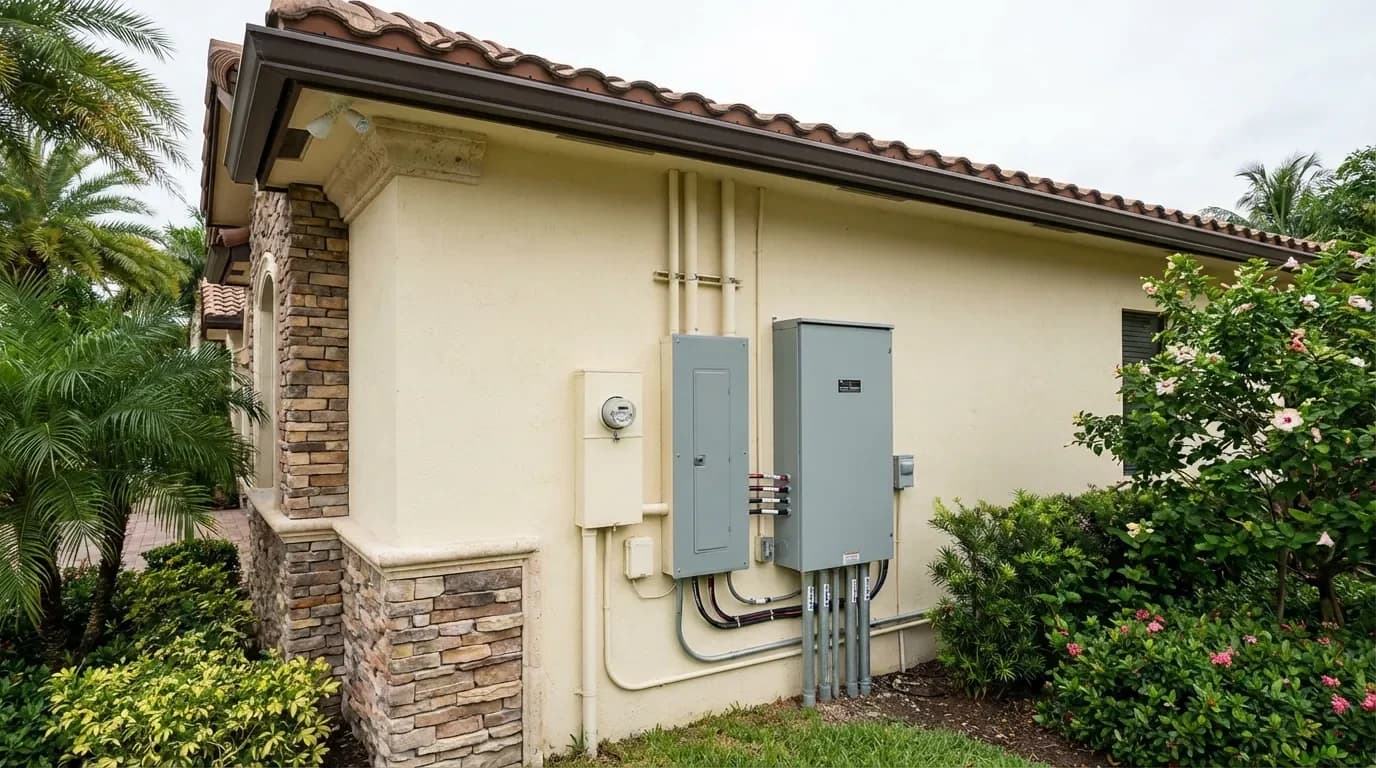
The ATS is wired between the utility feed and your main electrical panel. When utility power drops, the ATS signals the generator to start, confirms stable voltage, then transfers the load — all in 10 to 30 seconds.
Concrete Pad & Anchorage
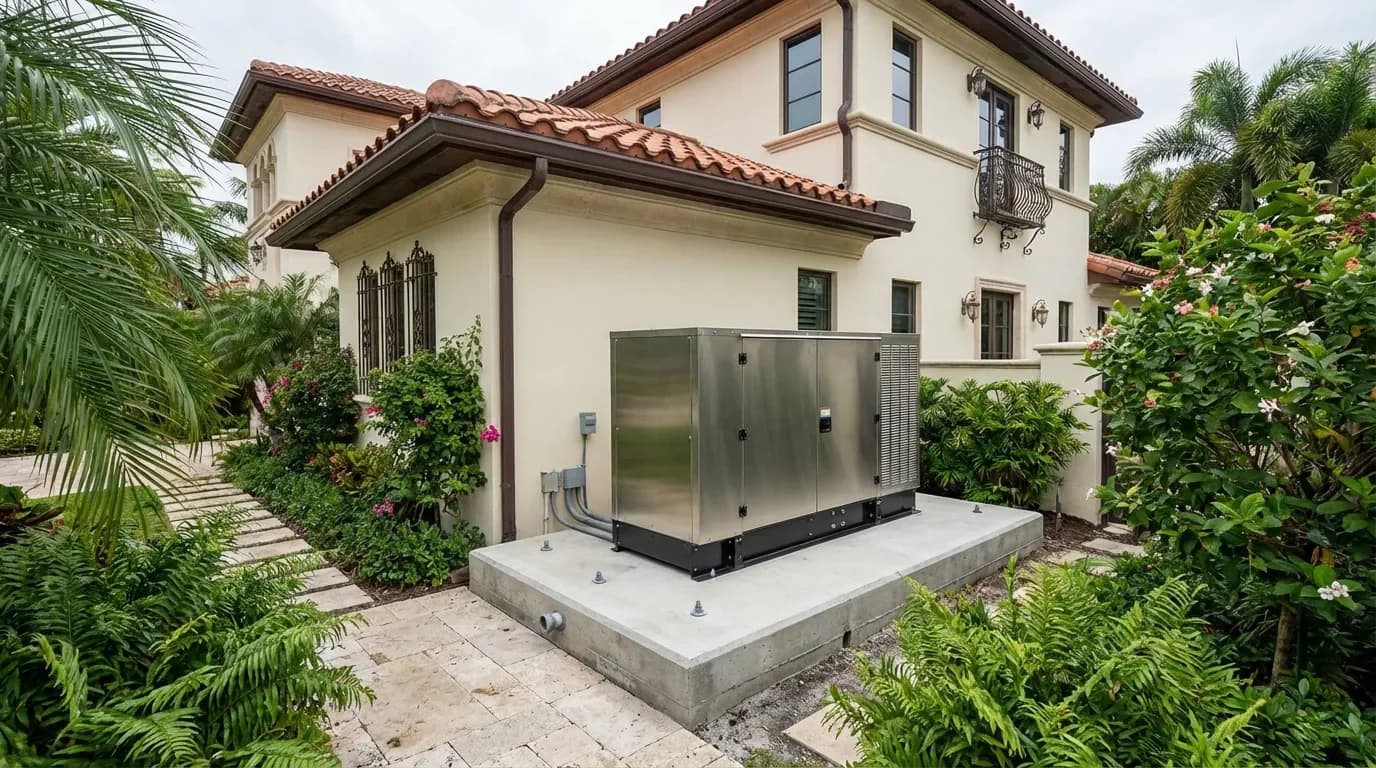
Florida Building Code requires generators to be mounted on a reinforced concrete pad, anchored to withstand design wind speeds for your municipality — 140 mph or higher in HVHZ zones within Broward County.
Startup, Testing & Owner Orientation
After final inspection, the crew performs a full-load test, programs the weekly self-test cycle, and walks you through manual override procedures and annual maintenance requirements.
In the Field
Concrete Pad & Code-Compliant Anchorage
Concrete Pad & Code-Compliant Anchorage — Dellamano Construction, Fort Lauderdale, FL
2 out of 3 whole house generator installations in Broward and Palm Beach Counties connect to natural gas because both counties have dense utility gas infrastructure. Natural gas requires no on-site storage — the utility supply is effectively unlimited during a storm, unlike a propane tank that must be filled before the hurricane season or refilled mid-event when fuel trucks are scarce.
When natural gas is not available — common in rural Wellington, western Palm Beach Gardens, or properties on septic systems where LP (liquefied propane) is the existing fuel — a properly sized above-ground propane tank is installed and permitted separately. A 500-gallon LP tank provides roughly 5 to 7 days of runtime for a 22 kW generator running at 50% load.
“2 out of 3 whole house generator installations in Broward and Palm Beach Counties connect to natural gas because both counties have dense utility gas infrastructure.”
The gas line itself is sized using BTU demand tables from the generator manufacturer and must be pressure-tested by a licensed plumbing contractor before the inspector signs off. Dellamano holds a Certified Plumbing Contractor license (CFC1434398), which covers gas-line rough-in under Florida statute — meaning no subcontractor handoff on this critical scope.
Side-by-Side
Natural Gas vs. LP Propane for Standby Generators
| Feature | Natural Gas | LP Propane |
|---|---|---|
| Fuel Supply During a Storm | Continuous — utility line stays pressurized | Limited to tank capacity; resupply may be delayed |
| On-Site Storage Required | None | 250- to 1,000-gal above-ground tank |
| Availability in South Florida | High — most suburban Broward & coastal Palm Beach | Higher in rural or western Palm Beach areas |
| Fuel Cost per kWh Generated | Lower — typically $0.08–$0.12 per kWh equivalent | Higher — typically $0.14–$0.20 per kWh equivalent |
| Permit Complexity | Gas meter tap; utility coordination required | Tank permit + fire-marshal setback approval |
| Generator Compatibility | All major brands — Generac, Kohler, Briggs & Stratton | Most brands with LP conversion kit or dual-fuel model |
Process
The Whole House Generator Installation Process
- 1
Site Assessment & Load Calculation
A licensed mechanical contractor walks the property, identifies the utility gas meter or LP tank location, measures panel capacity, inventories all electrical loads, and calculates the minimum generator kW rating. Equipment brand and transfer switch amperage are selected at this stage.
- 2
Permit Application
Dellamano files the building permit application with your municipality — whether that is Broward County Building Code Services or Palm Beach County Planning, Zoning & Building. Sub-permits for electrical, mechanical, and gas are filed simultaneously. Plan review typically takes 2 to 4 weeks in Broward and 3 to 5 weeks in Palm Beach County.
- 3
Concrete Pad & Generator Delivery
Once permits are approved, the crew pours a reinforced concrete pad to the manufacturer's minimum dimensions — typically 30" x 60" for a 22 kW unit, larger for higher-kW models. The generator is delivered and set on the cured pad within 5 to 7 business days of the pour.
- 4
Gas Line, Electrical & ATS Rough-In
The plumbing contractor routes and pressure-tests the gas line from the meter or tank to the generator. The electrical crew installs the automatic transfer switch in the main panel room and runs the generator's control wiring and output conductors. All work is inspected in rough-in phase before walls or conduit are closed.
- 5
Final Inspection, Load Test & Startup
The municipal inspector reviews all completed work. After approval, the crew performs a full-load startup test — verifying transfer time, voltage stability, and frequency under load. The weekly exercise cycle is programmed, and the homeowner receives an orientation on manual operation and maintenance intervals.
Ready to talk to a real local GC?
Tell us about your project — we respond within 24 hours.
One License Holder — No Subcontractor Gaps
Aldo Dellamano holds active Florida DBPR licenses as a Certified General Contractor (CGC1525289), Certified Mechanical Contractor (CMC1251666), and Certified Plumbing Contractor (CFC1434398) — meaning the gas line, the transfer switch wiring, and the concrete pad are all self-performed by one accountable crew.
Florida Building Code sets minimum clearances for standby generators: 5 feet from any window or door opening, 18 inches from the exterior wall of the structure, and specific distances from property lines that vary by municipality. In dense neighborhoods across Fort Lauderdale, Pompano Beach, and Hollywood, lots are narrow enough that setback compliance requires careful pad placement during the design phase — not as an afterthought. Noise is an equally important variable.
Most residential standby generators produce 65 to 70 dB(A) at 23 feet — roughly equivalent to a window air conditioner. Many HOAs in Weston, Parkland, and Coral Springs have community sound ordinances that restrict generator runtime hours for non-emergency operation, which directly affects scheduled weekly exercise cycles. Dellamano reviews HOA declarations and municipal noise codes before finalizing pad location, so you don't face a neighbor complaint or a code violation after installation.
“Most residential standby generators produce 65 to 70 dB(A) at 23 feet — roughly equivalent to a window air conditioner.”
com/).
By the Numbers
South Florida Generator Installation: Key Numbers
22–36 kW
Typical Sizing Range
For 2,000–4,500 sq ft South Florida homes with central AC
10–30 sec
ATS Transfer Time
Automatic transfer switch restores power within seconds of outage
4–8 weeks
Permit-to-Install Timeline
Varies by municipality; Broward and Palm Beach County review times
3 licenses
Dellamano In-House Trades
General Contractor, Mechanical Contractor, Plumbing Contractor — all active DBPR
In the Field
ATS Panel Integration & Load Transfer Wiring
ATS Panel Integration & Load Transfer Wiring — Dellamano Construction, Fort Lauderdale, FL
A whole house generator requires annual maintenance to stay reliable when you need it most — and Florida's heat and humidity accelerate wear on engine components faster than in northern climates. A standard annual service includes an oil and filter change, spark plug inspection, air filter replacement, coolant check, battery load test, and a full-load exercise run.
Generac recommends oil changes every 200 hours of runtime or annually, whichever comes first — and after a major storm event that runs the generator for 72 or more continuous hours, that 200-hour interval can be hit in a single season. gov) certified generators are tested for fuel efficiency under load, which matters when you're burning natural gas or propane for days at a time.
“A standard annual service includes an oil and filter change, spark plug inspection, air filter replacement, coolant check, battery load test, and a full-load exercise run.”
Dellamano recommends scheduling your annual maintenance in April or May — before the June 1 hurricane season start — so any parts that need replacement are sourced before supply chains tighten during storm prep. Pre-season service also validates that the automatic transfer switch exercises weekly as programmed and that fuel supply lines are free of corrosion, which salt-air exposure accelerates on coastal properties in Boca Raton, Delray Beach, and Boynton Beach.
Not sure what your project should cost?
Free, itemized estimates — no obligation, no sales pressure.
Flood Zone Properties Need Extra Planning
Homes in FEMA-designated flood zones must elevate generator pads above the Base Flood Elevation (BFE) — verify your flood zone at the FEMA Flood Map Service Center before finalizing pad design.
Generator installation is one of the most-requested add-ons during larger renovation projects across South Florida. Homeowners completing a full Interior Renovation — whether a kitchen remodel, home addition, or whole-home gut renovation — often upgrade their electrical panel and add a standby generator in the same permit cycle, reducing inspection trips and mobilization costs.
Outdoor renovations are a natural pairing as well: homeowners investing in Exterior Living & Outdoor Construction — outdoor kitchens, pergolas, or pool enclosures — frequently want a generator to power outdoor entertainment systems, landscape lighting, and pool equipment year-round. Bundling these scopes under one general contractor eliminates the coordination failures that occur when separate contractors share a job site.
“Generator installation is one of the most-requested add-ons during larger renovation projects across South Florida.”
All of Dellamano's generator work is part of the broader Construction & Renovation scope the company delivers across Broward and Palm Beach Counties, from coastal Fort Lauderdale and Pompano Beach through inland communities like Wellington and Palm Beach Gardens. org/other/consumer-resources) consumer resources are a useful reference for understanding how to evaluate contractors and scope renovation projects before you commit.
Get a Free Generator Sizing Estimate
Dellamano Construction provides free whole house generator consultations across Broward and Palm Beach Counties. One call covers the load calculation, site assessment, permit path, and equipment recommendation — all under three active Florida DBPR licenses with no subcontractor handoffs. Contact us today to schedule your pre-season assessment before equipment lead times extend.
Frequently Asked
Common Questions
How do I know what size whole house generator I need for my South Florida home?
+
Generator sizing in South Florida requires a licensed mechanical contractor to calculate your home's total connected load — every HVAC compressor, air handler, water heater, refrigerator, pool pump, and lighting circuit adds to the total. A 2,500 sq ft home in Broward or Palm Beach County with a 5-ton central AC system typically needs a 22 kW to 26 kW standby generator for full coverage. Homes with two HVAC zones, electric water heaters, and pool equipment can require 30 kW to 36 kW or more. Undersizing forces the generator to run at maximum capacity continuously, which shortens engine life and risks tripping the automatic transfer switch under peak demand. Dellamano Construction performs a complete load calculation before recommending any equipment, ensuring the generator you buy is sized for your actual electrical profile.
Does a whole house generator installation require a permit?
+
Yes — every permanent standby generator installation in Broward and Palm Beach Counties requires a building permit, along with sub-permits for electrical, mechanical, and gas work. Broward County Building Code Services and Palm Beach County Planning, Zoning & Building both require approved plans before installation begins. The permit process covers the generator pad, automatic transfer switch wiring, gas line routing, and final inspection sign-off. Attempting to install a whole house generator without permits violates the Florida Building Code, can void your homeowner's insurance, and creates serious complications when you sell the property. Dellamano Construction files all required permits simultaneously and manages municipal inspections through to final approval.
How long does a whole house generator installation take?
+
The total timeline from permit application to startup typically runs 6 to 10 weeks in Broward and Palm Beach Counties. Municipal plan review accounts for most of that time — Broward County reviews average 2 to 4 weeks, while Palm Beach County reviews often run 3 to 5 weeks. Once permits are approved, the physical installation — concrete pad pour, generator delivery and setting, gas line routing, electrical and ATS rough-in, and final inspection — typically takes 5 to 10 business days of field work. Equipment lead times from manufacturers like Generac, Kohler, and Briggs & Stratton can add another 2 to 4 weeks depending on the season. Starting the process in early spring — March or April — ensures your whole house generator is operational before the June 1 hurricane season start.
Can a whole house generator run on natural gas or propane?
+
Most homes in suburban Broward County and coastal Palm Beach County — including Fort Lauderdale, Pompano Beach, Boca Raton, and Delray Beach — have access to FPL natural gas utility lines, making natural gas the preferred fuel for whole house generators. Natural gas provides an effectively unlimited supply during a storm event because the utility line stays pressurized, unlike a propane tank that must be pre-filled and cannot be easily resupplied when fuel trucks are unable to operate during a hurricane. Propane (LP) is a practical alternative for properties in rural western Palm Beach County areas like Wellington where natural gas infrastructure is less dense. A 500-gallon propane tank provides roughly 5 to 7 days of runtime at moderate load for a 22 kW unit. Dellamano holds a Certified Plumbing Contractor license covering gas line routing for both fuel types.
Are there noise or setback rules for generators in HOA communities?
+
Yes, and they vary significantly by municipality and community. Florida Building Code requires a minimum 5-foot clearance from any window or door opening and 18 inches from the exterior building wall. Property line setbacks vary by municipality and can be as tight as 3 feet in dense Broward County neighborhoods. Beyond building code, many HOA communities in Weston, Parkland, and Coral Springs impose sound ordinances that restrict non-emergency generator runtime hours — which directly affects the weekly self-test exercise cycle every standby generator runs automatically. Most residential generators produce 65 to 70 dB(A) at 23 feet. Dellamano reviews HOA declarations and local noise codes during the design phase, not after the pad is poured, so pad placement satisfies both code and community rules before installation begins.
What maintenance does a whole house generator need in our climate?
+
South Florida's heat, humidity, and salt-air exposure accelerate wear on generator components faster than in cooler climates, making annual maintenance non-negotiable. A standard annual service for a whole house generator in Broward or Palm Beach County includes an oil and filter change, spark plug inspection and replacement if needed, air filter service, coolant level check, battery load test, and a timed full-load exercise run. Generac specifies oil changes every 200 hours of runtime or annually — whichever comes first. After a major storm event where the generator runs continuously for 72 or more hours, that interval can be reached in a single outage. Coastal properties in Boca Raton, Boynton Beach, or Pompano Beach should also have fuel supply lines inspected for salt-air corrosion annually. Scheduling pre-season service in April or May ensures your generator is ready before hurricane season and before repair parts become difficult to source.
Is electrical panel work and gas line service handled in-house?
+
Yes — Dellamano Construction self-performs all three trades required for a whole house generator installation. Founder Aldo Dellamano holds active Florida DBPR licenses as a Certified General Contractor (CGC1525289), Certified Mechanical Contractor (CMC1251666), and Certified Plumbing Contractor (CFC1434398). The mechanical license covers generator sizing, specification, and the automatic transfer switch installation scope. The plumbing license covers gas line routing and pressure testing for both natural gas and LP propane configurations. All licenses are verifiable at the Florida DBPR contractor lookup at myfloridalicense.com. Because all three scopes are performed in-house, there are no subcontractor hand-offs that can delay inspections or create accountability gaps on your installation.