Electrical · South Florida
Licensed Electrical Contractor in South Florida
Panel upgrades, whole-home rewires, EV chargers & generator circuits — done by a licensed electrical contractor under one Florida GC permit in Broward &.
Reviewed by Aldo Dellamano, Licensed Florida General Contractor·Last updated: April 2026
Introduction
lectrical work in South Florida is not like electrical work anywhere else. Salt air corrodes aluminum service conductors ahead of schedule.
Summer storms can push 150-mph gusts through High-Velocity Hurricane Zone (HVHZ) corridors in Broward County. An aging panel that survived Hurricane Wilma may still be running undersized breakers today.
' stage — they've got a failing panel, a whole-home renovation underway, a new EV in the garage, or cloth-insulated wiring that their insurance company just flagged. This page covers what South Florida electrical work actually involves: code requirements, permit sequencing, material choices, and cost drivers — so you can compare contractors with real knowledge.
Questions about your remodel or addition?
Get a free, no-pressure estimate from our licensed South Florida team.
org) (FBC), which adopts the National Electrical Code (NEC) with Florida-specific amendments — and the 2023 edition is currently enforced. Every residential electrical permit in Broward and Palm Beach Counties requires a licensed electrical contractor of record, a permit pulled before work begins, rough-in inspections before drywall closes, and a final inspection before the panel is energized.
In HVHZ zones — which cover much of coastal Broward — conduit fill, raceway fastening intervals, and weatherhead (the service entrance mast) bracing must all meet stricter wind-load specs than the standard FBC. aspx) each maintain separate inspection queues and slightly different fee schedules, so knowing which county your project falls in affects your permit timeline by days to weeks.
One License Holder, Zero Coordination Gaps
Dellamano Construction's in-house mechanical, electrical, and plumbing crews all work under the same Florida DBPR license holder — Aldo Dellamano's Certified General Contractor credential (CGC1525289) — which eliminates the schedule gaps that form between subcontracted trades on typical renovation projects.
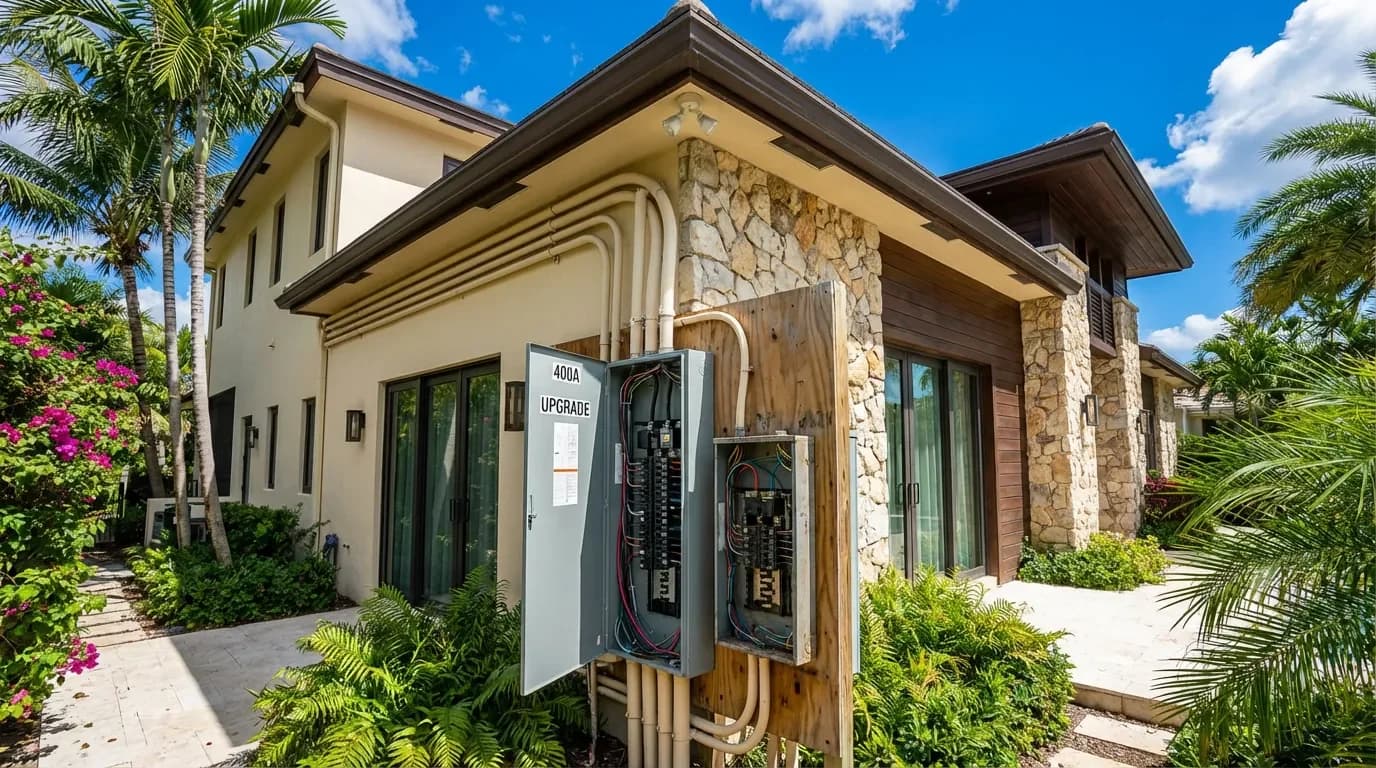
A standard 200-amp (200A) service panel handles most single-family homes built before 2005, but modern load demands — dual EV chargers, 5-ton HVAC systems, whole-home generators, and induction ranges — can push a household to 300A–400A of calculated load under NEC Article 220 methods. The NEC requires a load calculation before any service upgrade to confirm the utility transformer feeding your home can handle the new demand. A 400-amp service requires a 2-inch schedule 80 PVC or rigid metallic conduit run from the meter base to a split 200A/200A panel pair, or a single 400A main disconnect with sub-panels.
“The NEC requires a load calculation before any service upgrade to confirm the utility transformer feeding your home can handle the new demand.”
Florida Power & Light (FPL) and other South Florida utilities have their own service entrance specs that must match the panel manufacturer's UL-listed configuration — a mismatch causes a failed inspection and a re-inspection fee. Homes in Weston, Coral Springs, and Plantation's newer subdivisions often already have 200A service with room for a sub-panel, making a targeted sub-panel addition more cost-effective than a full 400A upgrade.
What You Get
What a Full Panel Upgrade Includes
Load Calculation (NEC Art. 220)
We calculate your total connected load — HVAC, water heater, range, EV charger, and general lighting — before specifying panel size. Skipping this step causes oversizing or undersizing.
Meter Base & Weatherhead Replacement
The utility-side meter base and service entrance conductors are replaced to match the new panel amperage and meet FPL's service entrance specifications.
Main Breaker & Branch Circuit Breakers
All breakers are replaced with new UL-listed units. Tandem (piggyback) breakers are removed if they violate the panel's listed configuration.
AFCI & GFCI Breaker Upgrades
The 2023 NEC expands Arc Fault Circuit Interrupter (AFCI) protection to nearly every room in the home. We install combination-type AFCI breakers at the panel, not cheap downstream devices.
Grounding Electrode System
Two 8-foot copper ground rods, bonded to the panel's grounding bar and the water service, are required by NEC 250.53 — a step many cut-rate contractors skip.
In the Field
200A to 400A Panel Upgrade — Broward County
200A to 400A Panel Upgrade — Broward County — Dellamano Construction, Fort Lauderdale, FL
A whole-home rewire is one of the highest-value electrical projects a South Florida homeowner can undertake — and one of the most misquoted. Homes built before 1975 in Pompano Beach, Hollywood, Dania Beach, and coastal Fort Lauderdale commonly have knob-and-tube (K&T) wiring or cloth-insulated aluminum branch circuits, both of which are uninsurable red flags.
Knob-and-tube uses open-air conductors without a ground wire — it cannot support modern GFCI or AFCI protection and is prohibited in concealed insulated spaces under the FBC. Cloth-sheathed wiring (often called 'cloth wire' or 'BX' depending on the era) has insulation that cracks and flakes at 50+ years in Florida's humidity.
“Cloth-sheathed wiring (often called 'cloth wire' or 'BX' depending on the era) has insulation that cracks and flakes at 50+ years in Florida's humidity.”
A licensed electrical contractor performing a whole-home rewire will pull all new 12 AWG or 14 AWG copper Romex (NM-B cable) through existing walls using fishing techniques, install new boxes at every device location, and terminate at a new panel. In open-attic construction — common in South Florida CBS (concrete block structure) homes — the wire run is faster, but thermal mass and salt-air infiltration still demand careful conduit use at exterior penetrations.
Side-by-Side
Knob-and-Tube vs Modern NM-B Wiring
| Feature | Knob-and-Tube (Pre-1950s) | Modern NM-B Copper (Current Code) |
|---|---|---|
| Ground Wire | None — 2-wire only | Full equipment ground on every circuit |
| AFCI/GFCI Compatible | No — cannot add downstream protection | Yes — AFCI breakers at panel, GFCI at wet locations |
| Insulation Life | Cotton/rubber degrades in 50–70 years | PVC jacket rated 90°C, 50+ year design life |
| Homeowner's Insurance | Often refused or surcharged heavily | Standard rates apply |
| Load Capacity | 15A circuits only — no 20A kitchen/bath runs | 20A circuits where required by NEC 210.11 |
| Code Compliance (2023 FBC) | Non-compliant in insulated spaces | Fully compliant |
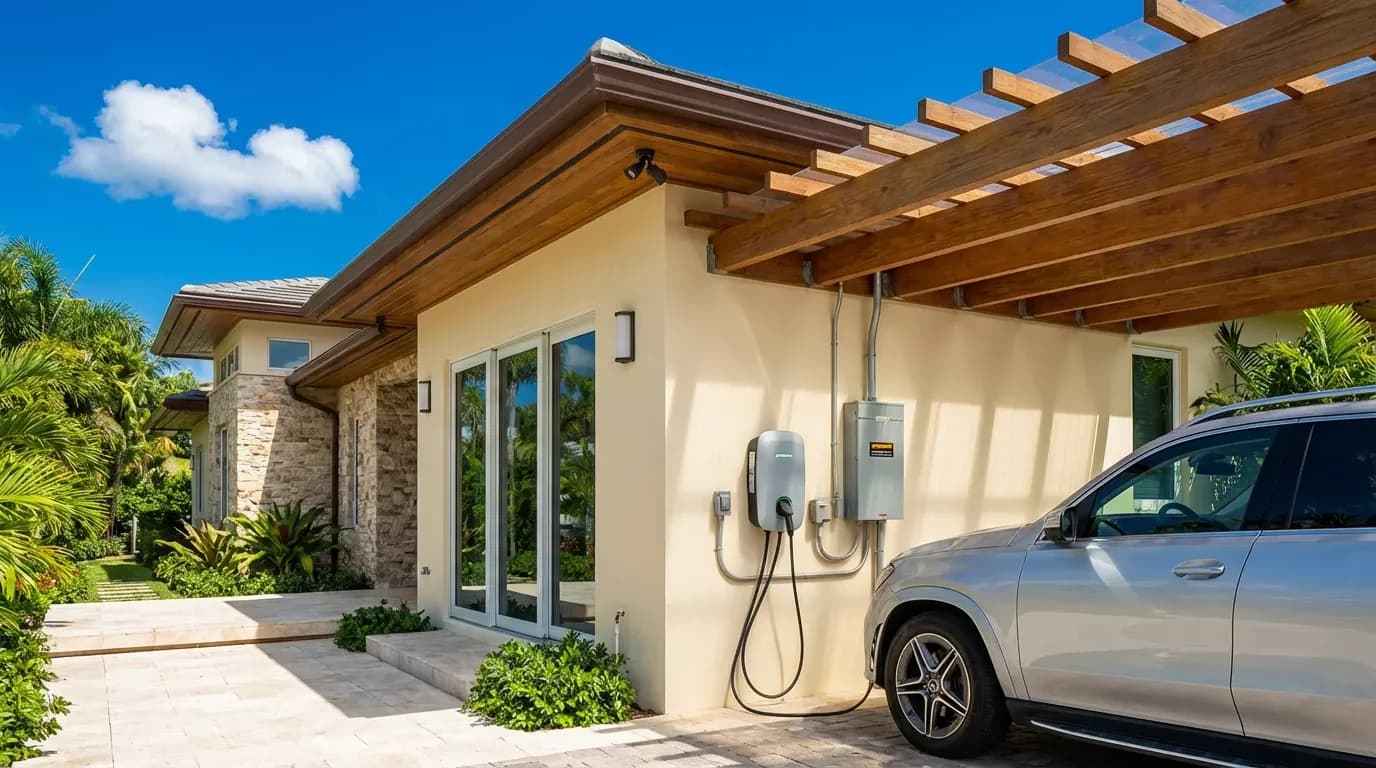
Two of the most-requested electrical upgrades in South Florida today are whole-house standby generator hookups and Level 2 EV charger circuits — and both require dedicated electrical scope that goes beyond a simple outlet install. A whole-house standby generator (typically 20kW–26kW for a 3,000 sq ft home) connects through a transfer switch (ATS — automatic transfer switch) that isolates the home from the utility grid before the generator energizes the panel. 7 and Florida statute both prohibit back-feeding the utility, making a listed ATS non-negotiable on permitted work.
The generator pad, fuel line routing, and ATS placement all need to clear HVHZ wind-load setbacks and local zoning setbacks simultaneously. EV charger circuits are simpler but still require a dedicated 240V/50A or 240V/60A circuit run from the panel to the garage — and if your panel is already near capacity, an EV charger may be the project that finally triggers a 200A-to-400A upgrade. Our Exterior Living & Outdoor Construction team often coordinates the generator pad and conduit routing when outdoor scope is part of the same renovation.
“7 and Florida statute both prohibit back-feeding the utility, making a listed ATS non-negotiable on permitted work.”
com/) before signing a contract.
Ready to talk to a real local GC?
Tell us about your project — we respond within 24 hours.
AFCI Protection Expanded in the 2023 NEC
The 2023 NEC — currently adopted in Florida — requires AFCI protection in bedrooms, living rooms, hallways, kitchens, and laundry areas. Any panel upgrade or rewire must include combination-type AFCI breakers in these spaces, or it will fail final inspection.
Process
How a Permitted Electrical Project Works in Florida
- 1
Site Visit & Load Calculation
We walk the home, identify existing panel capacity, note wire types, flag K&T or cloth wire, and run the NEC Article 220 load calculation to size the new service accurately.
- 2
Permit Application
The licensed electrical contractor of record submits plans and the permit application to Broward or Palm Beach County Building. Residential electrical permits typically take 3–10 business days for approval, depending on county workload.
- 3
Utility Coordination
We coordinate the FPL (or applicable utility) meter pull and temporary power arrangement before demo begins. This step is often skipped by inexperienced GCs and causes costly delays.
- 4
Rough-In & County Inspection
All new wiring, boxes, and conduit are installed before drywall. The county inspector visits for the rough-in inspection. No walls close until the inspector signs off.
- 5
Trim-Out, Final Inspection & Energizing
Devices, covers, and panel connections are completed. The county inspector performs the final electrical inspection. Once approved, the utility re-energizes the meter and the system goes live.
In the Field
EV Charger & Generator Interconnect — Palm Beach County
EV Charger & Generator Interconnect — Palm Beach County — Dellamano Construction, Fort Lauderdale, FL
By the Numbers
South Florida Electrical: Key Numbers
2023
NEC Edition Enforced
Florida adopted the 2023 NEC via the Florida Building Code
400A
Max Residential Service
Required for dual EVs, whole-home generators, and large HVAC loads
150 mph
HVHZ Wind Design Speed
Applies to much of coastal Broward — affects weatherhead and raceway specs
3
In-House Trade Licenses
GC, mechanical, and plumbing — all under one Florida DBPR credential
Not sure what your project should cost?
Free, itemized estimates — no obligation, no sales pressure.
Most homeowners hire a general contractor who then subs out electrical work to a separate electrical contractor — creating two separate schedules, two separate permit holders, and two invoices that rarely align. On a whole-home renovation, that coordination failure typically costs 5–15 days of schedule slippage every time the electrical sub is unavailable when the GC needs a rough-in inspection scheduled. Dellamano Construction operates differently: our electrical scope runs under the same project management umbrella as the Interior Renovation and framing work, so rough-in, inspection calls, and trim-out are sequenced by one project manager, not negotiated between two companies.
Our Construction & Renovation approach covers all trades under one roof. This matters most on complex projects — home additions with new sub-panels, whole-home rewires combined with kitchen remodels, or generator installs that require simultaneous concrete, gas, and electrical scope. For homeowners in Wellington, Royal Palm Beach, and Palm Beach Gardens who are building additions on large lots, coordinating transformer sizing with the utility while the GC manages framing is exactly the kind of multi-discipline work where a fragmented sub model breaks down.
“The NAHB Remodeling resources page is a solid starting point for understanding how to vet a GC's coordination process before signing.”
org/other/consumer-resources) page is a solid starting point for understanding how to vet a GC's coordination process before signing.
Energy Efficiency and Smart Circuits
Pairing a panel upgrade with ENERGY STAR-rated appliance circuits and LED-ready lighting layouts can reduce your home's electrical load by 20–30%, which directly affects the panel size you need and your FPL bill going forward.
Get a Free Electrical Estimate in Broward or Palm Beach
Whether you need a 200A-to-400A panel upgrade in Fort Lauderdale, a whole-home rewire in Boca Raton, a generator hookup in Weston, or an EV charger circuit in Delray Beach — Dellamano Construction's licensed electrical contractor team is ready to scope the project, pull the permit, and pass the inspection. Contact us for a free on-site estimate.
Frequently Asked
Common Questions
Does a licensed electrician need to pull the permit for panel upgrades?
+
Yes. In Broward County, all electrical panel upgrades — including service changes from 200A to 400A — require a permit pulled by the licensed electrical contractor of record before any work begins. Homeowner permits are not allowed for service-entrance work. Broward County Building Code Services requires the permit application to include the load calculation and, for larger services, a site plan showing the meter and panel locations. Work that begins without a permit can result in stop-work orders and require the walls to be opened for a retroactive rough-in inspection.
How can I tell if my home has knob-and-tube or cloth-insulated wiring?
+
In South Florida homes built before 1960, knob-and-tube (K&T) wiring is identified by porcelain knobs stapled to joists with open single-conductor wires, and ceramic tubes where the wire passes through framing. Cloth-insulated wiring — common from the 1940s through the early 1970s — has a braided fabric jacket over rubber insulation that becomes brittle and cracks with age. Both can often be seen in attic spaces or in the main panel's incoming branch circuit wires. If you're unsure, a licensed electrical contractor can do a visual inspection and use a wire-tracing tool to identify circuit types without opening every wall.
What panel size do I need for an EV charger and a whole-house generator?
+
In Palm Beach County, a home running a Level 2 EV charger (48A draw on a 60A circuit) plus a 20kW–26kW standby generator, along with standard HVAC and kitchen loads, will almost certainly require a 400A service or a 200A main panel with a dedicated 200A sub-panel. The correct answer depends on your NEC Article 220 load calculation — specifically the 'optional method' for dwelling units, which accounts for demand factors. Palm Beach County Planning, Zoning & Building requires the load calc to be submitted with the permit application for any service upgrade. Dellamano Construction runs this calculation during the free estimate visit.
How long does a whole-home rewire take in a South Florida CBS home?
+
A whole-home rewire in a typical South Florida concrete block structure (CBS) home of 2,000–3,000 square feet generally takes 5–10 business days of field labor, plus permit approval time. CBS construction is slower to rewire than wood-frame because you can't snake wire laterally through block walls — conduit or surface raceway is required at block wall runs, and the attic becomes the primary distribution plane. Permit approval in Broward and Palm Beach Counties currently runs 5–15 business days for residential electrical permits. Total project duration from permit submission to final inspection is typically 3–5 weeks depending on county inspection scheduling.
Is AFCI protection required on older homes during a panel replacement?
+
Yes. When a licensed electrical contractor replaces a service panel in a South Florida home — even in an older home that didn't originally require AFCI protection — the 2023 Florida Building Code triggers AFCI requirements on all circuits that are being replaced or extended. AFCI (Arc Fault Circuit Interrupter) protection is now required in bedrooms, living rooms, hallways, kitchens, laundry areas, and most other living spaces under the 2023 NEC. This means a panel replacement is not just a box swap — it's an opportunity to bring the entire branch circuit protection scheme up to current code, which also makes the home more insurable.
Can you handle both electrical and general contracting on a renovation?
+
Yes. Dellamano Construction is a licensed Florida general contractor (CGC1525289) with in-house electrical scope managed under the same project team. On a renovation in Fort Lauderdale or anywhere in Broward County, this means the electrical permit, the framing permit, and any mechanical or plumbing permits are all coordinated under one GC rather than spread across multiple sub-contractors with separate schedules. This single-GC model is especially valuable on whole-home renovations, home additions, and kitchen remodels where electrical rough-in must be sequenced precisely with framing inspections and drywall installation.
What HVHZ requirements affect panel and conduit installations?
+
The High-Velocity Hurricane Zone (HVHZ) designation — which applies to much of coastal Broward County and parts of Dade County — imposes stricter attachment and bracing requirements on service entrance equipment. Under the Florida Building Code, weatherheads (the service entrance mast) in HVHZ areas must be braced to withstand a 150-mph design wind speed, conduit fastening intervals are shortened compared to standard FBC, and exterior junction boxes require gasketted, impact-rated covers. These requirements trace back to lessons learned from Hurricane Andrew in 1992 and Hurricane Wilma in 2005, when thousands of service entrances and weatherheads failed during those storms. A licensed electrical contractor working in HVHZ areas must be familiar with these specs — failure to comply results in failed inspections and potential liability after a wind event.