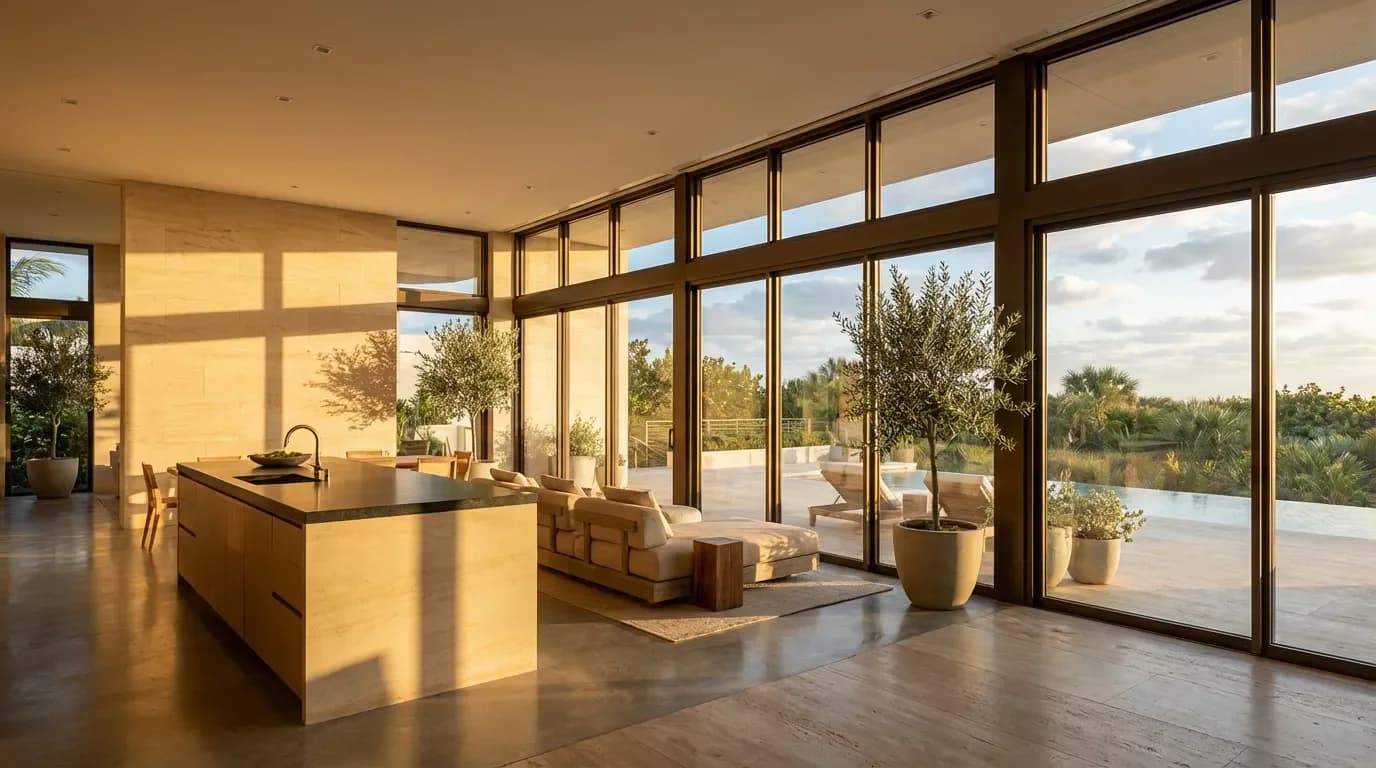
Pool Construction · South Florida
South Florida Pool Builder: In-Ground Concrete Pools
In-ground concrete pools, screen enclosures, and full GC coordination across Broward & Palm Beach Counties. One licensed team handles deck, MEP, and permits.
Reviewed by Aldo Dellamano, Licensed Florida General Contractor·Last updated: April 2026
Introduction
uilding a pool in South Florida is not like building one anywhere else in the country. The High-Velocity Hurricane Zone (HVHZ) wind-load requirements, salt-air corrosion, year-round UV exposure, and strict county permitting rules all shape every decision — from the thickness of your gunite shell to the engineering stamp on your screen enclosure. Dellamano Construction is a licensed Florida pool builder and general contractor serving homeowners across Broward and Palm Beach Counties.
Because Aldo Dellamano holds active licenses as a Certified General Contractor (CGC1525289), Certified Mechanical Contractor (CMC1251666), and Certified Plumbing Contractor (CFC1434398), one team manages the pool shell, plumbing rough-in, electrical bonding, deck, screen enclosure, and permit — without farming critical work to three separate subs. This guide covers everything you need to know about pool construction in South Florida, from shell design and gunite vs. shotcrete to chlorine vs.
salt systems.
Questions about your remodel or addition?
Get a free, no-pressure estimate from our licensed South Florida team.
Florida Building Code (FBC) Chapter 33 governs residential swimming pool construction statewide, and Broward County's HVHZ overlay adds wind-load engineering requirements that most out-of-state pool contractors are not prepared to meet. Every in-ground pool requires a signed and sealed set of engineered plans before a permit is issued — that means a licensed structural engineer of record stamps the rebar layout, shell wall thickness, and screen enclosure frame before a single shovel hits the ground. Pool decks must meet FBC Section 454 slip-resistance minimums, and all pool equipment within 10 feet of the water must comply with NEC (National Electrical Code) Article 680 bonding requirements.
“Understanding these rules upfront prevents costly re-inspections and timeline delays.”
Understanding these rules upfront prevents costly re-inspections and timeline delays. aspx) for local amendments.
One License Holder. Every Scope.
Because one license holder covers the General Contractor, Mechanical (CMC1251666), and Plumbing (CFC1434398) scopes, Dellamano Construction self-performs MEP rough-in in-house instead of coordinating three separate subcontractors — a rare combination in South Florida residential construction.
3,500 PSI is the minimum compressive strength most South Florida engineers specify for an in-ground concrete pool shell — and both gunite and shotcrete can hit that target, but the methods differ in ways that matter on a real job site. Gunite is a dry-mix process: cement and aggregate are combined dry, then water is added at the nozzle as the mix is sprayed onto a rebar cage. Shotcrete is a wet-mix process: the concrete arrives in a truck pre-mixed and is pumped through a hose at high velocity.
Gunite gives the nozzle operator more real-time control over the water-to-cement ratio, which is why many South Florida pool builders prefer it for freeform designs with complex curves. Shotcrete tends to produce more consistent batch-to-batch strength, making it popular on larger, rectangular pools where volume matters. Both require a 28-day cure before the interior finish is applied.
“Gunite is a dry-mix process: cement and aggregate are combined dry, then water is added at the nozzle as the mix is sprayed onto a rebar cage.”
The rebar cage itself — typically #4 bar (half-inch diameter) on 12-inch centers — is inspected by the building department before any concrete is sprayed, so the structural layout is never hidden from oversight.
What You Get
Pool Shell & Finish Options
Gunite Shell
Dry-mix sprayed concrete ideal for freeform shapes and tight access sites. Gives the nozzle operator real-time water ratio control, reducing rebound waste on curved walls.
Shotcrete Shell
Wet-mix pumped concrete with consistent batch strength. Preferred on larger rectangular pools and commercial builds where high volume placement speed matters.
Pebble Tec / Pebble Sheen Interior
Aggregate finishes that expose small stones for a natural texture. More durable than standard white plaster in South Florida's high-UV, high-use environment — typical lifespan 15–20 years.
Quartz Plaster
A mid-grade finish blending white cement with quartz aggregate. Resists staining from mineral-rich South Florida municipal water and provides a smooth, bright surface.
Glass Tile Waterline
Porcelain or glass tile at the waterline handles chemical and sun exposure better than standard plaster and adds a design focal point visible from the pool deck.
In the Field
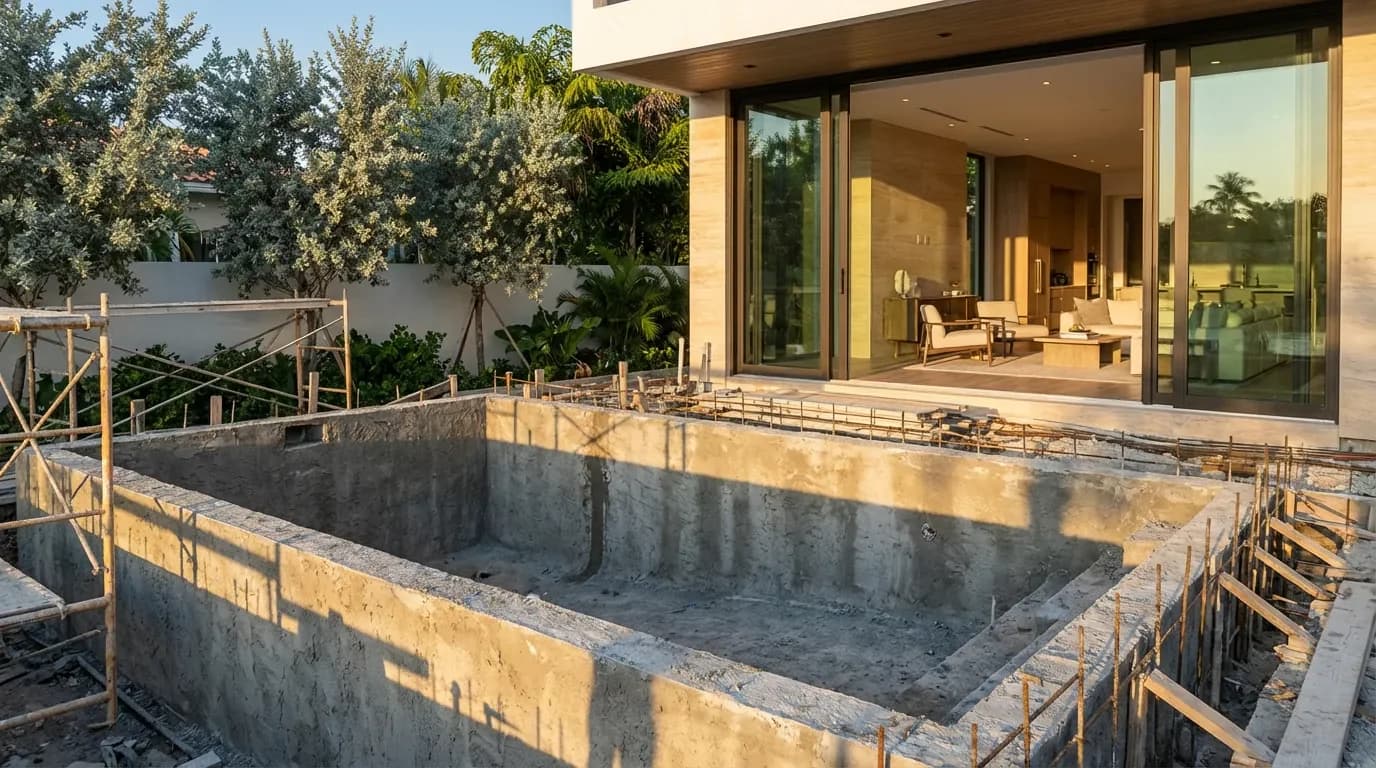
Gunite Shell Before Interior Finish
Gunite Shell Before Interior Finish — Dellamano Construction, Fort Lauderdale, FL
170 miles per hour — that is the design wind speed Broward County's HVHZ provisions require screen enclosures to withstand, a standard set after Hurricane Andrew's 1992 landfall exposed catastrophic failures in aluminum screen rooms across South Florida. Every screen enclosure today must be engineered by a licensed structural engineer and permitted with signed and sealed drawings before installation begins.
The aluminum framing members — typically 6063-T5 or 6063-T6 alloy — must be sized to resist both uplift and lateral loads calculated at the site-specific wind exposure category. Screen mesh is rated in openings per inch; finer mesh filters more debris and insects but also increases wind drag on the frame, so the engineer must account for the mesh's drag coefficient in the load calculation.
“The aluminum framing members — typically 6063-T5 or 6063-T6 alloy — must be sized to resist both uplift and lateral loads calculated at the site-specific wind exposure category.”
Post-Hurricane Irma (2017) inspections showed that the most common failure points were anchor bolts at the concrete slab — so proper embedment depth and epoxy-set anchors are non-negotiable. Our Exterior Living & Outdoor Construction team designs and builds screen enclosures that meet HVHZ requirements and integrate seamlessly with the pool deck.
By the Numbers
South Florida Pool Construction by the Numbers
170 mph
HVHZ Design Wind Speed
Required for screen enclosures in Broward County's HVHZ zone
3,500 PSI
Minimum Shell Strength
Compressive strength spec for in-ground concrete pool shells
NEC 680
Electrical Bonding Code
National Electrical Code article governing pool equipment bonding
28 days
Gunite Cure Time
Minimum before interior finish is applied to the shell
NEC Article 680 requires that every metal part within 5 feet of the pool water — the ladder, handrails, pump motor housing, light niches, and even rebar in the shell — be connected to a common equipotential bonding grid. This grid equalizes voltage across all conductive surfaces so that a stray current leak cannot create a shock hazard in the water.
The bonding wire (typically #8 AWG solid copper) is not the same as grounding; it is an additional safety layer specific to pools. Beyond bonding, a licensed electrical contractor must install GFCI (ground-fault circuit interrupter) protection on all pool circuits, and all pool lighting must be 12-volt low-voltage or listed for wet-niche use at line voltage.
“ENERGY STAR certified pool pumps can save homeowners $300–$500 per year in electricity costs compared to older single-speed models.”
On the mechanical side, variable-speed pump motors are now required by Florida statute — they consume up to 80% less energy than single-speed pumps at low-flow settings and qualify for utility rebates in many South Florida jurisdictions. gov) certified pool pumps can save homeowners $300–$500 per year in electricity costs compared to older single-speed models.
Ready to talk to a real local GC?
Tell us about your project — we respond within 24 hours.
Side-by-Side
Chlorine vs. Salt Water Pool Systems
| Feature | Chlorine System | Salt Water System |
|---|---|---|
| Sanitizer Source | Liquid or tablet chlorine added manually or via feeder | Salt cell (electrolytic chlorine generator) produces chlorine from dissolved salt |
| Upfront Cost | Lower — standard equipment, no salt cell | Higher — salt cell adds $800–$2,000 to equipment package |
| Ongoing Cost | Ongoing chlorine purchases; ~$50–$150/month | Salt cell replacement every 5–7 years; lower monthly chemical spend |
| Water Feel | Can cause eye and skin irritation at higher chlorine levels | Softer feel; lower free-chlorine levels reduce irritation |
| Corrosion Risk | Low — standard pool materials compatible | Salt accelerates corrosion on some metals; specify marine-grade fixtures |
| South FL Suitability | Well-proven in hot, high-UV climate; easier to shock after heavy rain | Popular choice; salt cell output must scale with South FL usage demand |
Salt Water ≠ Low Maintenance
A salt water pool still produces chlorine — it just generates it on-site via electrolysis. You still need to test pH, alkalinity, and cyanuric acid weekly. In South Florida's heat and heavy summer rain, water chemistry shifts fast.
4 inches of concrete with #3 rebar on 18-inch centers is a standard pool deck specification, but the design decisions that matter most are slope, finish, and how the deck connects to the house's existing slab. Florida requires a minimum 1/8-inch-per-foot slope away from the pool and toward deck drains to prevent standing water — critical in a climate that drops 60-plus inches of rain per year.
Travertine pavers are a popular South Florida choice: they stay cooler underfoot than plain concrete in direct sun, drain through the joints, and tolerate freeze-thaw cycles (which, while rare, do occur in northern Palm Beach County). Brushed concrete with a broom finish is the most affordable slip-resistant option that still meets FBC 454 requirements.
“Brushed concrete with a broom finish is the most affordable slip-resistant option that still meets FBC 454 requirements.”
When a pool project includes an outdoor kitchen — a combination we build frequently for clients in Parkland, Weston, and Coral Springs — the deck layout must account for gas line routing, GFCI receptacle placement, and ventilation clearances around the grill hood. We also coordinate any deck expansion with interior work, such as when a homeowner is combining a pool build with an Interior Renovation that opens the great room toward the lanai.
In the Field
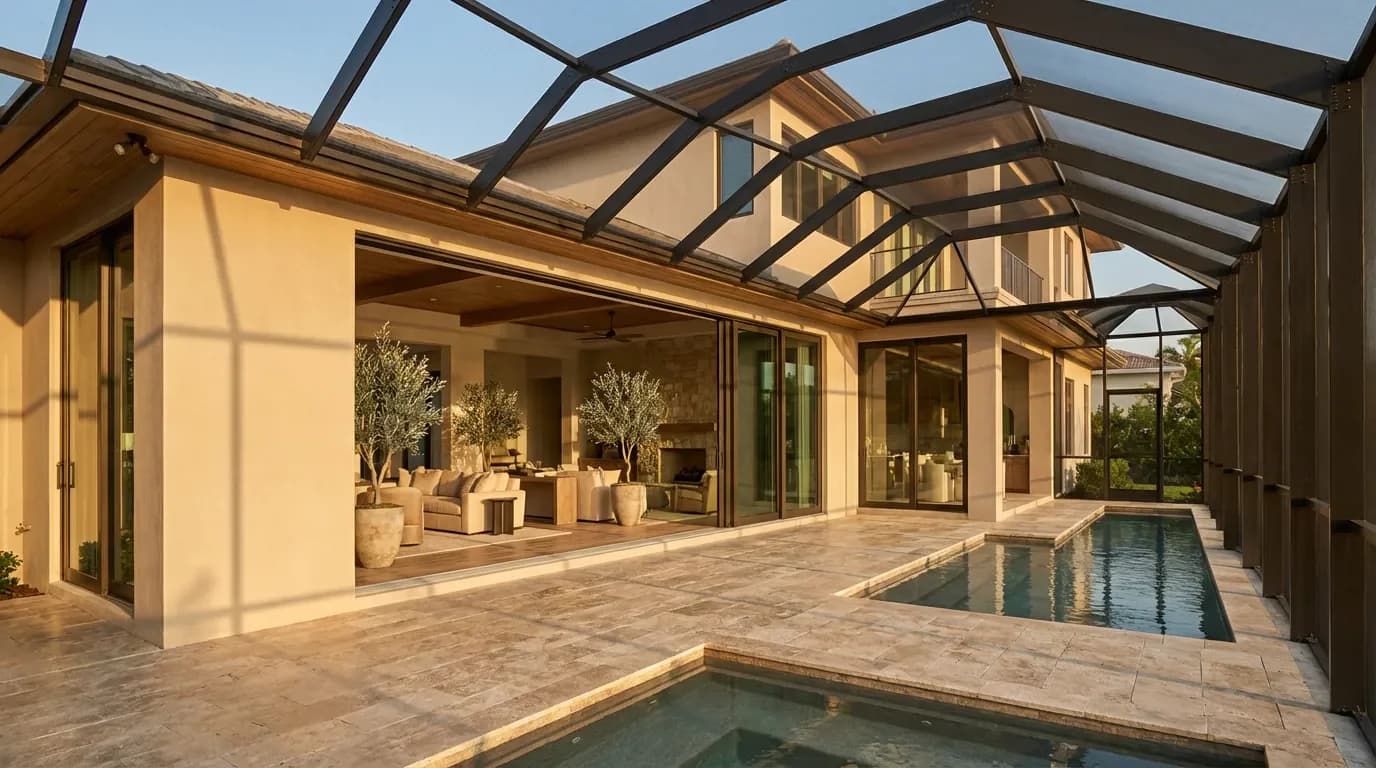
Travertine Deck with Screen Enclosure
Travertine Deck with Screen Enclosure — Dellamano Construction, Fort Lauderdale, FL
Process
How the Pool Construction Process Works
- 1
Design, Engineering, and Permitting
We finalize pool shape, depth, equipment package, and deck layout with you, then commission a licensed structural engineer to produce signed and sealed drawings. The permit application is submitted to the county building department — Broward or Palm Beach — along with the engineered plans, soil report if required, and HOA approval documentation where applicable. Permit timelines vary: expect 4–10 weeks depending on county workload and plan review complexity.
- 2
Layout, Excavation, and Rebar
Once the permit is in hand, we stake the pool footprint and begin excavation. The rebar cage — typically #4 bar on 12-inch centers — is assembled in the hole and tied by hand. A building department inspector reviews and approves the rebar before any concrete is sprayed. This inspection is mandatory under the Florida Building Code and cannot be skipped.
- 3
Gunite or Shotcrete Shell
After rebar approval, the concrete crew sprays the shell in a single continuous session to prevent cold joints (weak seams between pours). Typical shell thickness is 6 inches on walls and 8–10 inches on the floor. The shell cures for a minimum of 28 days, during which it is kept wet by continuous misting or ponding to prevent shrinkage cracks.
- 4
Plumbing, Equipment, and Electrical
Our in-house plumbing and mechanical team rough-ins all pool plumbing — main drains, return jets, skimmer lines, and equipment pad connections — before the deck is poured. The variable-speed pump, filter, heater (if selected), salt cell, and automation controller are set on the equipment pad. Our electrical team installs the bonding grid, GFCI breakers, and pool lighting per NEC Article 680.
- 5
Deck, Enclosure, Interior Finish, and Final Inspection
The pool deck is formed, poured, and finished to match the overall outdoor design — travertine pavers, brushed concrete, or a combination. The screen enclosure is erected by our crew using engineer-approved aluminum framing. Interior plaster or aggregate finish is applied, the pool is filled, and water chemistry is balanced before the final building department inspection and county sign-off.
Not sure what your project should cost?
Free, itemized estimates — no obligation, no sales pressure.
Verify Any Contractor Before You Sign
Florida law requires pool contractors to hold a state-issued license. Verify any contractor's license — including ours — at the Florida DBPR contractor lookup before signing a contract. Dellamano Construction's licenses are CGC1525289, CMC1251666, and CFC1434398.
2 inspections are required at minimum for every in-ground pool in Florida — the pre-concrete rebar inspection and the final inspection — but most county building departments schedule 4–6 intermediate inspections covering plumbing rough-in, electrical bonding, deck reinforcement, and screen enclosure framing. Every permit application must include a signed and sealed survey showing setback compliance, engineered pool drawings, a drainage plan, and proof of contractor licensure. HOA communities in Parkland, Weston, and Wellington typically require an additional architectural review committee (ARC) approval before the county permit is issued — and ARC timelines are independent of the county, so starting both processes simultaneously saves weeks.
Palm Beach County also requires a Notice of Commencement (NOC) recorded with the county clerk before any work begins, protecting the homeowner's property from mechanic's liens. org) is the authoritative reference for statewide pool construction requirements; local amendments are layered on top. Dellamano Construction handles the full permit application as part of every pool construction project — we submit the plans, track review status, and schedule inspections so homeowners are not navigating county portals on their own.
“Every permit application must include a signed and sealed survey showing setback compliance, engineered pool drawings, a drainage plan, and proof of contractor licensure.”
Our broader Construction & Renovation practice means we also coordinate any related interior or structural work under the same permit envelope when scope allows.
Ready to Build Your Pool? Let's Talk.
Dellamano Construction serves homeowners across Broward and Palm Beach Counties — from coastal communities in Fort Lauderdale, Pompano Beach, Hollywood, Boca Raton, and Delray Beach to gated communities in Parkland, Weston, Palm Beach Gardens, and Wellington. As a licensed pool builder with in-house GC, mechanical, and plumbing coverage, we coordinate the entire project — shell, deck, enclosure, equipment, and permit — under one contract. Contact us today for a free consultation and project estimate.
Frequently Asked
Common Questions
How long does pool construction take in Broward or Palm Beach County?
+
A typical in-ground concrete pool in Broward or Palm Beach County takes 12–20 weeks from signed contract to final inspection. The largest variable is permit review time — Broward County's building department currently averages 4–8 weeks for pool plan reviews, while Palm Beach County timelines vary by municipality. Once the permit is issued, excavation through plaster usually takes 6–10 weeks depending on weather delays, inspection scheduling, and pool complexity. HOA architectural review, if required, runs parallel to county permitting and should be submitted simultaneously to avoid stacking delays.
Does a pool in South Florida require engineered drawings?
+
Yes. Florida Building Code requires that every in-ground pool permit application include a set of drawings signed and sealed by a licensed Florida structural engineer. The engineered plans must show the rebar layout, shell wall thickness, equipment pad design, and — for screen enclosures — the aluminum framing sized to the local wind speed design requirement. In Broward County's HVHZ zone, the wind design speed for screen enclosures is 170 mph. Dellamano Construction commissions the engineering as part of our full-service pool construction package, so homeowners do not need to source their own engineer of record.
What is the difference between gunite and shotcrete for a South Florida pool?
+
Gunite and shotcrete are both methods of spraying concrete onto a rebar cage to form a pool shell. Gunite uses a dry-mix process where water is added at the nozzle, giving the operator real-time control over the water-to-cement ratio — preferred for freeform pool shapes common in South Florida. Shotcrete uses a pre-mixed wet concrete pumped at high velocity, which delivers more consistent batch strength and is well-suited to larger rectangular pools. Both methods can achieve the 3,500 PSI minimum compressive strength specified by Florida structural engineers, and both require a 28-day cure before the interior finish is applied. The right choice depends on pool geometry, site access, and your pool builder's crew expertise.
Are salt water pools better than chlorine pools in South Florida?
+
Salt water systems are popular in South Florida because they produce chlorine electrolytically from dissolved salt, reducing the need to handle and store liquid or tablet chlorine. They also produce softer-feeling water with slightly lower free-chlorine levels, which reduces eye and skin irritation. However, salt accelerates corrosion on certain metals, so fixtures, ladders, and screen enclosure hardware must be specified in marine-grade or non-ferrous materials. Salt water pools are not maintenance-free — pH, alkalinity, and cyanuric acid still need weekly testing, and in South Florida's intense UV and heavy summer rainfall, water chemistry shifts quickly. The salt cell (electrolytic chlorine generator) typically needs replacement every 5–7 years, adding a future cost that a chlorine system does not have.
What electrical bonding is required for a pool in South Florida?
+
NEC Article 680 requires an equipotential bonding grid that electrically connects every metal component within 5 feet of the pool water — including the rebar in the concrete shell, pump motor housing, light niches, ladders, handrails, and the water itself via a bonding conductor in the pool water. The bonding wire is typically #8 AWG solid copper. This grid equalizes voltage across all conductive surfaces so that a stray current leak cannot create an electrocution hazard in the pool. Bonding is separate from grounding and is inspected by the county building department during construction. Dellamano Construction's in-house licensed electrical team installs pool bonding grids in compliance with NEC 680 and schedules the county inspection as part of the standard pool construction process.
Do I need HOA approval before building a pool?
+
Most gated and master-planned communities in Parkland, Weston, and Wellington require Architectural Review Committee (ARC) approval before pool construction begins. ARC review is entirely separate from the county building permit — the HOA sets its own timeline, which can range from 2 to 8 weeks depending on the community. Submitting the ARC application and the county permit application simultaneously is the best way to prevent the HOA review from delaying your project start date. Dellamano Construction prepares HOA submittal packages — typically including site plan, pool shape drawing, finish selections, and screen enclosure specifications — as part of our full-service pool builder scope in these communities.
How much does a pool cost to build in South Florida?
+
In-ground concrete pool construction in Broward and Palm Beach Counties typically ranges from $75,000 to $200,000 or more depending on pool size and shape, interior finish selection, screen enclosure specifications, deck material, equipment package (standard vs. variable-speed pump, heater, automation controller, auto-cover), and site conditions such as soil type and access constraints. HVHZ screen enclosure engineering in Broward County adds cost compared to standard enclosures. Permit fees, engineering, and HOA submittals are additional line items that vary by municipality. Dellamano Construction provides detailed written estimates that break out each scope — shell, deck, enclosure, equipment, and permit — so homeowners can compare proposals on an apples-to-apples basis.