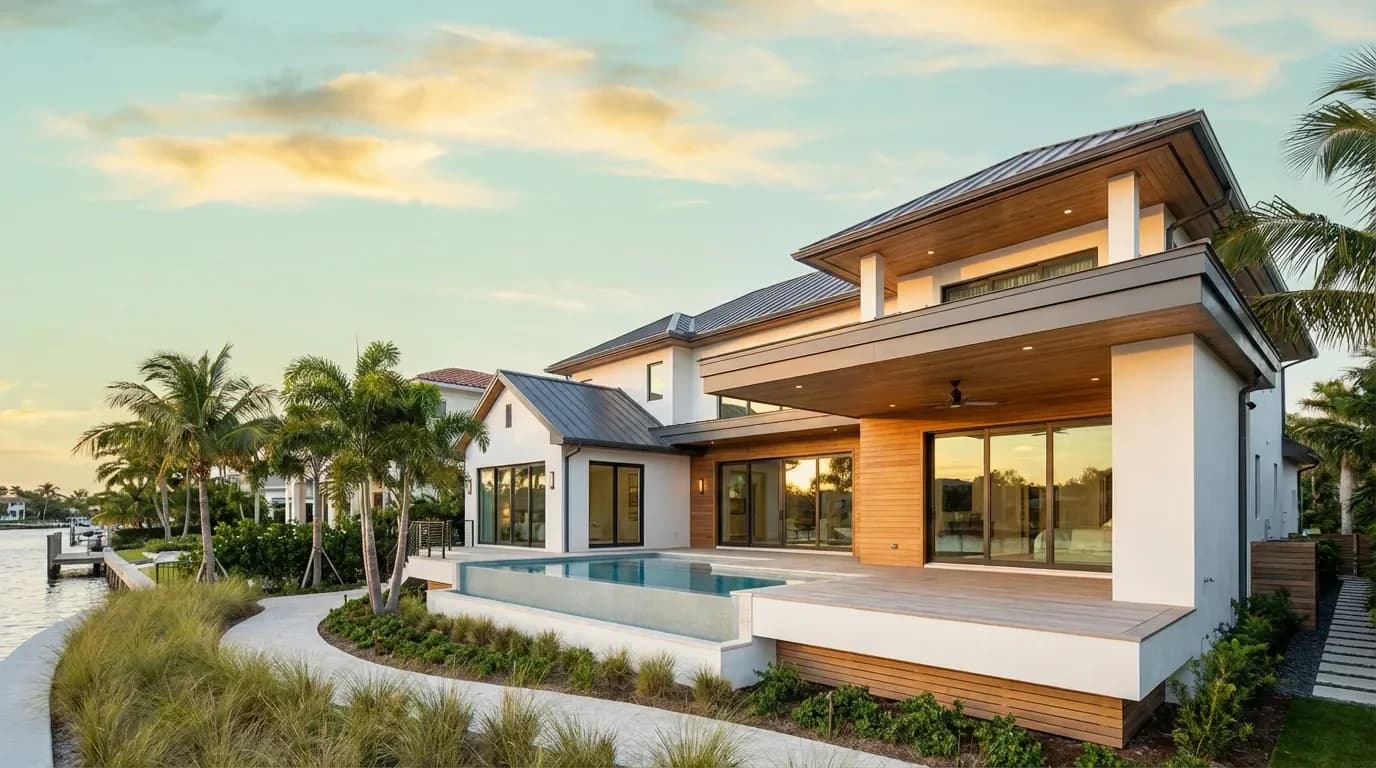
General Contractor · South Florida
General Contractor Services in South Florida
Licensed Florida general contractor self-performing MEP trades in-house. Permit coordination, HVHZ compliance, and one team from demo to final inspection.
Reviewed by Aldo Dellamano, Licensed Florida General Contractor·Last updated: April 2026
Recent Work
Project Gallery
General Contractor services
What falls under the GC umbrella
Commercial construction, tenant fit-outs — each has its own detailed guide.
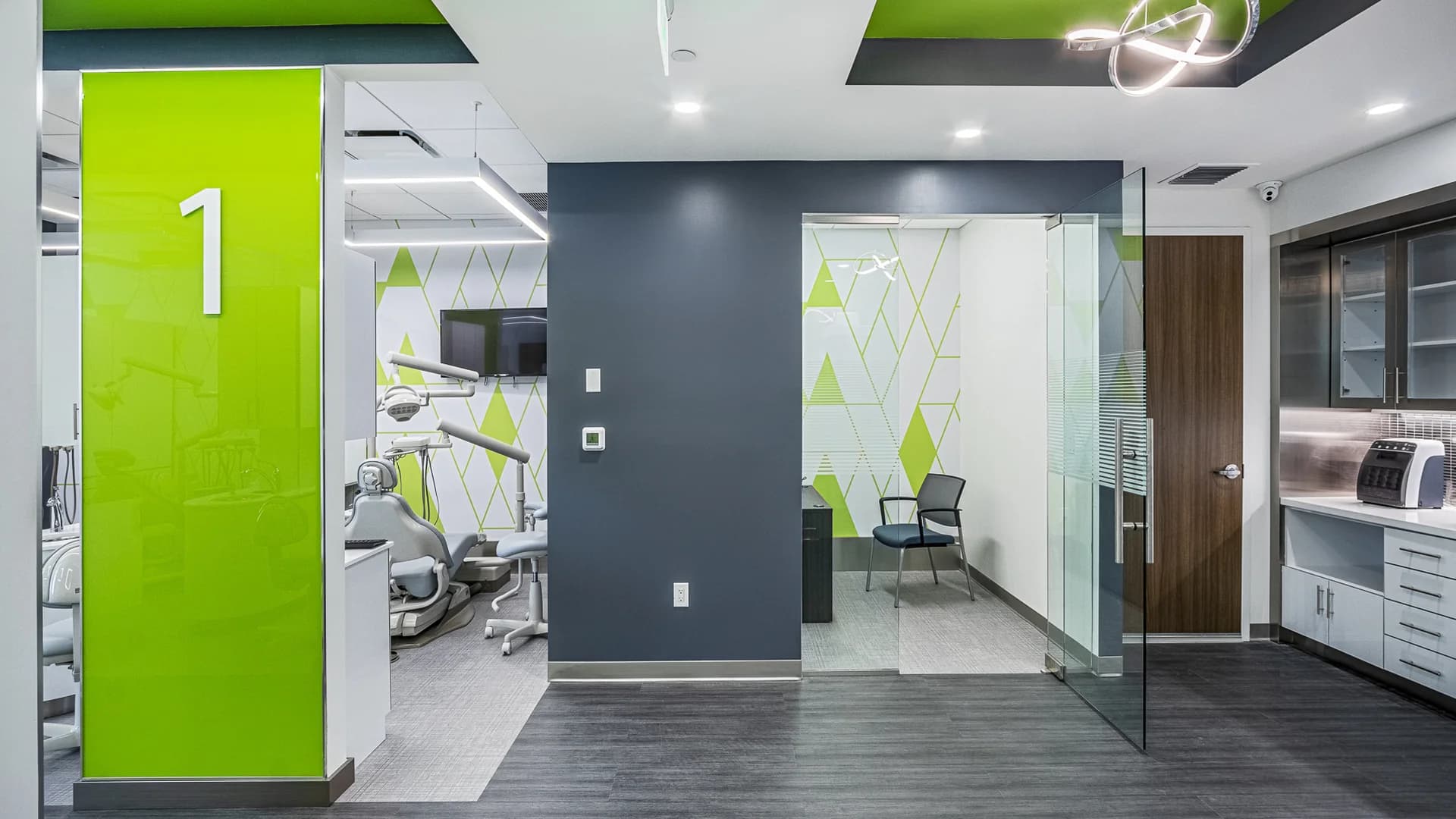
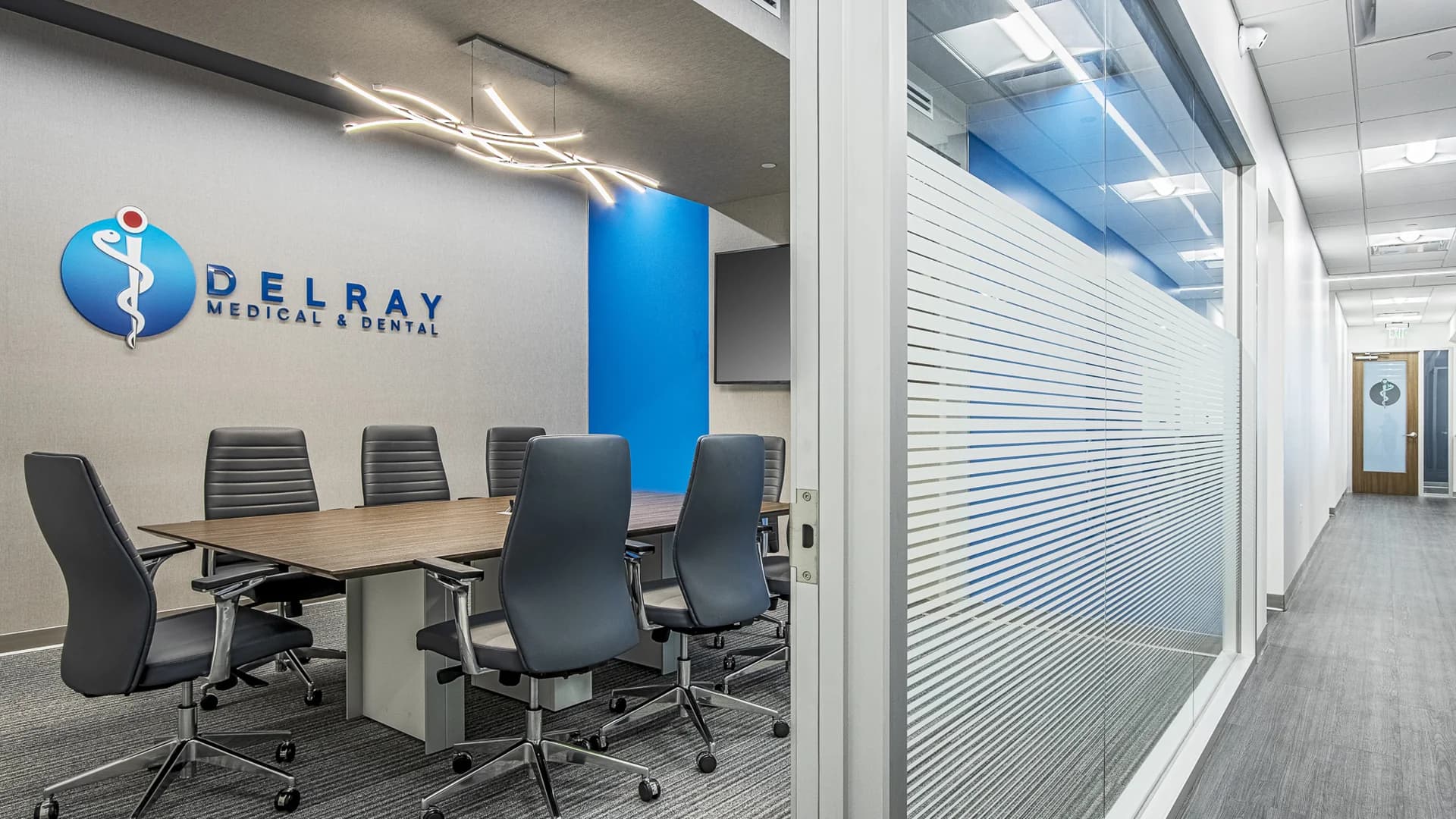
Introduction
iring a general contractor in South Florida is not the same as hiring one in Atlanta or Dallas. Homes here face salt-air corrosion, intense hurricane-season wind loads, and a building code — the Florida Building Code (FBC) — that is updated every three years specifically to address those risks. In the High-Velocity Hurricane Zone (HVHZ), which covers parts of Broward County, wind-load documentation and product approval requirements are stricter than anywhere else in the contiguous United States.
Dellamano Construction is a licensed Florida GC that holds active mechanical and plumbing contractor licenses under one roof, meaning our founder Aldo Dellamano personally oversees MEP (mechanical, electrical, and plumbing) rough-in — not an outside subcontractor. That distinction changes the entire project experience, from permit pull to final inspection sign-off.
Questions about your remodel or addition?
Get a free, no-pressure estimate from our licensed South Florida team.
Florida law requires a licensed general contractor to hold a valid state DBPR (Department of Business and Professional Regulation) license for every scope of work performed on a permitted project. Dellamano Construction runs under 3 active Florida DBPR licenses held by founder Aldo Dellamano: Certified General Contractor (CGC1525289), Certified Mechanical Contractor (CMC1251666), and Certified Plumbing Contractor (CFC1434398).
com/). That multi-trade structure means mechanical and plumbing rough-in stays in-house instead of going to an independent sub whose schedule, quality standards, and accountability chain differ from the GC's.
“Keeping those trades under one license holder removes that failure mode entirely.”
On a typical multi-sub project, 30–40% of schedule delays trace back to coordination gaps between the general contractor and a specialty trade — misaligned rough-in inspections, conflicting wall-open windows, or a sub who pulls his own permit and then goes dark. Keeping those trades under one license holder removes that failure mode entirely.
One License Holder, Zero Coordination Gaps
When the same license holder controls the GC, mechanical, and plumbing scopes, rough-in inspections can be sequenced on a single schedule — not negotiated across three separate contractor calendars.
What You Get
What Dellamano Self-Performs In-House
Mechanical (HVAC)
Ductwork layout, equipment selection, and refrigerant-line rough-in are handled under CMC1251666 — no third-party mechanical sub needed for permitted residential and commercial work.
Plumbing Rough-In
Drain-waste-vent (DWV) stacks, supply lines, and fixture rough-in fall under CFC1434398, keeping water and waste systems on the same inspection schedule as framing and electrical.
Permit Coordination
We pull every required permit — building, mechanical, plumbing, roofing — from Broward County or Palm Beach County building departments and track each inspection milestone so you don't have to.
HVHZ Wind-Load Documentation
In High-Velocity Hurricane Zone areas of Broward County, we prepare product approval (NOA — Notice of Acceptance) submittals and wind-load calculations required by the Florida Building Code before a permit is issued.
Project Communication
Homeowners receive a weekly written progress update and have a direct line to the project manager — not a call center — throughout construction.
In the Field
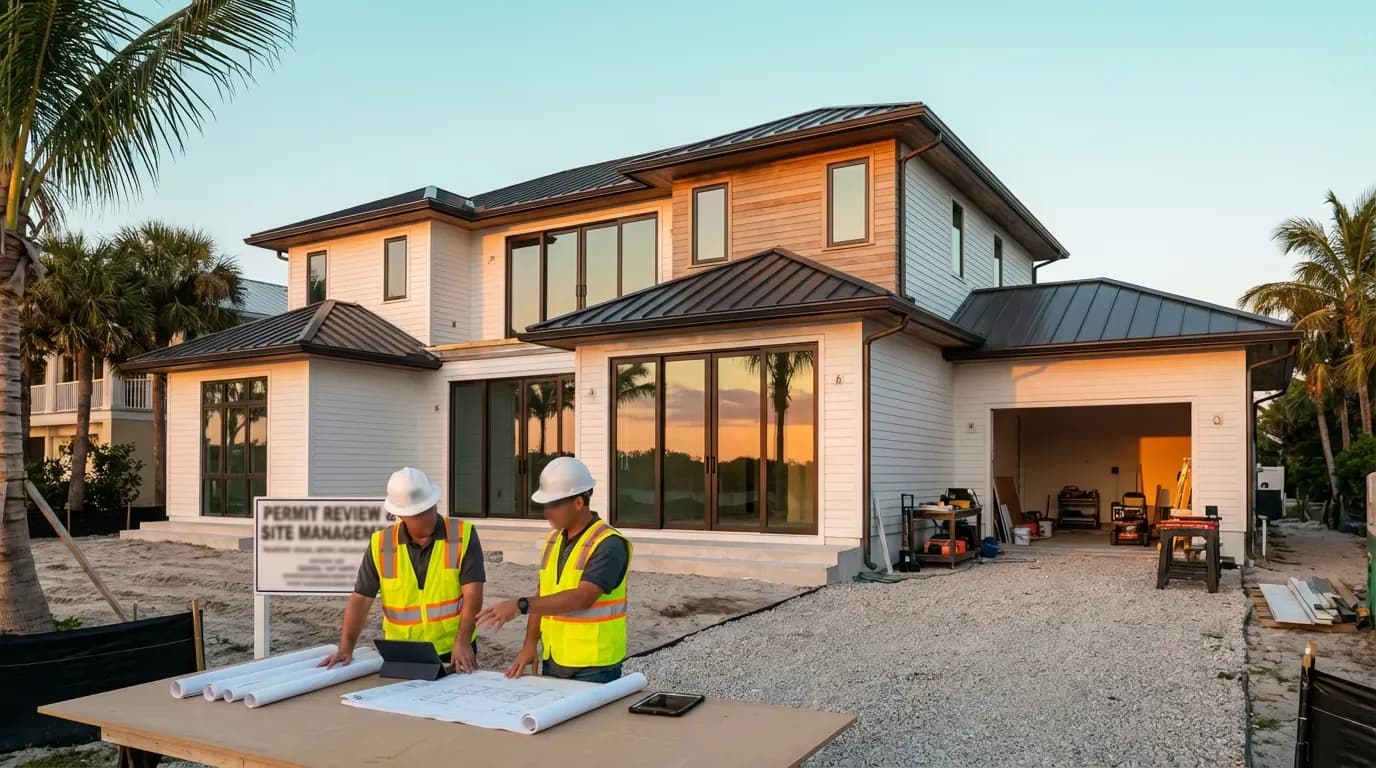
Permit Review & Site Management
Permit Review & Site Management — Dellamano Construction, Fort Lauderdale, FL
Pulling permits in South Florida is not a single-step process. aspx) each have distinct submittal portals, plan review queues, and inspection scheduling systems.
A full addition or whole-home renovation typically requires separate permits for the building envelope, mechanical system, plumbing, and electrical — 4 or more active permits running concurrently. Our team manages every permit package: site plans, floor plan revisions, energy calculations (Florida uses the IECC-based Florida Energy Code), product approvals for windows and doors in HVHZ, and structural engineering letters where required.
“Broward County Building Code Services and Palm Beach County Planning, Zoning & Building each have distinct submittal portals, plan review queues, and inspection scheduling systems.”
For waterfront properties along the Broward coast — Fort Lauderdale, Pompano Beach, Hollywood, and Dania Beach — additional floodplain management reviews may apply. gov/portal/home) at project intake, before design begins, so flood-vent or freeboard (elevated floor) requirements don't surface as change orders mid-construction.
org) — applies to Miami-Dade and Broward Counties. It imposes the strictest residential wind-load standards in the nation, a direct response to Hurricane Andrew's catastrophic 1992 destruction.
Every exterior opening (window, door, skylight, garage door) must carry a Miami-Dade or Florida Product Approval NOA (Notice of Acceptance) rated for the site's design wind speed — often 170 mph or higher in coastal zones. Roof-to-wall connections must be verified with clips or straps at each rafter or truss, and the building official can require a special inspector to document those connections before sheathing closes them in.
“The High-Velocity Hurricane Zone designation — codified in Chapter 44 of the Florida Building Code — applies to Miami-Dade and Broward Counties.”
Hurricanes Wilma (2005), Irma (2017), and Nicole (2022) each reminded South Florida homeowners that code compliance is not paperwork — it is the margin between a repaired roof and a total loss. Dellamano's team prepares HVHZ submittals as a standard part of every affected project, not an add-on service.
By the Numbers
By the Numbers
3
Active DBPR Licenses
GC, Mechanical, and Plumbing under one license holder
170+ mph
HVHZ Design Wind Speed
Minimum product approval rating for coastal Broward openings
4+
Concurrent Permits
Typical permitted addition or whole-home renovation
2
Counties Served
Broward and Palm Beach, from coastal to inland communities
Process
How a General Contractor Project Runs
- 1
Pre-Construction & Scope Development
We meet on-site, review your goals, and produce a written scope of work with a fixed-price or detailed line-item estimate. For additions and new construction, a design-build or architect coordination phase happens here.
- 2
Permit Submittal & Plan Review
Our team prepares and submits all permit packages to the appropriate county building department. We track plan review comments and respond to corrections — keeping the clock moving without burdening the homeowner.
- 3
Demo, Site Prep & Rough-In
Demolition, foundation or slab prep, and MEP rough-in (mechanical ductwork, plumbing DWV and supply, electrical conduit) happen in a coordinated sequence. Because we self-perform mechanical and plumbing, rough-in inspections are scheduled around our crew — not a sub's availability.
- 4
Inspections at Every Phase Gate
Florida law requires rough-in inspections before walls close. We schedule framing, rough mechanical, rough plumbing, and rough electrical inspections in sequence and have documents ready for the inspector on arrival — no delays waiting for paperwork.
- 5
Finish Work & Final Inspection
Drywall, tile, cabinetry, fixtures, trim, and paint come after all rough-in approvals. We coordinate finish trades, conduct a pre-final walkthrough with the homeowner, and manage the final inspection and Certificate of Occupancy (CO) or Certificate of Completion.
Ready to talk to a real local GC?
Tell us about your project — we respond within 24 hours.
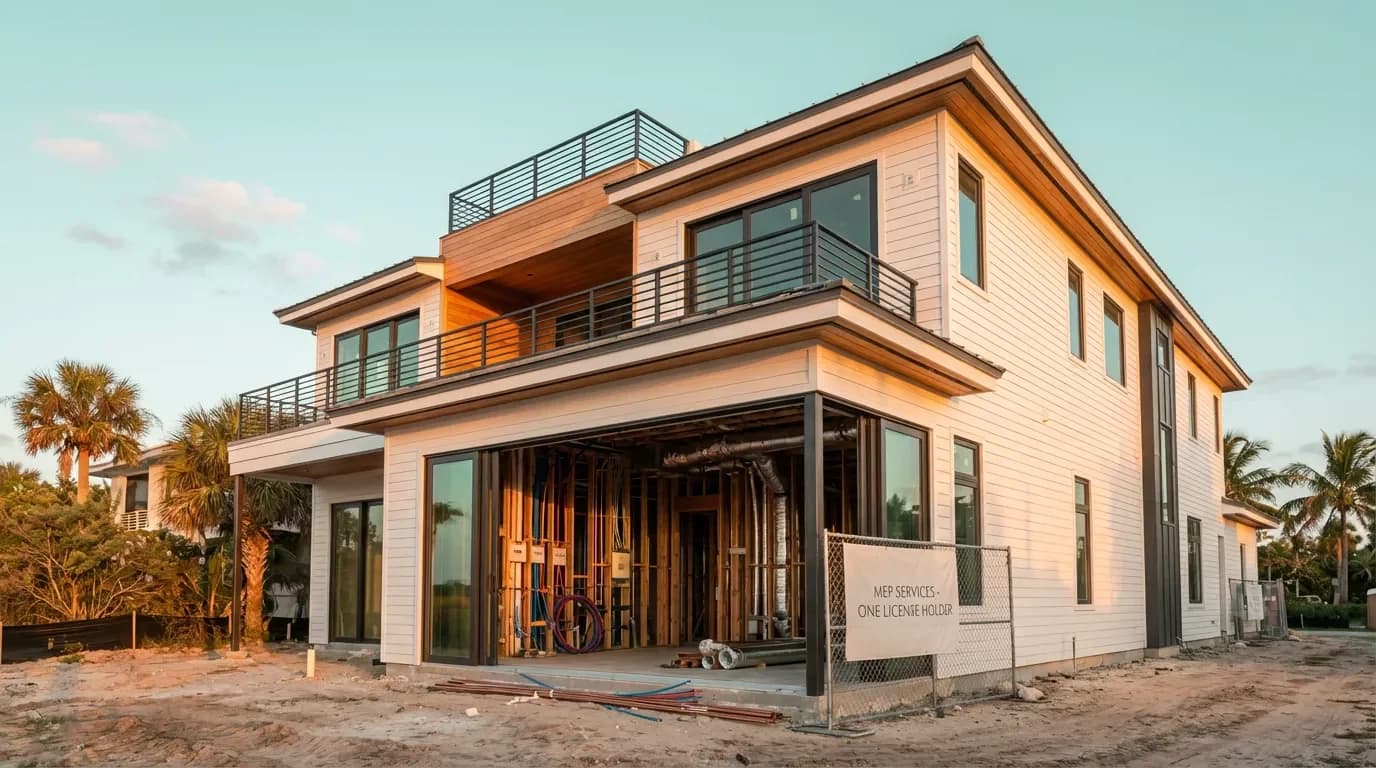
In the Field
MEP Rough-In Under One License Holder
MEP Rough-In Under One License Holder — Dellamano Construction, Fort Lauderdale, FL
Dellamano Construction serves homeowners across 2 counties with distinctly different building environments. In coastal Broward — Fort Lauderdale, Pompano Beach, Hollywood, and Dania Beach — HVHZ requirements and salt-air material selection dominate project planning. Aluminum, stainless fasteners, and PVC or CPVC piping are often preferred over materials that corrode in marine-grade air within 5 miles of the coast.
Inland and gated-community Broward — Parkland, Weston, Coral Springs, Plantation, and Davie — tends toward larger renovations and whole-home additions where community architectural review boards add a pre-permit approval layer we navigate on the homeowner's behalf. Along the Palm Beach coast, communities from Boca Raton and Delray Beach north through Boynton Beach, Palm Beach, and Jupiter combine luxury custom-build expectations with Palm Beach County's own permitting cadence. Inland Palm Beach — Wellington, Royal Palm Beach, Palm Beach Gardens, and West Palm Beach — features active new construction and whole-home renovation demand.
“Aluminum, stainless fasteners, and PVC or CPVC piping are often preferred over materials that corrode in marine-grade air within 5 miles of the coast.”
Our Construction & Renovation practice covers all of these markets under one license structure, from a kitchen remodel in Coral Springs to a custom home in Jupiter.
Side-by-Side
Single-License GC vs. Multi-Sub GC Model
| Feature | Dellamano — Single License Holder | Typical Multi-Sub GC |
|---|---|---|
| MEP Coordination | Mechanical and plumbing in-house; one schedule | Independent subs; separate schedules to negotiate |
| Permit Accountability | GC pulls all permits; one point of contact for building dept. | Subs may pull their own permits; GC has limited oversight |
| Rough-In Inspection Sequencing | GC controls timing; inspections booked around crew | Inspection timing subject to sub availability |
| HVHZ Submittal Prep | Handled in-house as standard scope | May require additional consultant fee |
| Change Order Risk | Lower — MEP conflicts caught internally before walls close | Higher — sub-to-sub conflicts surface late and cost more |
| License Verification | 3 licenses, one holder: CGC1525289, CMC1251666, CFC1434398 | Multiple separate license holders to verify independently |
Verify Any Contractor Before You Sign
Florida law requires every GC and specialty trade contractor to hold an active state license. Check any contractor's license status — including ours — at the Florida DBPR contractor lookup before signing a contract.
Not sure what your project should cost?
Free, itemized estimates — no obligation, no sales pressure.
A general contractor license is the foundation, but South Florida homeowners often need more than four walls and a roof. Dellamano's service range extends into Interior Renovation — including whole-home renovations, kitchen remodels, home additions, and custom home builds managed by our licensed GC team from demolition through final inspection.
We also design and build Exterior Living & Outdoor Construction projects: outdoor kitchens, pergolas, hardscape, and pool enclosures engineered for South Florida's sun, salt air, and wind loads. Generator installations — whole-house standby systems permitted and connected under our mechanical and electrical coordination — round out the offering.
“Generator installations — whole-house standby systems permitted and connected under our mechanical and electrical coordination — round out the offering.”
org/other/consumer-resources) resource library is a useful starting point if you're researching project budgets and timelines before your first contractor conversation. When you're ready for a site-specific discussion, Dellamano offers free estimates with no obligation.
Free Estimates — No Obligation
Contact Dellamano Construction for a free on-site estimate. We'll review your project scope, flag any permit or HVHZ requirements, and give you a written number — not a ballpark.
Ready to Talk to a Licensed South Florida GC?
Dellamano Construction brings 3 active DBPR licenses, in-house MEP trades, and hands-on HVHZ experience to every project across Broward and Palm Beach Counties. Call us or fill out our contact form to schedule a free on-site estimate.
Frequently Asked
Common Questions
What licenses should a general contractor hold in South Florida?
+
In South Florida, a general contractor must hold an active Florida DBPR Certified General Contractor license to pull building permits and oversee construction. If the GC also performs mechanical (HVAC) or plumbing work in-house, the state requires separate Certified Mechanical Contractor and Certified Plumbing Contractor licenses for those scopes. Dellamano Construction's founder Aldo Dellamano holds all three — CGC1525289, CMC1251666, and CFC1434398 — which you can verify at the Florida DBPR contractor lookup at myfloridalicense.com. Broward and Palm Beach Counties both require proof of active licensure before issuing a building permit, so checking license status before signing any contract is a critical first step for South Florida homeowners.
What is the HVHZ and does it affect my Broward County renovation?
+
The High-Velocity Hurricane Zone (HVHZ) is a designation in Chapter 44 of the Florida Building Code that applies to Miami-Dade and Broward Counties. It sets the strictest residential wind-load and product approval standards in the contiguous U.S. — a direct result of Hurricane Andrew's 1992 destruction. In Broward County, every exterior opening (window, door, skylight, garage door) on a permitted project must carry a Miami-Dade or Florida Product Approval NOA (Notice of Acceptance) rated for the site's design wind speed, which can exceed 170 mph in coastal areas. Roof-to-wall connections require straps or clips documented before sheathing closes. If your renovation touches the building envelope in Broward, HVHZ compliance is required — not optional. Dellamano Construction prepares HVHZ submittals as a standard part of every affected project.
How is permit coordination handled across both counties?
+
Dellamano Construction manages the full permit lifecycle for every project in both Palm Beach and Broward Counties. That includes preparing and submitting building, mechanical, plumbing, and roofing permit packages through each county's respective portal — Broward County Building Code Services and Palm Beach County Planning, Zoning & Building. We track plan review comment cycles, respond to correction requests, and schedule all required inspections at each phase gate (framing, rough-in, insulation, final). For waterfront properties in communities like Fort Lauderdale, Pompano Beach, Delray Beach, or Boca Raton, we also verify the property's FEMA flood zone designation at project intake to ensure floodplain elevation and flood-vent requirements are built into the design before permits are submitted — not discovered as a costly change order after construction begins.
Why does self-performing mechanical and plumbing work matter?
+
When a general contractor subcontracts mechanical and plumbing to independent trades, each sub operates on its own schedule, pulls its own permits in some cases, and answers to its own business priorities — not the GC's timeline. That coordination gap is where 30–40% of renovation schedule delays originate: misaligned rough-in inspection windows, wall-open conflicts between trades, and disputes over who is responsible when plumbing and ductwork compete for the same joist bay. Dellamano Construction self-performs mechanical and plumbing rough-in under Aldo Dellamano's CMC and CFC licenses, so rough-in inspections are scheduled around one crew on one calendar. The practical result is fewer inspection failures, tighter phase sequencing, and a shorter overall project timeline for South Florida homeowners in Broward and Palm Beach Counties.
What types of projects does a South Florida general contractor typically manage?
+
A licensed South Florida general contractor manages any permitted construction project from a single-room renovation to a custom home build. Common scopes include whole-home renovations, kitchen and bathroom remodels, home additions, second-story additions, garage conversions, commercial buildouts, and accessory dwelling units (ADUs). In South Florida specifically, GCs also manage hurricane-hardening retrofits — impact window and door replacements, roof replacements with HVHZ-compliant systems, and whole-house standby generator installations. Dellamano Construction handles all of these scopes, plus outdoor living projects like outdoor kitchens, pergolas, and hardscape through its Exterior Living & Outdoor Construction service, and full interior work through its Interior Renovation service — all under the same licensed team serving communities across Broward and Palm Beach Counties.
How do I verify a contractor's license before hiring?
+
Florida makes contractor license verification straightforward through the DBPR (Department of Business and Professional Regulation) online lookup at myfloridalicense.com. Search by name, license number, or company name to confirm that the license is active, covers the correct scope (general contractor, mechanical, plumbing, electrical), and carries no disciplinary history. Broward County and Palm Beach County building departments will also check license status when a permit application is submitted — but that happens after you've signed a contract, so homeowners should verify independently before signing. For any project in South Florida, confirm that the GC holds at minimum an active Certified General Contractor license and that any specialty trades either hold their own active licenses or are covered under the GC's license structure.
What communities and counties are included in the service area?
+
Yes. Dellamano Construction serves homeowners and property owners across both Broward and Palm Beach Counties. In Broward, the team works throughout coastal communities like Fort Lauderdale, Pompano Beach, Hollywood, and Dania Beach, as well as inland and gated-community markets including Parkland, Weston, Coral Springs, Plantation, and Davie. In Palm Beach County, the service area includes coastal markets like Boca Raton, Delray Beach, Boynton Beach, and Jupiter, as well as inland communities like Wellington, Royal Palm Beach, Palm Beach Gardens, and West Palm Beach. Each market has its own building department, permitting portal, and community-specific requirements — factors the Dellamano team accounts for at project intake rather than mid-construction.