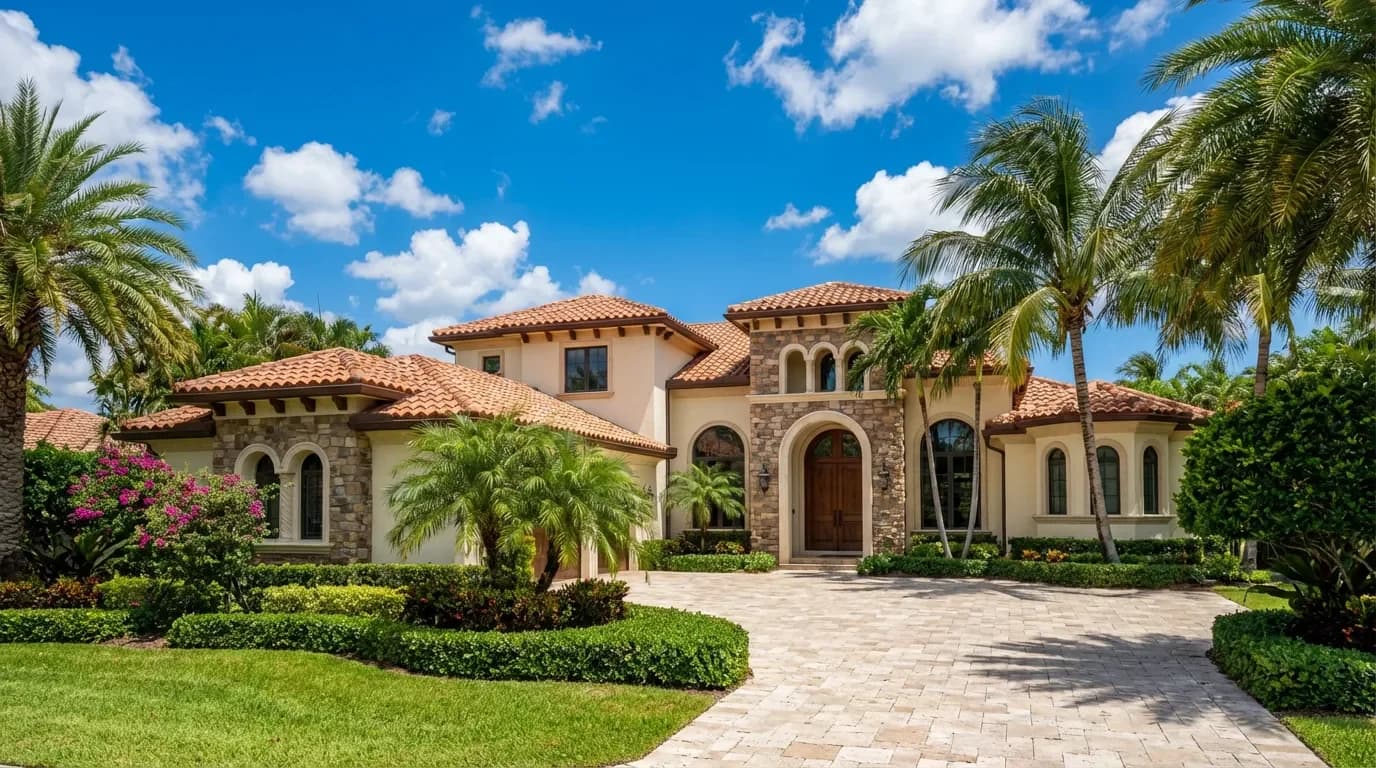
Hardscapes · South Florida
Paver Patio Installation & Hardscape Design in South Florida
Paver patio installation, pool decks, and driveways built for South Florida rain and salt air. Base prep, drainage, and permits handled by a licensed FL GC.
Reviewed by Aldo Dellamano, Licensed Florida General Contractor·Last updated: April 2026
Introduction
aver patio installation in South Florida is not the same job it is in Atlanta or Phoenix. Broward and Palm Beach Counties receive 60–65 inches of rain per year, sit within a salt-air corridor that accelerates efflorescence (white mineral deposits that migrate to the surface) and joint erosion, and in parts of Broward County, fall under High-Velocity Hurricane Zone (HVHZ) wind-load rules that affect every attached structure on the lot. Get the base prep wrong and you're relaying pavers in three years.
Get the drainage wrong and you're fighting standing water and mold at your back door. Dellamano Construction designs and installs paver patios, pool decks, driveways, and full hardscape systems with the same engineered discipline we apply to every trade under our Construction & Renovation umbrella — because outdoor surfaces are structural, not decorative.
Questions about your remodel or addition?
Get a free, no-pressure estimate from our licensed South Florida team.
South Florida's sandy, expansive soils shift with every wet-dry cycle, and a paver system installed over an inadequate base will show it within 18–24 months. org) requires compacted subgrade for any hardscape surface classified as an impervious area, and local amendments in Broward and Palm Beach Counties add lot-coverage and setback calculations that affect permit issuance.
A properly engineered base starts with 6–8 inches of compacted #57 limestone aggregate (Florida's standard angular crushed stone), topped with 1 inch of coarse bedding sand — not fine play sand, which pumps (migrates under load) in wet conditions. Compaction is verified with a plate compactor making minimum 2 passes at 90 degrees to each other, achieving 95% of Modified Proctor density.
“South Florida's sandy, expansive soils shift with every wet-dry cycle, and a paver system installed over an inadequate base will show it within 18–24 months.”
Skip that step and the pavers sink unevenly, joints open, and water channels under the field instead of away from it. Every Dellamano hardscape project starts with a site-level drainage plan before a single paver is set.
What You Get
Paver & Surface Material Options for South Florida
Concrete Interlocking Pavers
The most common choice for South Florida paver patio installation. Concrete pavers absorb and release heat better than a monolithic slab and can be individually replaced if one shifts or stains. Look for pavers rated at 8,000 PSI or above for driveway use.
Natural Travertine & Porcelain Tile
Travertine is a limestone-based natural stone quarried primarily in Turkey and Italy, prized for its cool surface temperature — a real advantage on a South Florida pool deck in August. Porcelain pavers rated for outdoor use offer near-zero absorption and resist salt-air staining, though they require a mortar-set system over concrete substrate rather than a sand-set base.
Stamped Concrete
Stamped concrete mimics paver and stone patterns at a lower upfront material cost. The trade-off: a crack in stamped concrete runs across the entire slab and cannot be spot-repaired the way an individual paver can. In Florida's UV environment, stamped concrete sealers need reapplication every 2–3 years.
Natural Coral Stone (Keystone)
Oolitic limestone quarried from South Florida, commonly called keystone or coral stone. Highly porous, which keeps it cool underfoot, but it must be sealed annually to control moisture infiltration and biological growth (algae, mildew) in a humid subtropical climate.
Permeable Paver Systems
Open-joint permeable pavers meet South Florida water-management district stormwater requirements on lots where new impervious coverage exceeds thresholds. They allow rainfall to infiltrate rather than sheet-flow, which can simplify permit approval and reduce swale (roadside drainage channel) sizing requirements.
Side-by-Side
Paver Patio vs. Stamped Concrete vs. Natural Stone
| Feature | Concrete Pavers | Stamped Concrete |
|---|---|---|
| Repairability | Individual units replaced — no slab demo | Crack repairs visible across entire pour |
| Heat retention | Moderate — joints break up radiant mass | High — monolithic slab stores heat longer |
| Upfront cost (installed) | Higher material + labor than stamped | Lower material cost, faster pour |
| Sealer cycle | Every 3–5 years with polymeric sand refresh | Every 2–3 years; UV degrades acrylic faster |
| Salt-air durability | Good — joint system absorbs movement | Fair — sealer protects but must be maintained |
| Flood-zone suitability | Excellent — can be set at grade or raised | Limited — slab pours must meet finished floor elevation |
In the Field
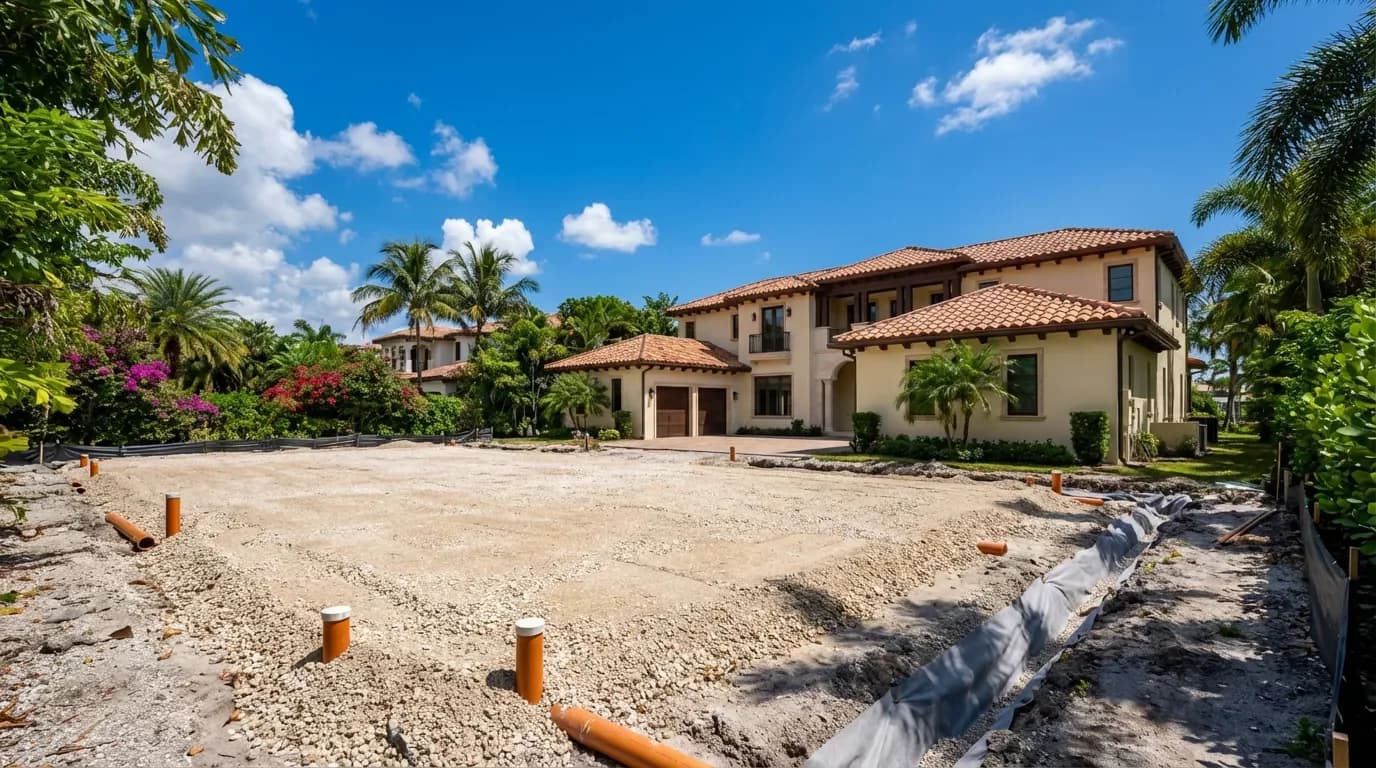
Engineered Base Prep for a South Florida Paver Patio
Engineered Base Prep for a South Florida Paver Patio — Dellamano Construction, Fort Lauderdale, FL
A paver patio installation that drains correctly from day one will last 25–40 years in South Florida conditions. The critical number is slope: ANSI (American National Standards Institute) and FBC guidelines call for a minimum 2% fall (¼ inch per foot) away from the home's foundation. 5% slope toward deck drains or overflow channels is standard to keep water moving without creating a slip hazard.
After installation, joints are swept with polymeric sand — a mixture of fine aggregate and polymer binders that activates with water and locks the joint against ant intrusion, weed germination, and joint washout during heavy rain events. A penetrating silane-siloxane sealer applied within 90 days of installation protects concrete pavers from salt-air chloride penetration and reduces efflorescence migration. Reapply every 3–5 years, or immediately after any joint sand replacement.
“A paver patio installation that drains correctly from day one will last 25–40 years in South Florida conditions.”
Travertine and coral stone require a color-enhancing or natural-finish impregnating sealer applied annually; their higher porosity means biological growth (algae, mildew) colonizes unsealed surfaces within a single wet season in Broward or Palm Beach County.
Efflorescence: What It Is and When to Worry
Efflorescence — the chalky white haze that appears on new pavers — is calcium carbonate migrating to the surface as moisture evaporates. It is normal in the first 6–12 months and typically weathers away. Persistent or recurring efflorescence after year one signals a drainage or sealer failure that needs correction, not just cleaning.
Driveway paver installation carries structural requirements that a patio or pool deck does not. ICPI (Interlocking Concrete Pavement Institute) guidelines for residential driveways call for a minimum 6-inch compacted aggregate base under a 3 1/8-inch (80mm) paver to handle the cyclic load of a standard passenger vehicle — roughly 4,000 lbs on two tires. For pickup trucks, SUVs, or any application where occasional delivery vehicles will park (a real consideration for South Florida homes that receive boat trailers, PODS containers, or large landscaping trucks), the base spec steps up to 8–10 inches of compacted aggregate with geotextile fabric at the subgrade interface.
“Driveway paver installation carries structural requirements that a patio or pool deck does not.”
Geotextile (also called filter fabric) prevents fines from the native sandy soil from migrating up into the aggregate layer under load — a process called pumping that collapses the base from below. Edge restraints — typically a 4-inch aluminum or plastic spike-set restraint or a concrete haunch — are mandatory at all driveway perimeters, since a paver field without edge containment will migrate outward under vehicle braking forces within 2–3 seasons.
Process
Our Paver Patio Installation Process
- 1
Site Assessment & Permit Review
We start with a site visit to measure grades, identify drainage flow paths, and check lot-coverage limits with the applicable county. In Broward County, Broward County Building Code Services requires a permit for hardscape work that changes impervious coverage or encroaches on setbacks. Palm Beach County projects are reviewed under Palm Beach County Planning, Zoning & Building rules. We pull permits before any ground is broken.
- 2
Subgrade Excavation & Grading
We excavate to the depth required by the base spec — typically 8–10 inches below finished paver surface for a patio, 10–12 inches for a driveway. Soft spots (areas where the native soil won't compact to 95% Proctor density) are undercut and backfilled with compacted limestone before base aggregate goes in. Swales and drainage slopes are cut into the subgrade at this stage, not corrected after the fact.
- 3
Base Aggregate Placement & Compaction
Crushed limestone aggregate is placed in 3–4 inch lifts and compacted with a plate compactor between each lift. Two compaction passes at perpendicular angles per lift are non-negotiable. A 1-inch bedding sand layer is screeded flat with story poles to achieve the correct finished elevation before paver setting begins.
- 4
Paver Setting, Cutting & Edge Restraint
Pavers are set in the specified pattern — herringbone, running bond, or custom basket-weave — with consistent joint widths maintained using spacer tabs or paver gauges. Cuts are made with a diamond-blade wet saw for clean, chip-free edges. Edge restraints are installed along all perimeter runs before joint sand is swept in.
- 5
Polymeric Sand, Compaction & Sealing
Polymeric sand is swept into joints in two passes, then the entire field is compacted again to seat the pavers firmly. The surface is blown clean, the polymeric sand is activated with a light water misting, and the sealer is applied per manufacturer specifications — typically a 24-hour cure before foot traffic and 72 hours before vehicle traffic.
Ready to talk to a real local GC?
Tell us about your project — we respond within 24 hours.
In the Field
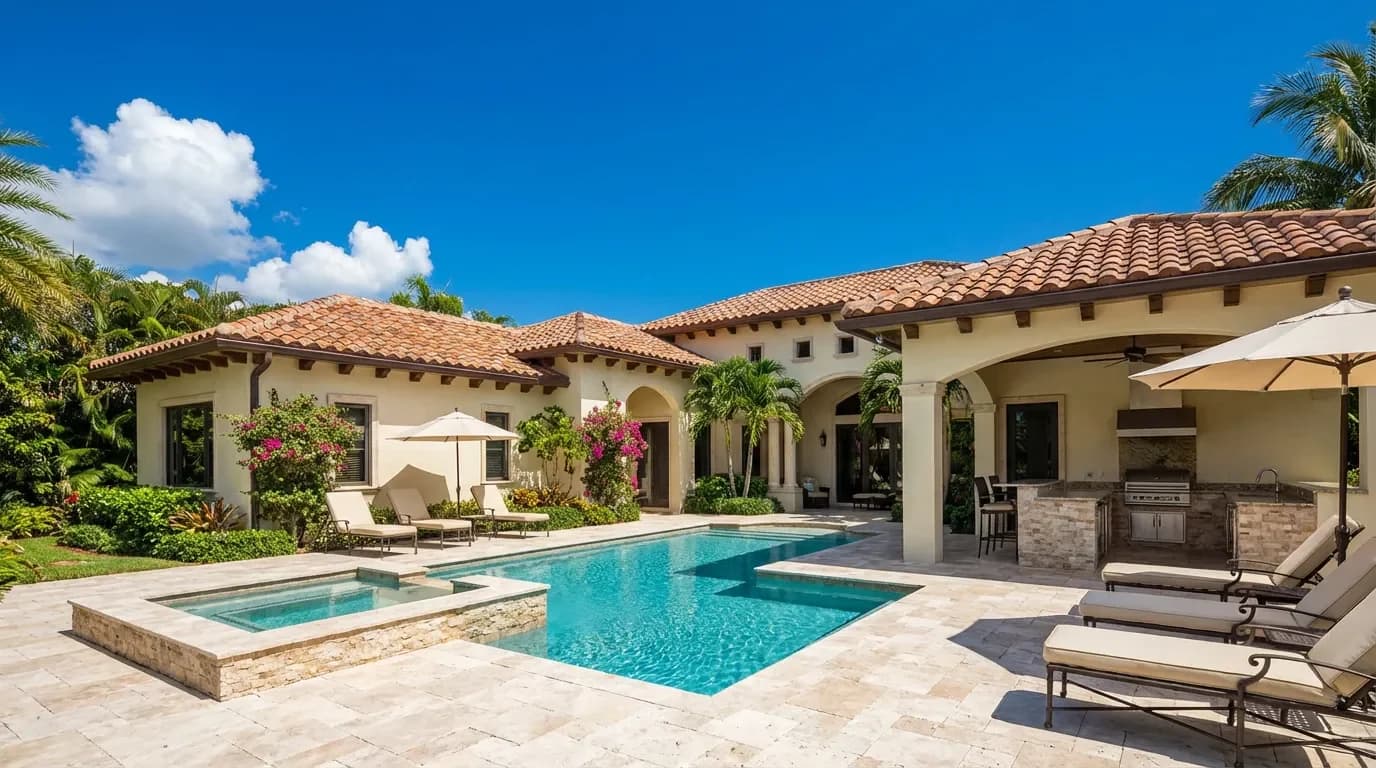
Pool Deck Pavers Integrated with an Outdoor Kitchen
Pool Deck Pavers Integrated with an Outdoor Kitchen — Dellamano Construction, Fort Lauderdale, FL
Pool deck paver installation introduces two constraints that a backyard patio does not face: bond-beam clearance and the pool barrier code. Florida Statutes Chapter 515 requires a compliant pool barrier — typically a fence with self-closing, self-latching hardware — and the hardscape layout must not compromise barrier continuity or create a climbable surface within 20 inches of the top of the barrier. We design paver elevations around the pool bond beam (the structural concrete ring at the top of the pool shell) using a coping (edge cap unit) that transitions from deck surface to pool interior at a consistent 1/8-inch grout joint.
“Pool deck paver installation introduces two constraints that a backyard patio does not face: bond-beam clearance and the pool barrier code.”
When a project also includes an outdoor kitchen — part of our Exterior Living & Outdoor Construction scope — the hardscape must account for gas-line trenching, electrical conduit, and drainage from the cooking area, all of which we coordinate in-house rather than handing off to separate subcontractors. That coordination advantage is especially clear on projects that also include Interior Renovation work, where a single schedule governs both the indoor and outdoor scopes.
One License Holder, Three Trades
Dellamano Construction's in-house mechanical, electrical, and plumbing crews all work under the same Florida DBPR license holder — Aldo Dellamano's Certified General Contractor credential (CGC1525289) — which eliminates the schedule gaps that form between subcontracted trades on typical renovation projects. Verify any Florida contractor's license at Florida DBPR contractor lookup.
By the Numbers
South Florida Hardscape by the Numbers
60–65"
Annual Rainfall
Broward & Palm Beach Counties average — drainage design is non-negotiable
6–8"
Minimum Base Depth
Compacted #57 limestone for patio applications; 10–12" for driveways
3–5 yrs
Sealer Reapplication Cycle
For concrete pavers in South Florida UV and salt-air conditions
25–40 yrs
Paver System Lifespan
With proper base prep, drainage, and maintenance cycles
Not sure what your project should cost?
Free, itemized estimates — no obligation, no sales pressure.
Most South Florida municipalities require a building permit for paver patio installation when the project adds impervious surface area, alters drainage patterns, or falls within a setback zone. Lot-coverage limits — expressed as a percentage of the total lot area that may be covered by impervious surfaces including roof, driveway, and hardscape — typically range from 40% to 60% in residential zones across Broward and Palm Beach Counties, but vary by municipality and zoning district.
A permit is also required any time work comes within 5 feet of a property line in most jurisdictions. Failing to pull a permit is not a minor administrative issue: unpermitted hardscape that changes drainage can create liability when a neighbor's property floods, and it will surface as an open violation in a title search when you sell.
“A permit is also required any time work comes within 5 feet of a property line in most jurisdictions.”
gov/portal/home) is the authoritative source for verifying whether your lot sits in a Special Flood Hazard Area, which triggers additional elevation and drainage requirements. Dellamano Construction files for all required permits and coordinates inspections — homeowners never have to navigate the building department alone.
Permeable Pavers Can Simplify Permit Approval
On lots that are near impervious-coverage limits, specifying a permeable paver system with open joints and a gravel reservoir base can reduce the calculated impervious area, allowing more hardscape without triggering stormwater mitigation requirements — ask us about this option during your site assessment.
Get a Free Hardscape Estimate
From a single paver patio installation to a full driveway, pool deck, and outdoor kitchen hardscape system — Dellamano Construction manages design, permitting, base engineering, and installation across Broward and Palm Beach Counties. Contact us to schedule your free on-site estimate and drainage assessment.
Frequently Asked
Common Questions
Do I need a permit for paver patio installation in Broward County?
+
In most Broward County municipalities, a permit is required for paver patio installation when the project increases the property's total impervious surface area, alters grade or drainage, or falls within a required setback from the property line or structures. Broward County Building Code Services reviews hardscape applications under Florida Building Code standards. Small courtyard replacements that swap existing pavers on an identical footprint may qualify as like-for-like replacements and avoid the permit requirement, but any new coverage or drainage change triggers review. Dellamano Construction evaluates permit requirements at the initial site assessment for every South Florida project.
How long does a paver patio installation take in South Florida?
+
A typical residential paver patio installation in South Florida — covering 400–800 square feet — takes 3–5 working days for an experienced crew once materials are on site. Larger projects that include pool deck, driveway, and outdoor kitchen integration run 7–14 working days. Permit review is the longest lead-time variable: Broward and Palm Beach County building departments typically process hardscape permits in 2–4 weeks, though expedited review is available in some municipalities. Dellamano Construction submits permit applications as soon as the design is finalized so permit review runs parallel to material procurement, not after it.
What is the best paver material for a South Florida pool deck?
+
Travertine and porcelain pavers are the top two performers for pool deck paver installation in South Florida. Travertine — a porous natural limestone — stays noticeably cooler underfoot than concrete pavers in direct summer sun because its air-filled pores reduce heat transfer to the foot. Porcelain pavers rated for outdoor use offer near-zero water absorption (less than 0.5%), which means they resist salt-air staining, algae colonization, and freeze-thaw damage (not a South Florida concern, but relevant for frost-prone guest properties). Concrete interlocking pavers are also widely used and cost less than natural stone, with a lifespan of 25–40 years when installed on an engineered base with proper drainage.
How do I prevent efflorescence on my South Florida pavers?
+
Efflorescence — the white calcium carbonate haze that appears on new concrete pavers — is a natural curing phenomenon in the first 6–12 months and typically weathers away with rain and foot traffic. To minimize it, specify low-alkali Portland cement content pavers, ensure the base drains freely so water doesn't wick upward through the system, and apply a penetrating silane-siloxane sealer within 90 days of installation. If efflorescence persists beyond 12 months or returns after cleaning, it signals a drainage or sealer failure beneath the surface. In humid subtropical South Florida, where summer rainfall is intense and frequent, proper subgrade drainage is the most effective long-term control.
Can I install pavers over my existing concrete driveway in Palm Beach County?
+
Yes, in many Palm Beach County jurisdictions you can install pavers over an existing concrete slab using a mortar-set system, provided the slab is structurally sound, free of active cracks, and at an elevation that accommodates the added paver thickness without creating a trip hazard or blocking drainage at garage thresholds. A mortar-set installation eliminates the need to excavate and rebuild the base but requires the slab beneath to perform structurally — if the slab has significant cracking or drainage issues, those problems transfer through to the paver layer. Dellamano Construction assesses the existing slab condition before recommending overlay versus full replacement so Palm Beach County homeowners get the right solution for their specific site.
What lot coverage limits apply to hardscape projects in South Florida?
+
Lot coverage limits in South Florida vary by municipality and zoning district, but most residential zones in Broward and Palm Beach Counties allow 40%–60% of the total lot area to be covered by impervious surfaces — including the home's roof footprint, driveway, pool deck, and any new paver patio installation. When a project pushes a lot close to or above the limit, specifying permeable paver systems with open joints and a gravel reservoir base can reduce the calculated impervious area and allow more hardscape without triggering stormwater mitigation requirements. The Palm Beach County Planning, Zoning & Building department and Broward County Building Code Services both publish zoning tables online, or your contractor can pull the applicable limits during the permit research phase.
How often do South Florida pavers need to be resealed?
+
In South Florida's humid subtropical climate with intense UV exposure and salt air near the coast, concrete pavers should be resealed every 3–5 years with a penetrating silane-siloxane sealer. Travertine and coral stone — both highly porous natural materials — should be sealed annually with an impregnating sealer to prevent biological growth such as algae and mildew. Polymeric sand in the joints should be inspected annually and replaced when it shows significant erosion, cracking, or ant intrusion. A simple water-bead test tells you when a sealer is spent: if water soaks in rather than beading on the surface, reapplication is due. Staying on the maintenance cycle protects the base investment and prevents costly joint repairs.