Commercial Construction · South Florida
Commercial General Contractor in South Florida
Commercial general contractor serving Broward & Palm Beach Counties — in-house MEP licenses, phased buildouts, ADA compliance, and permit-ready engineered.
Reviewed by Aldo Dellamano, Licensed Florida General Contractor·Last updated: April 2026
Recent Work
Project Gallery
Introduction
ommercial construction in South Florida moves at a different pace than residential work — and carries heavier consequences when it stalls. A late Certificate of Occupancy (CO) costs tenants rent abatements and pushes your return on investment further out.
A permit rejection caused by incomplete engineered plans costs weeks, not days. Dellamano Construction operates as a licensed commercial general contractor across Broward and Palm Beach Counties, and the difference that matters most is this: Aldo Dellamano holds active licenses as a Certified General Contractor (CGC1525289), a Certified Mechanical Contractor (CMC1251666), and a Certified Plumbing Contractor (CFC1434398) — so one license holder signs every permit across every trade.
That structure eliminates the handoff delays that slow most commercial buildouts. If you are comparing contractors for a ground-up build, a tenant improvement (TI), or a phased renovation in an occupied space, this guide walks through exactly how commercial permitting, MEP coordination, code compliance, and CO scheduling work in South Florida.
Questions about your remodel or addition?
Get a free, no-pressure estimate from our licensed South Florida team.
Commercial construction in Broward and Palm Beach Counties requires a minimum of 3 engineered plan sets — architectural, structural, and MEP (mechanical, electrical, and plumbing) — stamped by Florida-licensed engineers of record before a building department will open a permit. org) governs every aspect of commercial work, from structural load paths to means of egress. aspx) each run their own plan review queues, and turnaround times vary by municipality within the county — Fort Lauderdale and Boca Raton both operate their own permitting portals with different submittal requirements.
“A commercial general contractor who does not know those local nuances will miss pre-application conferences, submit incomplete packages, and lose 4 to 8 weeks at first review.”
A commercial general contractor who does not know those local nuances will miss pre-application conferences, submit incomplete packages, and lose 4 to 8 weeks at first review. Dellamano Construction coordinates directly with engineers of record and the building department on every submittal to front-load corrections before they become schedule hits.
One GC, Three Active Trade Licenses
Aldo Dellamano holds CGC1525289, CMC1251666, and CFC1434398 — meaning one license holder signs the GC, mechanical, and plumbing permits on your project. You can verify every active license at the Florida DBPR contractor lookup.
What You Get
What a Commercial Buildout Includes
Engineered plan coordination
Architectural, structural, MEP, and fire-protection drawings are coordinated before submittal to prevent clashes that cause revision cycles and plan-check delays.
In-house MEP rough-in
Mechanical ductwork, plumbing rough-in, and coordination with the electrical sub are managed by Dellamano's own licensed holders — no separate mechanical or plumbing GC needed.
ADA and life-safety compliance
Restroom clearances, door hardware, accessible routes, exit signage, and fire-sprinkler rough-in are designed to the ADA Standards and Florida Fire Prevention Code from day one — not corrected at final inspection.
Phased occupancy planning
Retail centers, medical offices, and restaurants often stay partially open during renovation. Dellamano sequences work zones, temporary egress, and dust barriers to keep uninvolved tenants operational.
Bonding and subcontractor oversight
Specialty trades — electrical, fire suppression, low-voltage — are vetted, bonded sub-contractors whose schedules and rough-in quality Dellamano manages with weekly on-site oversight.
CO and inspection scheduling
Final inspections are sequenced across trades so that framing, rough MEP, insulation, and drywall inspections are all cleared before requesting a CO — preventing the last-minute correction lists that delay certificate issuance.
In the Field
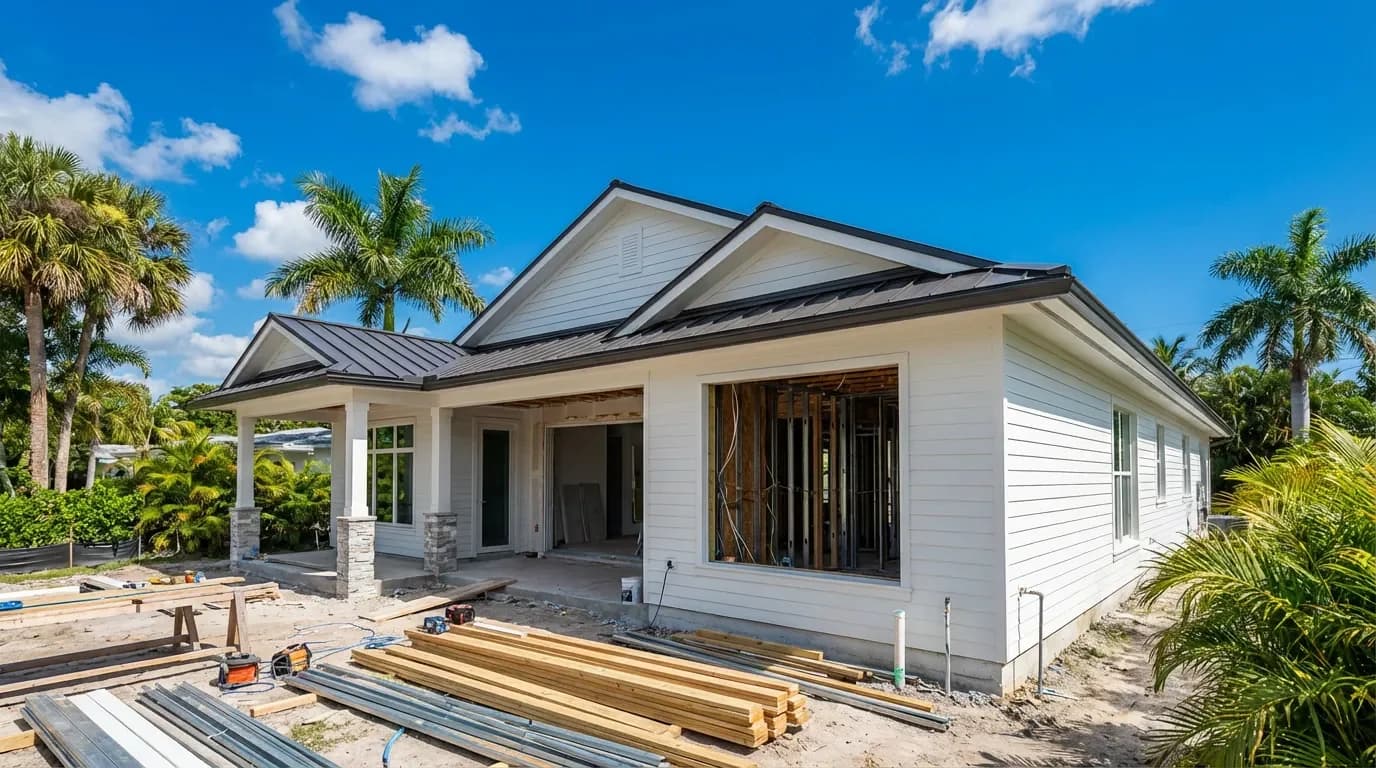
Framing and MEP rough-in staged for concurrent inspection
Framing and MEP rough-in staged for concurrent inspection — Dellamano Construction, Fort Lauderdale, FL
Because one license holder covers the General Contractor, Mechanical (CMC1251666), and Plumbing (CFC1434398) scopes, Dellamano Construction self-performs MEP rough-in in-house instead of coordinating three separate subcontractors — a rare combination in South Florida commercial construction. Most commercial GCs subcontract mechanical and plumbing to independent firms, each of whom schedules inspections on their own timeline. That creates 3 separate rough-in inspection windows that must all close before insulation and drywall can proceed.
When one trade falls behind — and in South Florida's busy construction market, trades are consistently booked 2 to 4 weeks out — the entire project timeline shifts. Dellamano's in-house MEP model compresses that window because mechanical and plumbing rough-in are scheduled together, inspected together, and corrected by the same crew. For a 4,000-square-foot commercial buildout, that coordination advantage typically saves 2 to 3 weeks on the permit-to-CO timeline.
“When one trade falls behind — and in South Florida's busy construction market, trades are consistently booked 2 to 4 weeks out — the entire project timeline shifts.”
That matters when a tenant's lease start date is fixed and the landlord is on the hook for delivery.
Process
Commercial Construction Process: Permit to CO
- 1
Pre-construction planning
Dellamano reviews the lease or ownership documents, existing as-built drawings, and any prior permit history. We confirm zoning, occupancy classification (per FBC Chapter 3), and fire-protection requirements before engaging engineers — avoiding scope surprises at plan review.
- 2
Engineered plan submittal
Architectural, structural, and MEP drawings are coordinated with licensed engineers of record and submitted to the building department. Pre-application meetings are requested when the municipality offers them. Municipal comments are resolved in one revision cycle wherever possible.
- 3
Permit issuance and mobilization
Once the permit is issued, the project schedule is locked with all subcontractors. Demolition, framing, and rough MEP are sequenced to reach rough-in inspections as a single package — not three separate calls to the building department.
- 4
Inspections and corrections
Framing, rough mechanical, rough plumbing, rough electrical, insulation, and fire-protection inspections are tracked on a shared schedule. Any correction notices are addressed within 48 hours to keep the inspection queue moving.
- 5
Final inspection and CO issuance
All trade finals — HVAC, plumbing, electrical, fire, and building — are requested concurrently where the municipality allows it. The Certificate of Occupancy is the finish line, and every prior inspection is designed to clear it without last-minute surprises.
South Florida Wind Load and HVHZ Requirements
Parts of Broward County fall within the High-Velocity Hurricane Zone (HVHZ) — a designation born from Hurricane Andrew's 1992 destruction — which requires impact-rated glazing, enhanced fastening schedules, and engineered roof-to-wall connections on all new commercial construction. Structural plans must address these provisions or they will fail plan review.
gov/law-and-regs/design-standards/) and the Florida Accessibility Code (FAC) simultaneously — two overlapping frameworks that must both be satisfied. Accessible restrooms require a minimum 60-inch turning radius, specific grab-bar placement, and door hardware that can be operated with a closed fist.
Accessible routes from public rights-of-way through the building must maintain a maximum 1:20 running slope and 1:48 cross slope. Fire and life-safety compliance layers on top: exit sign placement, emergency lighting, fire-sprinkler coverage per NFPA 13 (National Fire Protection Association standard for sprinkler systems), and occupant load calculations that drive the number of required exits.
“Accessible restrooms require a minimum 60-inch turning radius, specific grab-bar placement, and door hardware that can be operated with a closed fist.”
1 (ventilation standard for acceptable indoor air quality). Dellamano's in-house mechanical license means HVAC design and code compliance are reviewed before the mechanical plans go to the engineer — not after.
Ready to talk to a real local GC?
Tell us about your project — we respond within 24 hours.
In the Field
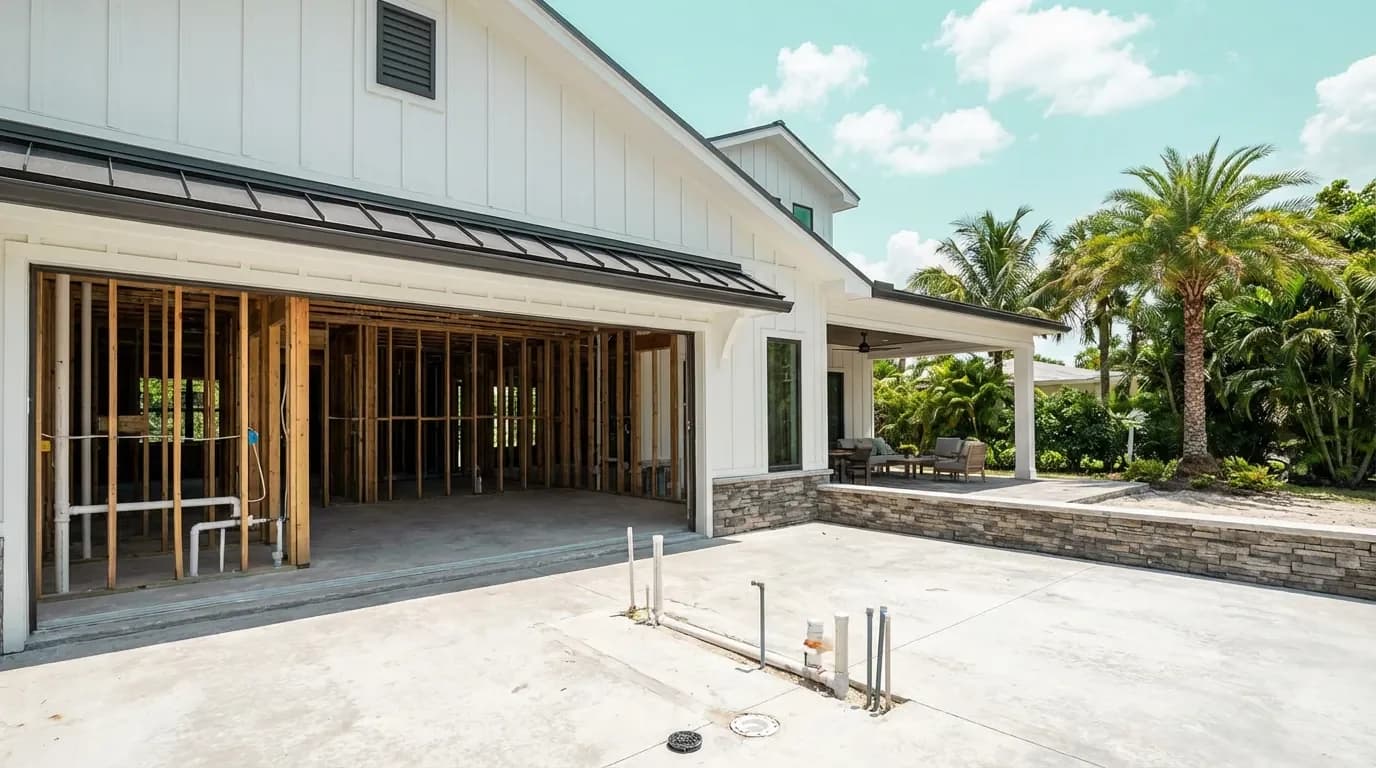
Plumbing rough-in staged for ADA restroom inspection
Plumbing rough-in staged for ADA restroom inspection — Dellamano Construction, Fort Lauderdale, FL
Side-by-Side
Single-License GC vs. Traditional Multi-Sub Model
| Feature | Dellamano (In-House MEP) | Traditional Multi-Sub GC |
|---|---|---|
| Mechanical permit holder | Aldo Dellamano, CMC1251666 | Separate mechanical sub — independent schedule |
| Plumbing permit holder | Aldo Dellamano, CFC1434398 | Separate plumbing sub — independent schedule |
| Rough-in inspection window | 1 coordinated inspection call for MEP | 3 separate inspection calls, staggered by days |
| Schedule risk when one trade slips | Low — same crew adjusts in-house | High — sub delays cascade to GC timeline |
| Correction notice response time | Same crew corrects within 48 hours | Depends on sub's availability — often 5–10 days |
| CO timeline for 4,000 sq ft buildout | Typically 2–3 weeks faster | Baseline — multi-sub coordination adds weeks |
Phased commercial renovation — where tenants or customers remain in part of the building while construction proceeds nearby — is one of the most operationally complex projects a commercial general contractor manages. Florida Building Code Section 3310 governs construction in occupied buildings and requires temporary means of egress, fire-rated separation between occupied and construction zones, and HVAC isolation to prevent construction dust from migrating into occupied areas.
Dellamano phases work in 1,000 to 2,000-square-foot zones and coordinates temporary wall framing, 1-hour fire-rated barriers where required, and dust-containment systems before any demolition begins. Inspection scheduling is more complicated in phased projects because each zone may require a partial CO (also called a Temporary Certificate of Occupancy, or TCO) before the adjacent zone opens.
“This operational discipline extends to Dellamano's broader Construction & Renovation practice across both residential and commercial scopes.”
Dellamano tracks each zone's inspection milestones independently and sequences the building department's inspection schedule so that TCOs are issued in order, keeping tenants on their agreed delivery dates. This operational discipline extends to Dellamano's broader Construction & Renovation practice across both residential and commercial scopes.
By the Numbers
Key Numbers on Every Commercial Project
3
Active Trade Licenses
GC, mechanical, and plumbing — all under one license holder
48 hrs
Correction Response Target
In-house MEP crew addresses inspection corrections without waiting on an outside sub
2–3 wks
Timeline Advantage
Typical savings vs. multi-sub model on a 4,000 sq ft commercial buildout
2
Counties Served
Broward and Palm Beach, with local permit knowledge in each municipality
Not sure what your project should cost?
Free, itemized estimates — no obligation, no sales pressure.
Every Florida commercial general contractor working on projects above certain contract thresholds must carry general liability insurance and workers' compensation coverage — and should carry a contractor's license bond. Dellamano Construction carries both, and subcontractors are required to provide current certificates of insurance before mobilizing on any Dellamano job site. Subcontractor vetting goes beyond paperwork: specialty subs for electrical, fire suppression, and low-voltage systems are evaluated on their current workload, inspection pass rates, and familiarity with the specific municipality's inspection requirements.
A fire-suppression sub who has never pulled a permit in a particular city will take longer to clear plan review than one who has an established relationship with that building department. South Florida's busy commercial construction market means good subs are in demand — Dellamano maintains long-term working relationships with vetted specialty trades rather than re-sourcing on each project. gov) benchmarking is a useful reference for comparing system performance against similar building types.
“For owners researching energy efficiency in commercial HVAC systems, ENERGY STAR benchmarking is a useful reference for comparing system performance against similar building types.”
Dellamano's commercial buildout practice complements its Interior Renovation work, where the same in-house MEP discipline applies to residential additions and kitchen remodels. Owners who also want outdoor amenities on a commercial property can explore Exterior Living & Outdoor Construction for hardscape and structure options.
Flood Zone Awareness in South Florida
Coastal commercial sites in Fort Lauderdale, Boca Raton, and Pompano Beach may fall within FEMA-designated flood zones that require finished floor elevations above the Base Flood Elevation (BFE). Verify your site's flood zone before finalizing the structural slab design at the FEMA Flood Map Service Center.
Get a Commercial Construction Estimate
Dellamano Construction is a licensed commercial general contractor serving Broward and Palm Beach Counties — from coastal Fort Lauderdale and Boca Raton to inland Coral Springs, Weston, West Palm Beach, and Wellington. One license holder signs every permit, and in-house MEP means your buildout moves faster than the multi-sub alternative. Contact us for a free estimate and a straight conversation about your project's permit path, timeline, and budget.
Frequently Asked
Common Questions
How long does a commercial permit take in Broward County?
+
Commercial permit timelines in Broward County vary significantly by municipality. Unincorporated Broward County Building Code Services typically processes commercial plan reviews in 4 to 6 weeks for a first review, but cities like Fort Lauderdale, Pembroke Pines, and Coral Springs run their own portals and may take 6 to 10 weeks for complex projects. Submitting complete engineered plans — architectural, structural, and MEP — in a single coordinated package reduces the chance of a rejection that restarts the clock. Dellamano Construction coordinates pre-application meetings with the building department when available and tracks comment responses to minimize revision cycles.
What engineered plans are required for a commercial buildout?
+
Palm Beach County Planning, Zoning & Building requires stamped engineered drawings for architectural, structural, mechanical, plumbing, and electrical scopes on most commercial projects. If the space has a fire-sprinkler system — which is required in most new commercial occupancies — a separate fire-protection drawing stamped by a licensed fire protection engineer is also required. Interior tenant improvements that do not touch the structure or fire system may qualify for a simplified permit path, but that determination is made at the pre-application stage. Dellamano Construction reviews each project's scope against the municipality's requirements before engaging engineers to prevent over-designed or under-documented submittals.
Does ADA compliance come standard on commercial buildouts?
+
Yes. ADA compliance is built into Dellamano's commercial buildout process from the design coordination stage — not added as a correction at final inspection. Florida commercial projects must satisfy both the ADA Standards for Accessible Design and the Florida Accessibility Code (FAC), which in some cases is stricter than federal ADA minimums. Accessible restrooms, door hardware, parking, and routes from the public right-of-way are laid out to code during the architectural plan phase. Dellamano coordinates directly with the architect to resolve any discrepancies between ADA and FAC requirements before submittal, reducing the likelihood of accessibility-related plan review comments.
What is a Temporary Certificate of Occupancy and when is it needed?
+
A Temporary Certificate of Occupancy (TCO) is issued by the building department when a specific portion of a commercial building is ready for occupancy but the overall project is not yet complete. TCOs are common in phased commercial renovations — for example, when a retail space opens in one zone while construction continues in an adjacent zone. Florida Building Code Section 3310 governs occupied-building construction and requires fire-rated separation, temporary egress, and HVAC isolation between occupied and construction areas. Dellamano Construction plans each phase's inspection milestones independently so that TCOs are issued in sequence, allowing tenants to take possession on their agreed dates while the broader project continues.
How does in-house MEP licensing speed up a commercial buildout?
+
In a traditional multi-subcontractor model, the general contractor coordinates separate mechanical and plumbing subs who each schedule their own inspections independently. In Boca Raton and Fort Lauderdale's busy commercial construction market, those subs may be 2 to 4 weeks out when a correction notice is issued, stalling the project. Because Dellamano Construction holds both a Certified Mechanical Contractor license (CMC1251666) and a Certified Plumbing Contractor license (CFC1434398) in-house, mechanical and plumbing rough-in are self-performed and inspection-ready at the same time. Correction notices are addressed within 48 hours by the same crew, not queued behind an independent sub's schedule. For a 4,000-square-foot commercial buildout, that coordination advantage typically saves 2 to 3 weeks on the permit-to-CO timeline.
Are commercial projects subject to HVHZ wind-load requirements?
+
Parts of Broward County fall within the High-Velocity Hurricane Zone (HVHZ), a designation established by the Florida Building Code after Hurricane Andrew's 1992 destruction of South Florida. HVHZ provisions require impact-resistant glazing systems, enhanced fastening schedules for roof sheathing, and engineered roof-to-wall connections that exceed standard code minimums. Commercial projects in HVHZ areas must have structural plans that specifically address these provisions — general structural notes referencing standard FBC wind speeds are insufficient. Palm Beach County projects above a certain wind-exposure category may also carry elevated load requirements depending on proximity to the coast. Dellamano Construction ensures structural engineers of record are briefed on the project's specific wind-exposure classification before plans are drawn.
How is subcontractor licensing verified on commercial projects?
+
Before any specialty subcontractor mobilizes on a Dellamano job site in Broward or Palm Beach County, their Florida DBPR license, general liability insurance certificate, and workers' compensation coverage are verified and filed. License verification is done directly through the Florida DBPR contractor lookup at myfloridalicense.com. Dellamano also evaluates subcontractors on their inspection pass rates and familiarity with the specific municipality's building department, since a sub unfamiliar with a city's plan review process can add weeks to permit issuance. Long-term relationships with vetted electrical, fire-suppression, and low-voltage subs mean Dellamano does not re-source specialty trades on each project — which reduces mobilization delays in South Florida's high-demand construction market.