Home Additions · South Florida
Home Addition Contractor for Broward & Palm Beach
South Florida's home addition contractor covering Broward & Palm Beach. Structural tie-in, MEP, permits, and finish work under one licensed GC.
Reviewed by Aldo Dellamano, Licensed Florida General Contractor·Last updated: April 2026
Introduction
home addition is one of the most complex projects a South Florida homeowner can undertake. You're not just building new square footage — you're surgically connecting new structure to an existing home, extending live mechanical, electrical, and plumbing systems, and satisfying multiple regulatory gatekeepers before a single framing nail gets driven.
Setbacks, lot-coverage limits, HVHZ (High-Velocity Hurricane Zone) wind-load requirements, HOA architectural review, and flood-zone overlays all intersect on a single permit set. Dellamano Construction is a licensed home addition contractor managing every one of those layers in-house — general contracting, mechanical, and plumbing under three active Florida DBPR licenses held by founder Aldo Dellamano.
From the first zoning review through final county inspection, one team carries the project. That's the standard for additions in Broward and Palm Beach Counties.
Questions about your remodel or addition?
Get a free, no-pressure estimate from our licensed South Florida team.
Every home addition in Florida must clear three zoning hurdles before a permit can be issued: setback compliance, lot-coverage limits, and impervious-surface ratios. Setbacks define how close any structure can sit to a property line — typically 5 to 25 feet depending on the municipality and the specific yard (front, rear, or side). Lot coverage caps the percentage of the lot that can be covered by structure, often 35–50% in suburban Broward and Palm Beach zones.
Impervious-surface ratios govern total hardscape plus structure to protect stormwater drainage — a real constraint in low-elevation coastal areas near Fort Lauderdale, Pompano Beach, and Boca Raton. Dellamano reviews the county property appraiser records, municipal zoning code, and any recorded plat restrictions before design begins. Catching a setback conflict at the survey stage costs nothing.
“Lot coverage caps the percentage of the lot that can be covered by structure, often 35–50% in suburban Broward and Palm Beach zones.”
Catching it after a structural footing is poured costs weeks and thousands of dollars. org) sets the baseline, but local amendments frequently tighten it.
What You Get
What a Home Addition Scope Covers
Foundation & Structural Tie-In
New footings are engineered to match the existing foundation type — monolithic slab, stem wall, or pile — and the structural connection is designed to transfer loads across the shared bearing wall without differential settlement.
Roof Tie-In, Flashing & Drainage
The addition roof ties into the existing roofline with step flashing, kick-out flashing, and a continuous waterproofing membrane. Drainage is re-engineered so the new roof slope doesn't direct water toward the house or foundation.
MEP System Extension
HVAC ductwork, electrical circuits, and plumbing supply and drain lines are extended from the existing home into the new addition — sized and balanced for the added square footage, not just spliced at the nearest junction.
Permit Coordination Under One GC
A single permit set covers structural, electrical, mechanical, and plumbing work. With Aldo Dellamano holding licenses in all three trade categories, there is no separate MEP sub pulling their own permit — fewer inspections, fewer handoffs, faster closeout.
Finish Work & Interior Continuity
Flooring, trim, ceiling texture, and paint are matched to the existing home. The goal is an addition that reads as original construction, not a visible afterthought.
HOA & ARB Approval Coordination
In gated communities across Parkland, Weston, and Coral Springs, the HOA Architectural Review Board must approve exterior design, materials, and color before permits are pulled. Dellamano prepares and submits ARB packages as part of the pre-construction phase.
In the Field
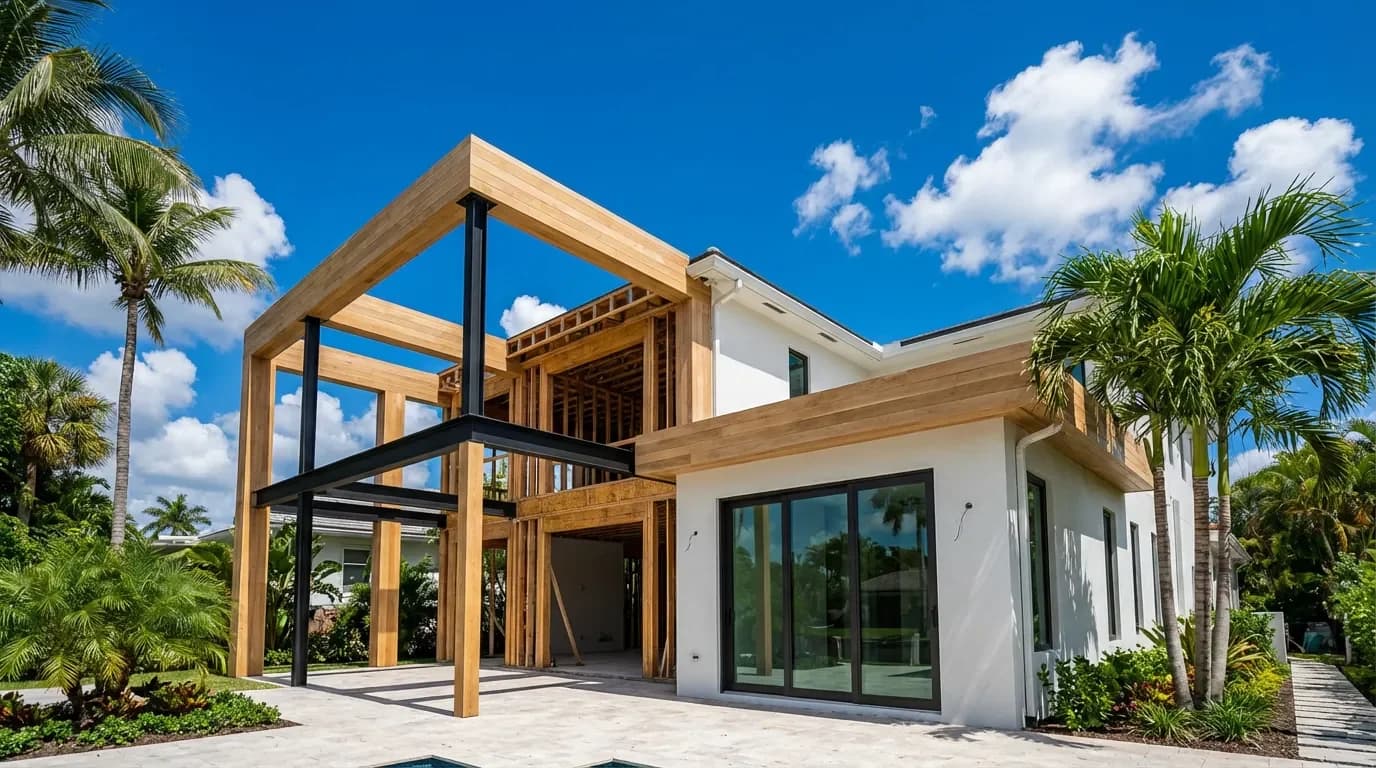
Framing & Structural Tie-In
Framing & Structural Tie-In — Dellamano Construction, Fort Lauderdale, FL
South Florida homes built before 1994 — pre-Hurricane Andrew — were often constructed to wind-load standards that are now well below current code. org) requirements, which can mean upgrading the connection hardware at the shared bearing wall even if the existing structure isn't being touched elsewhere. In HVHZ-designated areas of Broward County, that means engineered metal connectors, specific nailing schedules, and in some cases continuous load path documentation from roof to foundation.
The foundation match is equally critical. Most South Florida homes sit on monolithic slab-on-grade. The addition footing must be poured to the same bearing depth, with a doweled rebar connection into the existing slab edge to prevent differential movement.
“South Florida homes built before 1994 — pre-Hurricane Andrew — were often constructed to wind-load standards that are now well below current code.”
On older homes with stem-wall construction, the tie-in requires a different strategy — a grade beam (a reinforced concrete beam at or below grade) spanning the joint. Getting this wrong produces visible cracks at the connection point within 2–3 years. Dellamano's approach starts with a structural engineer's foundation assessment before design begins.
One License Holder — Three Trade Scopes
Aldo Dellamano holds active Florida DBPR licenses as a Certified General Contractor (CGC1525289), Certified Mechanical Contractor (CMC1251666), and Certified Plumbing Contractor (CFC1434398). All three licenses are verifiable at myfloridalicense.com. That means MEP rough-in is self-performed — no sub coordination failures, no schedule gaps between trades.
Extending mechanical, electrical, and plumbing (MEP) systems into a home addition is where most multi-sub projects fall apart. A typical GC hires 3 separate licensed subs — one for HVAC, one for electrical, one for plumbing — each pulling their own permit, scheduling their own inspections, and optimizing for their own scope without coordinating with the others. Duct routes compete with plumbing chases. Electrical panels get sized for today, not for a future addition.
The HVAC system gets extended without a Manual J (load calculation) to verify the existing equipment can handle the new square footage. Dellamano self-performs the mechanical and plumbing scopes under Aldo Dellamano's CMC and CFC licenses, and coordinates electrical through a dedicated subcontractor on the same permit set. That means duct sizing, pipe routing, and electrical load calculations happen as a single coordinated design — not three separate designs that have to be reconciled in the field. In South Florida's humid subtropical climate, an undersized or poorly balanced HVAC extension produces moisture problems and mold within one wet season.
“In South Florida's humid subtropical climate, an undersized or poorly balanced HVAC extension produces moisture problems and mold within one wet season.”
Sizing it right the first time is non-negotiable. This integrated approach is part of Dellamano's broader Construction & Renovation model.
Process
Home Addition Project Process
- 1
Zoning & Survey Review
We pull the property survey, review municipal setback and lot-coverage limits, check for HOA deed restrictions, and verify the FEMA flood zone designation using the FEMA Flood Map Service Center. Any constraints are identified before design costs are incurred.
- 2
Design & Engineering
Architectural drawings and structural engineering are developed together — not sequentially. Foundation type, roof tie-in geometry, and MEP routing are resolved in the design phase so the permit set is complete and coordinated when submitted.
- 3
HOA / ARB Submittal
For homes in gated communities throughout Parkland, Weston, Plantation, and Coral Springs, we prepare and submit the Architectural Review Board package — exterior elevations, material specifications, and color boards — and track the approval timeline so it doesn't delay the permit submission.
- 4
Permit Pull & Pre-Construction
A single permit set covering structural, mechanical, plumbing, and electrical is submitted to the county or municipality. For Broward County projects, submissions go through Broward County Building Code Services; Palm Beach County projects go through Palm Beach County Planning, Zoning & Building. While permits process, we finalize the phasing plan and material procurement.
- 5
Construction & Inspections
Work is sequenced to minimize disruption: demo and foundation first, framing, roof tie-in, and then MEP rough-in before insulation and drywall. Required inspections — foundation, framing, rough MEP, insulation, and final — are scheduled as each phase completes, not batched at the end.
- 6
Finish & Final Inspection
Interior finishes are matched to the existing home. A pre-final walkthrough identifies any punch-list items before the county final inspection. Certificate of occupancy (or certificate of completion for additions) is obtained and delivered to the homeowner with the closed permit set.
The roof connection is the highest-risk detail in any home addition — and the most commonly botched. A poorly executed tie-in produces water intrusion at the valley (the angle where two roof planes meet) within 1–2 South Florida wet seasons. Proper execution requires step flashing — individual L-shaped metal pieces woven between each course of roofing shingle or tile — plus kick-out flashing at the bottom of the valley to direct water away from the wall.
On flat or low-slope roofs common in mid-century Fort Lauderdale and Hollywood homes, the connection requires a continuous modified-bitumen or TPO (thermoplastic polyolefin) membrane lapped under the existing roofing and sealed with compatible adhesive. Drainage continuity is equally critical. The new roof area adds runoff load to the existing drainage system.
“A poorly executed tie-in produces water intrusion at the valley (the angle where two roof planes meet) within 1–2 South Florida wet seasons.”
Gutters, downspouts, and where applicable, French drain or drip-edge routing, must be re-engineered for the combined roof area. On coastal properties in Dania Beach, Pompano Beach, and Boca Raton, salt air accelerates corrosion in aluminum flashing — we spec stainless or copper at those locations.
Ready to talk to a real local GC?
Tell us about your project — we respond within 24 hours.
Live-In or Relocate? Make the Decision Early
A well-phased addition can often be built while the family stays home — if the connection to the existing structure is planned carefully. Roof open, MEP tie-in, and HVAC cutover are the three moments that typically require a 1–5 day temporary relocation. Plan for them, don't discover them.
Side-by-Side
Single GC with In-House MEP vs. Multi-Sub Model
| Feature | Dellamano — One GC, Three Licenses | Typical Multi-Sub GC |
|---|---|---|
| MEP Permit | Single permit set, one point of contact | 3 separate permits, 3 separate sub contacts |
| MEP Coordination | Duct, pipe, and wire routes designed together | Each sub optimizes their own scope independently |
| HVAC Load Calculation | Manual J sized for new total square footage | Often skipped or estimated by the HVAC sub |
| Inspection Scheduling | Coordinated across all trades by one GC | Each sub schedules independently, gaps occur |
| License Verification | All licenses held by one individual — verifiable at DBPR | Multiple license holders, each must be independently verified |
| Schedule Risk | Lower — no inter-sub handoff delays | Higher — any sub delay cascades to the next trade |
By the Numbers
Home Addition: Key Numbers to Know
3
Active DBPR Licenses
GC, mechanical, and plumbing held by one license holder
35–50%
Typical Lot-Coverage Cap
Varies by municipality across Broward and Palm Beach Counties
175+ mph
HVHZ Design Wind Speed
Required in High-Velocity Hurricane Zone areas of Broward County
6–12 mo
Typical Addition Timeline
Includes design, permitting, construction, and final inspection
Not sure what your project should cost?
Free, itemized estimates — no obligation, no sales pressure.
In the Field
HOA & ARB Approval Process
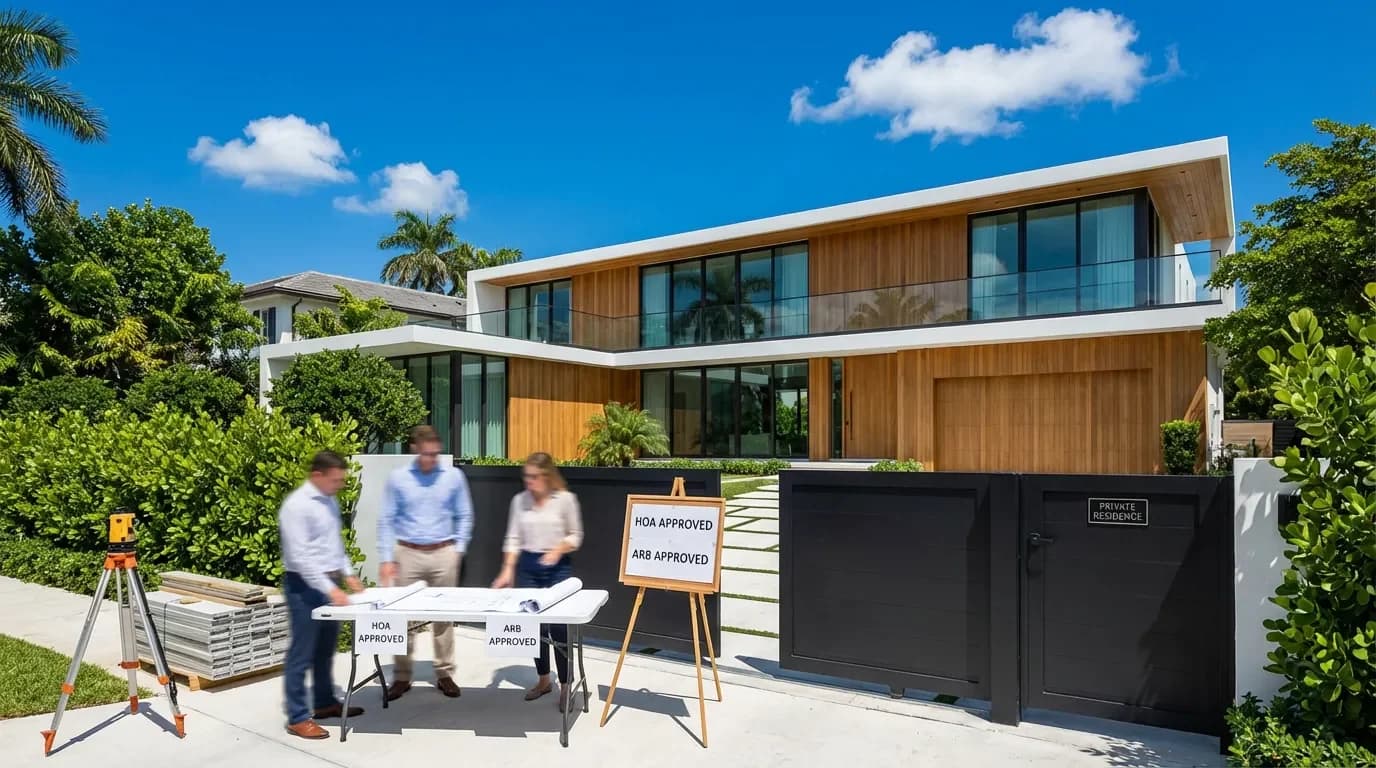
HOA & ARB Approval Process — Dellamano Construction, Fort Lauderdale, FL
Roughly 40% of South Florida's single-family homes sit within a homeowners association. In gated-community markets like Parkland, Weston, and Wellington, that number is closer to 80%. Every exterior modification — including a home addition — requires Architectural Review Board (ARB) approval before a county permit can be pulled. ARB packages typically require dimensioned site plans showing setbacks, exterior elevation drawings with material and color callouts, and in some communities, a letter from adjacent neighbors.
Processing times range from 2 weeks to 3 months depending on how often the ARB meets and how complete the submittal is. An incomplete package restarts the clock. Dellamano prepares ARB submittals as part of the pre-construction scope — not as an afterthought. We also flag deed restrictions that go beyond the HOA's standard rules, such as maximum addition square footage caps or prohibited roofline changes.
“Roughly 40% of South Florida's single-family homes sit within a homeowners association.”
These restrictions are recorded in the property deed and don't appear in the HOA's published guidelines, but they're fully enforceable. Catching them before design is finalized prevents costly redesigns. Our broader Interior Renovation and Exterior Living & Outdoor Construction work in these same communities follows the same ARB-first workflow.
NAHB Research on Addition ROI
According to NAHB Remodeling resources, primary suite additions and family room additions consistently rank among the highest-return remodeling projects in markets with constrained housing inventory — a description that fits coastal Broward and Palm Beach Counties precisely.
Get a Home Addition Estimate
Dellamano Construction offers free estimates for home additions across Broward and Palm Beach Counties — from Fort Lauderdale and Hollywood on the coast to Parkland, Weston, and Wellington inland. One licensed GC handles zoning review, engineering coordination, permits, construction, and final inspection. Call or submit a project inquiry to get started.
Frequently Asked
Common Questions
How long does a home addition take to complete in Broward County?
+
A typical home addition in Broward County takes 6 to 12 months from the start of design to final county inspection. The timeline breaks down roughly as follows: 4 to 8 weeks for design and engineering, 6 to 12 weeks for permit processing (Broward County Building Code Services processes most residential permits within this window, though complex projects or HVHZ-specific engineering reviews can take longer), and 12 to 20 weeks for construction depending on scope. HOA or ARB approval, when required, runs parallel to the permit process and can add 2 to 8 weeks if the community's review board meets infrequently. The biggest schedule risks are incomplete permit sets that trigger revision cycles and MEP coordination gaps between trades — both of which Dellamano's in-house multi-license model is specifically designed to eliminate.
What permits are required for a home addition in Palm Beach County?
+
A home addition in Palm Beach County requires a building permit from Palm Beach County Planning, Zoning & Building, with sub-permits or trade scopes covering structural, electrical, mechanical (HVAC), and plumbing work. The permit set must include a site plan showing setbacks and lot coverage, architectural drawings, structural engineering with signed and sealed calculations, and energy compliance documentation under Florida's energy code. If the home is in a flood zone — verifiable through the FEMA Flood Map Service Center — a floodplain development permit or elevation certificate may also be required. Palm Beach County uses an online permitting portal; most residential addition permits are reviewed within 4 to 10 weeks. Dellamano submits complete, coordinated permit packages to minimize revision cycles and back-and-forth with the county.
Do I need HOA approval before getting a home addition permit?
+
Yes. In gated communities across Parkland, Weston, and most of Broward County's planned unit developments, the HOA Architectural Review Board must approve the exterior design of a home addition before — or concurrently with — the county permit application. Some municipalities require proof of ARB approval as part of the permit submittal; others allow the permit to be pulled simultaneously but won't issue a final certificate of completion without the ARB sign-off. ARB packages typically require dimensioned site plans, exterior elevation drawings with material and color specifications, and in some communities, neighbor notification. Dellamano prepares ARB submittals as part of the pre-construction scope and tracks approval timelines so they don't delay the permit process.
Can I stay in my home during a home addition construction project?
+
Most South Florida homeowners can remain in their homes throughout a home addition project, with careful phasing. The critical moments that sometimes require a temporary 1 to 5 day relocation are: the roof open period when the new addition roof is tied into the existing structure (weather-dependent), the HVAC cutover when the existing system is connected to the new ductwork (typically 4 to 8 hours of downtime), and any load-bearing wall demolition connecting the addition to the existing home. A detailed phasing plan — developed before construction begins, not improvised during — determines whether live-in phasing is feasible for your specific project layout. Dellamano maps out these decision points during the pre-construction planning phase so homeowners aren't surprised mid-project.
What wind-load standards apply to home additions in South Florida?
+
Home additions in South Florida must comply with the Florida Building Code, and in HVHZ (High-Velocity Hurricane Zone) designated areas — which include most of Miami-Dade County and parts of Broward County — design wind speeds of 175 miles per hour or higher apply. Even outside the formal HVHZ boundary, Broward and Palm Beach County additions must meet the FBC's wind-load requirements, which were substantially strengthened after Hurricane Andrew in 1992 and further refined after Hurricane Wilma in 2005 and Hurricane Irma in 2017. Structural connectors, roof-to-wall ties, and opening protection (impact windows and doors or shutters) must all be engineered for the site-specific wind exposure. The Florida Building Code website provides the current code edition; Dellamano's structural scope on every addition is designed and sealed by a licensed engineer to the applicable wind-load category.
How is HVAC handled when adding square footage to a home?
+
Adding square footage without recalculating HVAC capacity is one of the most common home addition mistakes in South Florida. The existing air handler and condensing unit may not have the capacity to condition the new square footage — and in South Florida's humid subtropical climate, an undersized or imbalanced system produces uncomfortable temperatures, high humidity, and mold risk within one wet season. The correct approach is a Manual J load calculation (the industry-standard HVAC sizing method) that accounts for the combined existing plus new square footage, local design temperatures, insulation values, window area, and orientation. Aldo Dellamano holds an active Florida Certified Mechanical Contractor license (CMC1251666), which means HVAC design and rough-in are self-performed and sized correctly — not estimated by a sub optimizing for the lowest bid.
What is the difference between a home addition and an ADU?
+
A home addition is an expansion of the primary dwelling's living space — it remains part of the main house, shares the same foundation, roof system, and utility connections, and does not create a separate dwelling unit. An accessory dwelling unit (ADU), sometimes called an in-law suite or guest cottage, is a secondary residential unit on the same parcel as the primary home — it has its own entrance, kitchen, and living space, and is subject to different zoning rules including owner-occupancy requirements in some municipalities. In Broward and Palm Beach Counties, ADU regulations vary significantly by city: some municipalities allow them by right on single-family lots, others require a special exception or variance. Dellamano handles both home additions and ADU construction under its general contractor license — the regulatory path is different, but the structural and MEP execution follows the same integrated workflow.