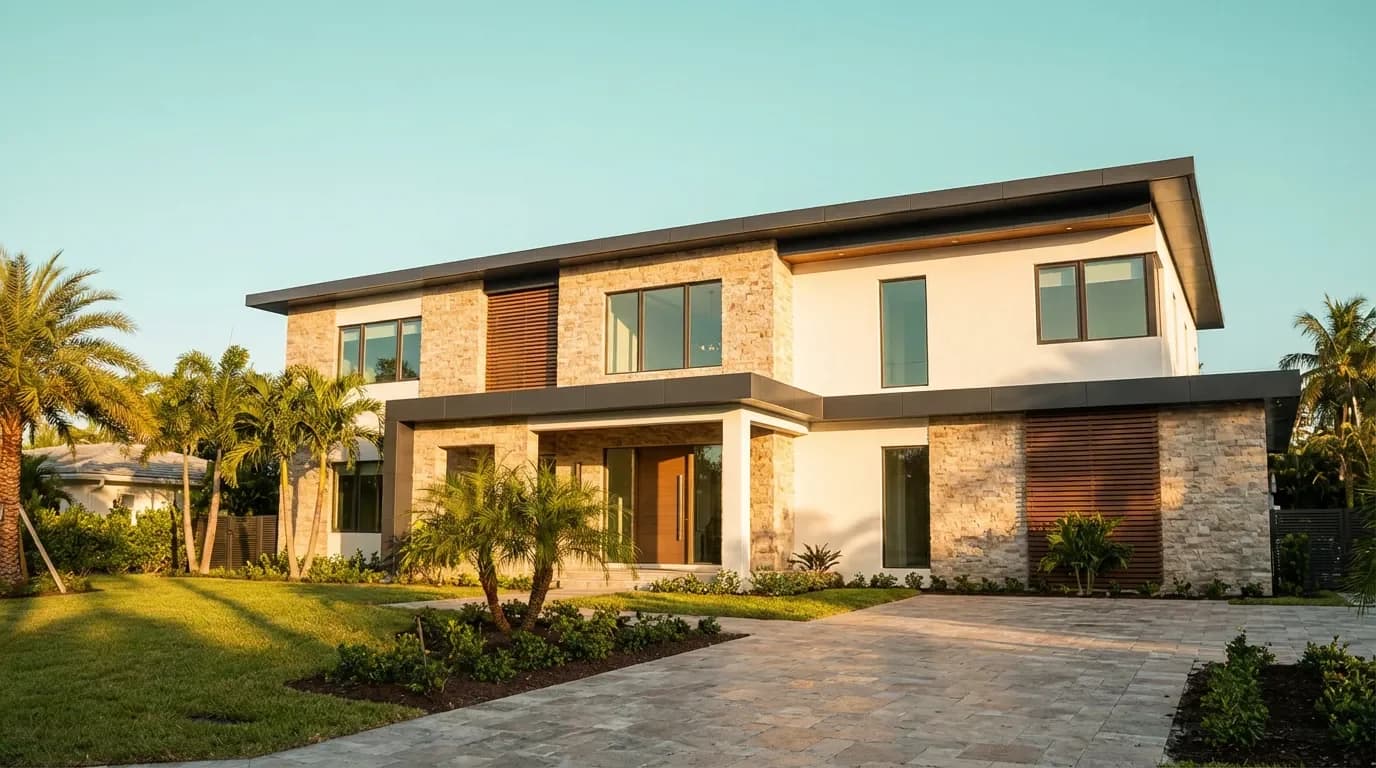
Custom Homes · South Florida
Custom Home Builder in South Florida
Custom home builder serving Broward & Palm Beach Counties. HVHZ-compliant construction, in-house MEP, and phase-based communication from lot to move-in.
Reviewed by Aldo Dellamano, Licensed Florida General Contractor·Last updated: April 2026
Recent Work
Project Gallery
Introduction
uilding a custom home in South Florida is not like building anywhere else. Every lot sits in a humid subtropical climate with salt air, intense summer storms, and in many parts of Broward County, the High-Velocity Hurricane Zone (HVHZ) — one of the most demanding residential building environments in the United States. org) imposes impact-rated openings, continuous load-path framing, and wind-rated roof assemblies that add engineering steps most out-of-state builders simply are not equipped to handle.
Dellamano Construction is a licensed Florida general contractor with in-house mechanical and plumbing trades, serving Broward and Palm Beach Counties from lot acquisition through final Certificate of Occupancy. This guide covers every phase of the custom home builder process: lot analysis, architectural coordination, HVHZ structural requirements, finish selection for coastal durability, and the draw schedule that keeps your project financially transparent.
Questions about your remodel or addition?
Get a free, no-pressure estimate from our licensed South Florida team.
South Florida custom home construction begins with 3 critical site factors before a single architectural line is drawn: flood zone classification, minimum finished floor elevation (FFE), and setback envelopes. gov/portal/home) — determine whether your lot sits in an AE, VE, or X zone, which directly controls how high your slab or stem wall must be. In Palm Beach County, many inland lots in AE zones require FFEs 1 to 3 feet above the Base Flood Elevation (BFE), adding fill and stem-wall cost that must be priced before you close on land.
“A licensed surveyor produces the Elevation Certificate; we review it before design starts so there are no foundation-cost surprises mid-project.”
Broward coastal lots in Hollywood, Pompano Beach, Fort Lauderdale, and Dania Beach often carry VE zone designations, which require breakaway-wall design on lower levels and can limit usable ground-floor square footage. A licensed surveyor produces the Elevation Certificate; we review it before design starts so there are no foundation-cost surprises mid-project.
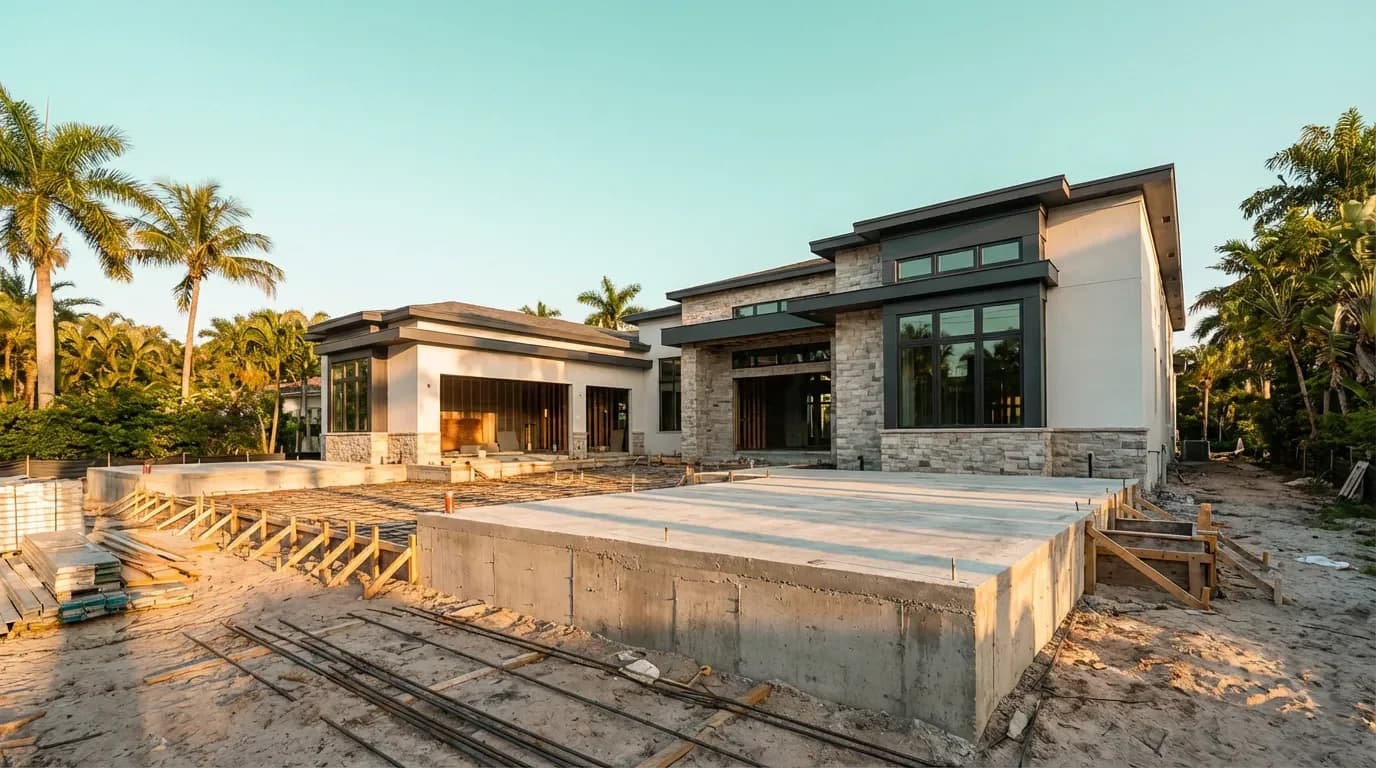
In the Field
Slab & Foundation Work
Slab & Foundation Work — Dellamano Construction, Fort Lauderdale, FL
What You Get
What Lot Due Diligence Covers
Flood Zone & BFE Review
We pull the current FIRM (Flood Insurance Rate Map) panel for your parcel and calculate the required finished floor elevation before architectural design begins.
Soil Borings & Bearing Capacity
South Florida's sandy, high-water-table soils often require a geotechnical (geotech) report to confirm bearing capacity and determine whether auger-cast piles or a thickened-edge slab is the right foundation strategy.
Zoning Setbacks & FAR
Floor Area Ratio (FAR) and setback rules vary by municipality. We map the buildable envelope early so the architect designs inside it from day one — not after a costly variance.
Utility Stub Locations
Water, sewer, electric, and gas connection points affect where the mechanical room lands and how long utility runs are — both cost drivers we identify before design is final.
Tree Survey & Mitigation
Many Broward and Palm Beach municipalities require a tree survey. Protected species require mitigation or relocation permits; catching this early avoids stop-work orders.
Value engineering (VE) in custom home construction means finding where a design change delivers equal or better performance at lower cost — without cutting corners on structural integrity or durability. At Dellamano Construction, our general contractor reviews architectural drawings alongside the MEP (mechanical, electrical, plumbing) scope before the plans go to the municipality for permit. This single-review step catches 2 common cost inflators early: structural beam spans that could be shortened with a minor wall shift, and HVAC duct runs that double in length when the air handler is placed on the wrong side of the attic.
com/). Because one person reviews structural, mechanical, and plumbing scopes together, conflicts that typically surface during rough-in are resolved on paper instead of on the job site, where changes cost 3 to 10 times more to fix.
One License Holder. Three Scopes.
Dellamano Construction self-performs MEP rough-in in-house instead of coordinating three separate subcontractors — a rare combination in South Florida residential construction that reduces scheduling conflicts and shortens timelines.
org). Every window and door must carry a Florida Product Approval (FPA) number for the specific wind zone, missile impact level, and pressure rating at that opening's location in the wall. Using a product that is approved in Miami-Dade but not at the correct pressure range for your specific wall height and exposure category will fail inspection.
5A vs. H10S) specified by the engineer of record. Underlayment must meet the ASTM D226 or ASTM D4869 standard, and if the roof is tile, a secondary water barrier (SWB) is mandatory.
“Underlayment must meet the ASTM D226 or ASTM D4869 standard, and if the roof is tile, a secondary water barrier (SWB) is mandatory.”
aspx) permitting on residential projects and knows which details reviewers flag most often.
By the Numbers
South Florida Custom Home Builder: Key Numbers
3
In-House Licenses
GC, Mechanical, and Plumbing — one license holder, zero MEP sub-coordination
175+ mph
HVHZ Design Wind Speed
Broward County HVHZ design wind speed driving impact-opening and roof-assembly specs
1–3 ft
Typical FFE Premium
Above Base Flood Elevation often required on Palm Beach AE-zone lots
6–14 mo
Typical Build Timeline
Permit-to-CO for a custom home in Broward or Palm Beach County
Process
The Custom Home Build Process, Phase by Phase
- 1
Site Analysis & Pre-Design
We review the survey, elevation certificate, flood zone, and zoning envelope. Soil borings are ordered if the lot's bearing data is unknown. This phase produces a site brief that guides the architect and prevents costly redesigns.
- 2
Architectural Design & Permitting
Our team coordinates with your architect (or refers one) during design development to value-engineer MEP routing, beam spans, and roof geometry before plans are finalized. Permit applications are submitted to the county building department — Broward or Palm Beach — with full structural, MEP, and energy compliance packages.
- 3
Foundation & Slab
Rough grade, fill compaction, and either a monolithic slab or stem-wall system are completed based on the geotech report and flood zone requirements. An elevation certificate is updated at this stage to confirm FFE compliance before framing begins.
- 4
Framing, MEP Rough-In & Inspections
Wood or light-gauge steel framing goes up with HVHZ-compliant hurricane straps at every connection point. Our in-house mechanical and plumbing crews run rough-in concurrently with electrical, which is subcontracted to a licensed master electrician. Multiple rough-in inspections are scheduled and passed before insulation is installed.
- 5
Finishes, Fixtures & Certificate of Occupancy
Impact windows and doors, roofing, insulation, drywall, tile, cabinetry, and fixtures are installed in a sequenced schedule. Owner walkthroughs occur at key milestones. Final inspections with the county produce the Certificate of Occupancy (CO) — your legal authorization to occupy the home.
Ready to talk to a real local GC?
Tell us about your project — we respond within 24 hours.
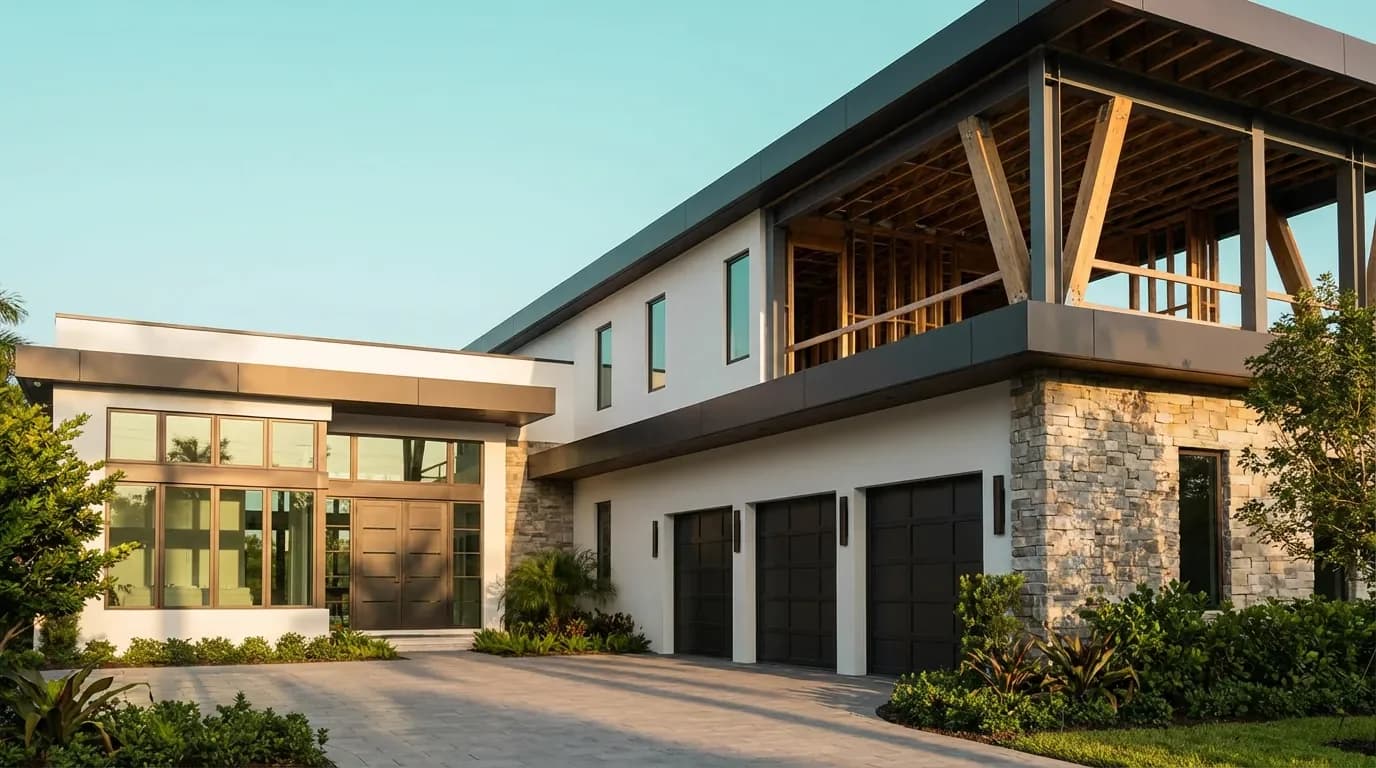
In the Field
Impact Windows & HVHZ Framing
Impact Windows & HVHZ Framing — Dellamano Construction, Fort Lauderdale, FL
S. climates. Choosing the right materials at the design stage prevents costly replacements within 5 to 10 years of move-in.
For exterior applications within 1 mile of the coast — common in communities along Fort Lauderdale, Pompano Beach, Boca Raton, and Delray Beach — aluminum or PVC trim outlasts wood-based composites by 15 to 20 years. Stucco systems should use a 3-coat application over concrete block (CBS — concrete block structure, the dominant wall assembly in South Florida) with an elastomeric paint finish that bridges hairline cracks before water intrusion begins. Interior finishes in bathrooms and laundry areas should use porcelain tile over large-format natural stone unless the stone is properly sealed annually, because South Florida's indoor humidity keeps grout and stone surfaces damp longer than in drier climates.
“Choosing the right materials at the design stage prevents costly replacements within 5 to 10 years of move-in.”
gov/watersense) certified products reduce water usage by 20% or more — important in a region under periodic water-restriction orders from the South Florida Water Management District.
CBS Construction Is the South Florida Standard
Concrete block structure (CBS) walls resist wind, moisture, and termite damage better than wood-frame in South Florida's humid subtropical climate — and CBS is what most municipal building departments expect to see on new custom home plans.
Side-by-Side
CBS Block vs. Wood Frame: South Florida Custom Homes
| Feature | CBS (Concrete Block Structure) | Wood Frame |
|---|---|---|
| Wind Resistance | Inherently rigid; meets HVHZ requirements with engineered bond beam and filled cores | Meets HVHZ only with extensive hurricane strapping, sheathing, and engineering |
| Moisture & Mold Risk | Block does not absorb water or rot; exterior stucco provides secondary barrier | Wood studs can absorb moisture in humid subtropical climate; requires vapor barrier |
| Termite Resistance | Block walls are not a food source; lower termite treatment frequency needed | Requires aggressive termite pre-treatment and periodic re-treatment |
| Insulation Options | Spray foam or rigid foam in the cores; continuous exterior insulation common | Batt insulation standard; spray foam optional in stud cavity |
| Construction Timeline | Block-laying adds 2–4 weeks vs. wood frame for same square footage | Faster to frame; advantage erased if engineered sheathing schedules are delayed |
| Resale Perception | Strong buyer preference in South Florida; CBS is a marketing positive | Acceptable but less preferred; buyers in coastal markets ask about wall type |
A construction draw schedule ties each payment from your construction loan (or owner funds) to a verified percentage of project completion — protecting both parties. Typical South Florida custom home builds use 5 to 7 draws: lot/mobilization, foundation complete, framing complete, rough-in inspections passed, drywall complete, substantial completion, and final CO. The lender's inspector or an independent third party confirms completion before each draw is released.
Dellamano Construction provides itemized progress reports at each draw milestone, including inspection records and updated schedules, so owners always know where their money has gone and what comes next. This phase-based transparency is especially important for owners building in Parkland, Weston, or Coral Springs — gated communities where HOA architectural review boards often require milestone documentation alongside the county permit record. aspx) to align inspection milestones with draw windows.
“A construction draw schedule ties each payment from your construction loan (or owner funds) to a verified percentage of project completion — protecting both parties.”
For a broader view of how this project fits within our full residential scope, visit our Construction & Renovation services hub.
Not sure what your project should cost?
Free, itemized estimates — no obligation, no sales pressure.
Draw Schedules Protect Your Construction Loan
Every draw milestone is backed by a passed county inspection — not just a contractor's word — so your lender's disbursement and your project's actual progress stay in sync from foundation to CO.
What You Get
Why South Florida Homeowners Choose Dellamano
In-House MEP Trades
Holding active mechanical (CMC1251666) and plumbing (CFC1434398) licenses in-house means rough-in is self-performed — no waiting on three separate subcontractors to schedule their crews.
HVHZ-Experienced Team
We know Broward's HVHZ impact-opening and continuous load-path requirements from repeated permit reviews, not from reading the code for the first time on your job.
Flood Zone Expertise
From AE-zone stem walls in Palm Beach County to VE-zone breakaway designs on Broward coastal lots, we price elevation requirements into the bid before you sign — not as a change order later.
Outdoor Living Integration
We design custom homes alongside Exterior Living & Outdoor Construction scopes — outdoor kitchens, pergolas, and hardscape — so the pool deck and summer kitchen are engineered as part of the home, not bolted on after.
Renovation Expertise for Mid-Build Scope Changes
If your project evolves from new construction to a major addition or gut renovation, our Interior Renovation team handles that scope under the same GC license — no re-bidding, no new contracts.
Ready to Build Your Custom Home in South Florida?
Dellamano Construction is a licensed Florida general contractor serving Broward and Palm Beach Counties — from waterfront lots in Fort Lauderdale and Boca Raton to gated communities in Parkland, Weston, and Wellington. Our in-house GC, mechanical, and plumbing licenses mean fewer subcontractors, fewer coordination failures, and a more transparent build from the first site visit to your Certificate of Occupancy. Request a free estimate and let's walk your lot together.
Frequently Asked
Common Questions
How long does it take to build a custom home in Broward County?
+
A custom home in Broward County typically takes 6 to 14 months from permit issuance to Certificate of Occupancy, depending on square footage, finish complexity, and inspection queue times. Pre-permit work — lot survey, architectural design, structural engineering, and county plan review — adds another 3 to 6 months before the clock starts on construction. Broward County's HVHZ requirements mean structural, impact-opening, and roofing submittals receive extra scrutiny during plan review, which can add 4 to 8 weeks compared to non-HVHZ counties. Choosing a contractor with a history of complete, code-compliant permit packages shortens that review cycle significantly.
What does HVHZ mean for my custom home in South Florida?
+
HVHZ stands for High-Velocity Hurricane Zone, a designation under the Florida Building Code that covers Miami-Dade and Broward Counties. In the HVHZ, every window and exterior door must have a Florida Product Approval (FPA) number confirming it meets both impact and pressure ratings for your specific wall location. Roof assemblies require a continuous load path — hurricane straps or clips at every rafter-to-top-plate connection — and a secondary water barrier under tile roofs. These requirements stem directly from damage patterns observed after Hurricane Andrew in 1992 and Hurricane Wilma in 2005. Palm Beach County is not designated HVHZ but still enforces strict wind-load standards under the Florida Building Code, so impact-rated products are strongly recommended county-wide.
Do I need an architect before hiring a custom home builder in Palm Beach County?
+
Yes. Palm Beach County requires signed and sealed architectural and structural drawings for all new residential construction. You can hire your own architect or work with one referred by your general contractor. Bringing the GC into the design phase early — before the architect finalizes plans — is one of the most cost-effective decisions you can make. A general contractor reviewing drawings during design development catches MEP routing conflicts, oversized beam spans, and HVHZ detailing gaps before the plans go to Palm Beach County Planning, Zoning & Building for permit review. Changes made on paper cost a fraction of field changes, which are common when structural and mechanical scopes are designed in isolation.
What is a construction draw schedule and how does it protect you?
+
A construction draw schedule is a payment plan tied to verified milestones in your custom home build — foundation complete, framing complete, rough-in inspections passed, and so on. Each draw is typically confirmed by a county inspection record or a lender's third-party inspector before funds are released. In South Florida, where construction loans from local and national lenders are common for custom builds, a well-structured draw schedule protects the owner from overpaying ahead of actual progress and gives the lender confidence that funds are disbursed against real, inspected work. Dellamano Construction provides itemized progress documentation at each milestone, including copies of passed county inspections, so owners in communities from Coral Springs to Wellington always have a clear record of where their project stands.
How does flood zone classification affect my custom home cost in South Florida?
+
Flood zone classification directly affects your finished floor elevation (FFE) requirement, which drives foundation costs. Lots in FEMA AE zones in Palm Beach County — common in Wellington, Royal Palm Beach, and parts of Boynton Beach — often require the slab or stem wall to be 1 to 3 feet above the Base Flood Elevation (BFE). VE zones on Broward coastal lots, such as those in Hollywood or Dania Beach, may require breakaway-wall construction on lower levels, significantly limiting how the ground floor is used. These elevation requirements must be priced into the construction budget before you close on land — not discovered as a change order after the geotech report comes back. Use the FEMA Flood Map Service Center at msc.fema.gov to look up your parcel's flood zone before making an offer.
Can you handle the outdoor living scope on a new custom home?
+
Yes. Dellamano Construction builds outdoor kitchens, pergolas, hardscape, and pool enclosures under the same general contractor license as the home itself. Designing the exterior living scope during the home's architectural phase — rather than after move-in — allows structural connections, utility rough-ins, and drainage to be engineered as part of the original permitted set. This avoids the common scenario where a homeowner builds a beautiful home and then discovers the pool equipment pad is in the wrong place or the gas line for the outdoor kitchen requires cutting a finished concrete deck. Our Exterior Living & Outdoor Construction scope and custom home construction work from a single coordinated plan.
How do I verify a custom home builder's license in Florida?
+
Every licensed contractor in Florida is listed in the Florida DBPR (Department of Business and Professional Regulation) online lookup at myfloridalicense.com. Search by license number or name to confirm the license type, status, and expiration date. For a full custom home project in Broward or Palm Beach County, you should verify at minimum a Certified General Contractor (CGC) license. Dellamano Construction holds CGC1525289 (General Contractor), CMC1251666 (Mechanical Contractor), and CFC1434398 (Plumbing Contractor) — all active and verifiable. Hiring a contractor who cannot produce verifiable license numbers for every trade scope they perform, or who relies on unlicensed subcontractors, exposes homeowners to stop-work orders, permit rejections, and uninsured liability.